Categories
Blog Desserts

Stonehenge in the Spring

The clocks spring forward one hour this weekend into British Summer Time, and we have just had the Spring Equinox. Yes, it’s full speed ahead now towards sunshine, holidays and barbecues.

Time to bring the motorhome out of winterisation, therefore, and head off down to the west country. It’s turned out to be a pleasant few days experiencing the very old, and eating the very sweet!

I’ll start with a visit to Stonehenge: somewhere I always enjoy going, whatever time of year. The last time I was there it was just before the winter solstice, with a brisk wind blowing and moody skies above (see my post here). In contrast, my photo above shows the Stones on a calm and sunny Spring day this past week.

We still do not fully know why our Neolithic ancestors transported these huge rocks, sometimes hundreds of miles, and positioned them here, carefully aligned to celebrate the movements of the Earth and its connection with the heavens above. The Stones have stood here for nearly 5,000 years, the toil and sacrifice of prehistoric man bringing pleasure and inspiration to many subsequent generations.

It is remarkable that this impressive feat of celestial engineering was achieved with only the most rudimentary tools and materials. Let’s see Artificial Intelligence do that, eh? 🙂

Every day, people travel here in their droves from all corners of the globe, to walk around, taking in the sight and its surroundings, and gaze in wonder. It is a World Heritage Site, and everyone is welcome, whatever religion, nationality or creed.

There is certainly something mysteriously compelling about being in the presence of the Stones. Perhaps their longevity is a modern day reminder that, whatever struggles there are in the world, fundamental values of indomitable spirit, endeavour, strong will and respect for others will always endure.

Inspiration comes in many forms, and this creation by Roly’s Fudge Shop, in nearby Salisbury, made me chuckle. Ladies and Gentlemen, I give you what Roly calls Fudgehenge.

Roly’s can be found near the entrance to Salisbury’s Cathedral Close, providing the perfect opportunity down the years for weary pilgrims to top up those flagging energy levels. The Cathedral itself is gearing up for the Easter season, and was looking splendid in the Spring sunshine.

Another fave refuelling station in these parts is the Boston Tea Party. I first came across BTP in Bristol a few years ago, and they now have a small number of cafes dotted around select west country towns. They do great coffee and choc brownies, so I can recommend a visit if you ever get the chance.
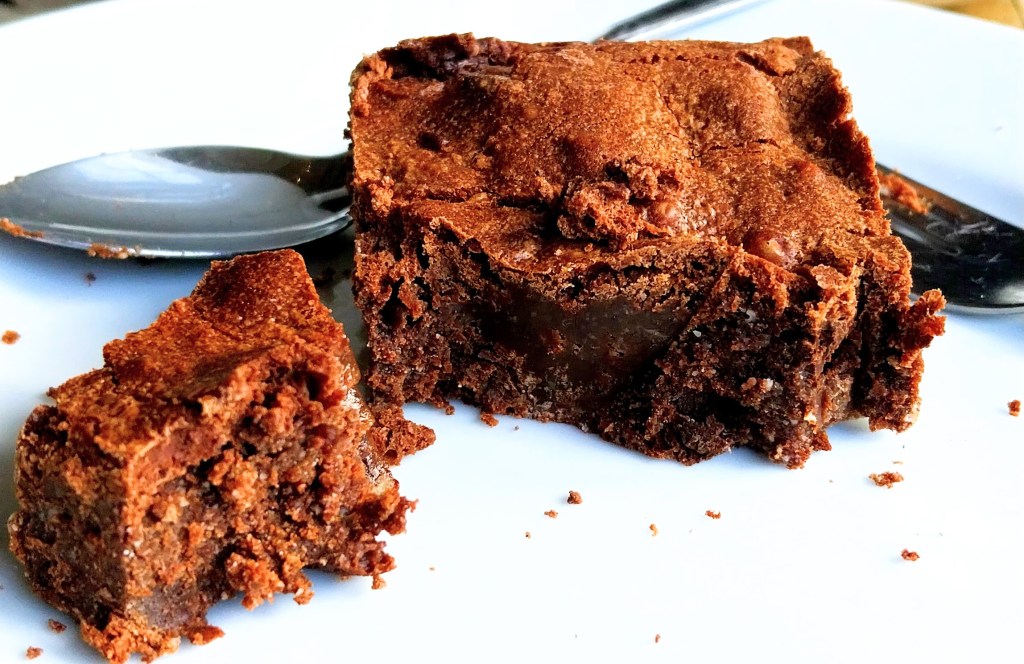
Well, that’s enough of a sugar rush for this week. I shall have to get back down the Farm Shop when I get home and make something a little healthier next week to compensate, haha.

Here’s a track from a legendary band who hail from the west country, as you can tell from singer Andy Partridge’s accent. this is XTC from the Drums and Wires album, with Helicopter.


Categories
Bakes Recipes

Spiced Plum & Almond Bakewells

It’s Valentine’s Day, and here’s a sweet treat you’ll love.

Recently we received a delicious present from a family friend – a jar of her home made Spiced Plum jam. Rich with soft plums in a silky, sweet coating and laced with the delicate influence of star anise, it deserved some special treatment.

I liked the idea of pairing it with almond, so have used it here as the jammy foundation for these bakewell slices. Never mind if you don’t have any spiced plum – ordinary plum or raspberry jam will do a perfectly fine job. Try to use home made though, as it gaves the cake that extra personal touch!

Servings

This made 16 bakewell slices.

Timings

30 mins to prepare, 10 mins to blind bake the pastry base at 180C, and 40 mins to bake the whole traybake at 160C (fan oven).

You Will Need:

For the Pastry Base

  • 125g plain flour
  • 100g plain wholemeal flour
  • pinch of salt
  • 100g butter or baking spread
  • a few drops of cold tap water

For the Sponge Filling

  • 150ml veg oil
  • 100g ground almonds
  • 100g self-raising flour
  • 1tsp baking powder
  • 160g caster sugar
  • 1tsp almond extract
  • 4 eggs
  • 25g flaked almonds
  • 5 – 6tbsp fruit jam

Method

  1. Grease a traybake tin – the one I used is 20cm square – and line with baking paper.
  2. Sieve the plain flours and salt into a food processor with blade fitted. Chop the butter/spread into cubes and add in. Pulse a few times until it resembles fine breadcrumbs. Add in a few drops of water and blitz. Repeat until the ingredients are fully combined and you have a ball of pastry dough whirling around inside the processor bowl.
  3. Roll out the pastry dough on a floured surface until it is roughly the size of the tin, including the sides. Carefully transfer to the tin and gently press down against the bottom and sides. Trim the edges as necessary with a knife to make a neat edge. Place the tin and pastry in the fridge and turn on a fan oven to 180C.
  4. While the pastry is chilling, and the oven warming up, make the sponge filling. Sieve the self-raising flour into a baking bowl. Add in the oil, baking powder, sugar, ground almonds, eggs and almond extract. Whisk with an electric mixer till combined into a smooth batter.
  5. When the oven is up to temp, remove the pastry and tin from the fridge. Line with a large, crumpled piece of baking paper and fill with ceramic baking beans. Place in the oven for 10 mins.
  6. After 10 mins, remove the tin and pastry from the oven, and turn the heat down to 160C. Remove the baking paper and beans, and spoon in the jam, spreading it evenly over the pastry base and into all 4 corners.
  7. Pour the sponge batter on top of the jam and smooth out to make even. Sprinkle the flaked almonds evenly all over the top, and place in the oven for 35 – 40 mins.
  8. Remove from the oven and check it is fully baked – a skewer inserted in the centre should come out with no wet batter showing. Leave aside to cool in the tin.
  9. Carefully transfer to a board and chop into slices. These will keep for 2 – 3 days, though they will all be snaffled up without delay, I assure you.

Customise It!

In addition to using your favourite fruit jam, you can feel free to use ready made or ready rolled pastry if you wish.

For Valentine’s Day I have chosen a track for the ADK Playlist written by that old punk romantic, Pete Shelley. This blog has a special relationship with his band, of course, taking its name from the title of their first album, the seminal Another Music in a Different Kitchen. This track is actually from their third album, but I’ve been playing it recently while making these bakewells, and realising how good it sounds. So here they are: Buzzcocks with You Say You Don’t Love Me.

Categories
Mains Recipes

Gochujang Lentil Roast

This week, my continuing search for comforting winter dinners has brought me to the Korean aisle in my local supermarket, to pick up a jar of Gochujang paste. I have used it before in a few recipes here on A Different Kitchen (Korean Pulled Pork Sandwich, Cauli Roast, Salmon Noodles) and am a real fan of its sweet and smoky taste.

Gochujang is a spicy condiment made from red chilli peppers and fermented soya beans, and is definitely worth a try if you haven’t come across it before. Find it in the Asian section of a reasonable-sized supermarket or in a specialist deli.

In this dish its magical spicy warmth is the base for a hearty lentil dahl-like stew with char-roasted winter veg.

Servings

4 adult portions.

Timings

30 mins to make.

You Will Need

  • a large roasting tray’s worth of chopped root veg – I used carrot, parsnip and sweet potato
  • 1 red pepper
  • oil
  • 1 clove garlic
  • 1 medium red chilli
  • 1 tbsp cumin seeds
  • 2 tbsp gochujang paste
  • 1 red onion
  • 3 celery sticks
  • 500g carton tomato passata
  • 100g red lentils

Method

  1. Switch on a fan oven to 180C.
  2. Chop the root veg and red pepper into chunks and spread out in the roasting pan. Drizzle with oil and place in the oven when it’s up to temp. Leave for 30 mins.
  3. Crush the garlic and place in a wok with a drizzle of oil, over a medium heat. Finely chop the chilli and add to the wok with the cumin seeds. Give it all a gentle stir and leave to sizzle for a few moments.
  4. Add the onion and celery, chopped, and stir again, and add in the gochujang paste. Stir once more so the veg is coated in the lovely smokey red paste.
  5. Tip in the passata. Fill the empty carton with tap water and add this also, then sprinkle in the lentils. Bring to the boil, then turn down to a simmer and leave to reduce and thicken.
  6. When the roasting veg have had their 30 mins, remove the tray from the oven and scrape them into the wok. The veg should be softened and a little charred at the edges. Stir so all the veg is coated, then serve. I served mine with steamed fresh kale, as shown in my photo at the top of the post.

Customise It!

Feel free to swap in whatever roasting veg you have to hand – swede, potato, celeriac can all be contenders, so can mushroom or aubergine.

Dance classic season continues here on A Different Kitchen. Next up is the legendary Teddy Pendergrass, in the form of Harold Melvin & The Blue Notes, with Don’t Leave Me This Way.

Categories
Mains Recipes

Mushroom & Bean Stroganoff

Crisp cold air, weak rays of sun on a walk along an empty beach, NFL play-offs, storms that have their own names, and Chris and Michaela in padded jackets outside a yurt on BBC’s Winter Watch – all the signs that we really are in the far depths of January.

It can only mean one thing in the ADK Kitchen – slow cooker season!

The electric slow cooker is a wonderful invention – chuck in a bunch of seasonal veg with some hearty stock, fresh herbs, a large glass of wine, and leave it to bubble away for a few hours in the corner of the kitchen, unassumedly radiating warmth and a delectable aroma that leaves everyone looking forward to dinner time.

Here’s a new addition to the ADK slow cooker recipe collection – a vegetarian hotpot rich in succulent mushrooms that take on the flavours of a creamy white wine and Dijon mustard sauce, with freshly torn thyme sprigs and the pleasing texture of soft cannellini beans. A true culinary comfort blanket!

No slow cooker? No problem – just use a casserole dish in a fan oven at 140C.

Servings

4 adult portions.

Timings

20 mins to prep – 3 hrs in the slow cooker.

You Will Need

  • 30g dried porcini mushrooms
  • 200ml boiling water
  • a drizzle of oil
  • 1 garlic clove
  • 1 onion
  • 3 celery sticks
  • 1 red pepper
  • 250g chestnut mushrooms
  • 3 tbsp plain flour
  • 150ml veg stock
  • 200ml dry white wine
  • 1 tsp cayenne pepper
  • 2 tbsp Dijon mustard
  • 1 bunch of fresh thyme
  • 1 400g can of cannellini beans

Method

  1. Switch on an electric slow cooker to the high setting.
  2. Cover the porcini mushrooms in the boiling water and let them sit in a bowl for around 20 mins.
  3. Crush the garlic and chop the onion into some hot oil in a wok. Then add in the chopped celery and pepper, and stir.
  4. After a few moments, add in the chestnut mushrooms, halved. Give it all a good stir and let it simmer for a few minutes.
  5. Turn the heat down and sprinkle over the flour. Turn the veg over with a spatula until all of it is coated in the flour, then pour in the stock and wine. Turn the heat up again and stir so that a thickish, creamy sauce begins to form around the veg.
  6. Add in the Dijon mustard and cayenne pepper. Twist in some black pepper and sea salt. Tear in a good few sprigs of the fresh thyme. Tip in the porcini mushrooms and the water they’ve been soaking in.
  7. Add the cannellini beans and mix through, then transfer to the bowl of the slow cooker. Turn down to the low setting and let it simmer for 3 hours, stirring every so often.
  8. Spoon on to warmed plates, and tear over some more sprigs of the fresh thyme. Serve with boiled brown rice.

Customise It!

I’ve used two different kinds of mushrooms – porcini and chestnut – but you could add in a third, maybe swapping in some chunked portobello in place of some of the chestnuts. I was tempted to change the white wine to a full-bodied, warming red, and may do this the next time I make this, as I reckon it will pair well with the beefy-like stock water that comes from the soaked porcinis.

Dance classics season continues in the ADK Kitchen – hey, it helps keep us warm this time of year! Here’s a great opportunity to hone those moves – it’s Gloria Gaynor with Never Can Say Goodbye.

Categories
Desserts Recipes

Golden Crème Brûlée

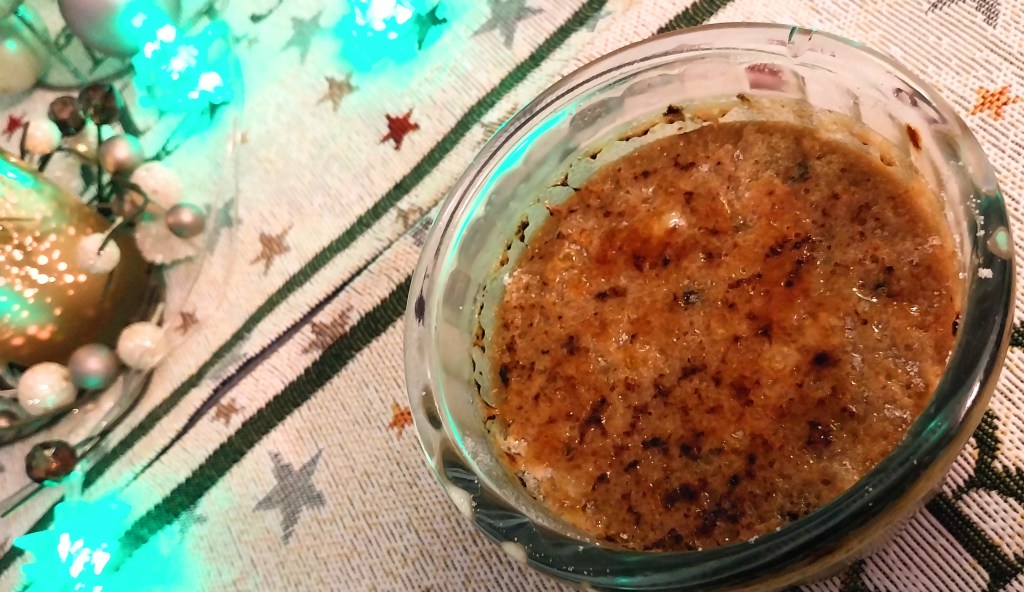
I love making Crème Brûlée – it gives me an excuse to fire up my chef’s mini blowtorch, which is always good fun! That’s it in action in my photo above.

It helps that it is also a magnificent dessert – silky vanilla custard nestled beneath a solid layer of brittle caramel shell, that splinters into shards when cracked with the side of a spoon. The soft underside, together with the crunchy topping, is simply sensational.

No blowtorch? No problem – just place the desserts under a hot grill to caramelise, keeping an eye on them so they don’t burn! You will need 4 individual ramekin dishes and a high-sided roasting dish to act as a bain-marie. Got that? OK, here we go…

Servings

This will make 4 individual desserts.

Timings

20 mins to prepare. 35 mins to bake. 5 – 10 mins for that all-important blowtorching before serving.

You Will Need:

  • some butter for greasing
  • 400 ml double cream
  • 1 tsp vanilla extract
  • 80g caster sugar (plus 4 tsp extra for the caramel topping)
  • the yolks of 4 large eggs

Method

  1. Preheat a fan oven to 140C.
  2. Prepare your bain-marie. That may sound posh, but really it is just a large roasting dish with deep sides, into which you will place 4 individual ramekin dishes. Grease the insides of each ramekin dish with butter.
  3. Tip the double cream into a saucepan and add the vanilla. Gradually bring it to a boil, stirring gently, then turn it down to a simmer for about 5 mins.
  4. Set out 2 bowls and crack the eggs carefully, catching the whites in one bowl and the yolks in the other. Set the whites aside to be used another time – we are working with just the yolks for making Crème Brûlée.
  5. Sprinkle the sugar into the bowl with the yolks, and whisk together till gold and creamy.
  6. Bring the double cream back to the boil stirring once again. When it just reaches the boil, pour it over the egg and sugar mixture, and whisk again to combine.
  7. Place a sieve over a jug, and pour the mixture through. This will take out any lumps that may have formed while heating the cream.
  8. Fill a kettle with water and boil.
  9. Take the jug of strained mixture and pour it equally between the 4 ramekins. Then pour boiling water into the bain-marie (roasting dish), so that it comes about halfway up the outside of the ramekin dishes.
  10. Cover the bain-marie with tin foil and place in the oven.
  11. Check after about 30 – 35 mins. The desserts are cooked when the custard has set. Note that the surfaces will not yet be golden caramel – that stage is yet to come!
  12. Using oven gloves, lift the ramekins from the bain-marie and set aside on a tray to cool. Carefully tip the hot water away.
  13. Once the ramekins have reached room temperature, place in the fridge to chill until you are ready to serve.
  14. Now the fun begins. Scatter a teaspoon full of caster sugar over the top of each ramekin. Fire up that blowtorch and heat so that they are caramelised and golden. Alternatively, place under a hot grill.
  15. Place each back in the fridge for a few minutes. The caramelised topping will set to a crisp.

Customise It!

I made a coffee version of this at New Year, dissolving 4 teaspoons of instant coffee granules in the double cream as it warms. It’s a really good variation, giving a good coffee taste and colour (see below). You can check out the reel of it (Café Crème Brûlée) on my Instagram site if you wish @differentkitch.

We’re sticking with the dance theme for the ADK Playlist this January. It’s a brand new year and, hey, I just know that something good is going to happen. Cue Utah Saints with the Kate Bush-inspired Something Good.

Categories
Bakes Recipes

Spiced Cranberry Muffins

This year’s home baked Christmas Cake has gone down well in the ADK household – so much so that we are now down to the final few crumbs on the serving plate. How to fill the gap, I wondered, and maybe also use up some of the tasty ingredients left over from making it?

We still had some currants, golden sultanas, glace cherries and mixed candied peel in the cupboard. There was also the last of the juicy red cranberries, left over from making the sauce I’d been merrily ladling on to my roast turkey.

Too good to waste, of course, so they’ve all ended up in these New Year muffins. I’ve incorporated cinnamon and nutmeg to add to that seasonal feel of deep midwinter, so cosy up and enjoy.

Servings

Makes 12 muffins.

Timings

15 mins to make, 20 mins to bake in a fan oven at 160C.

You Will Need

  • 280g plain flour
  • 3 tsp baking powder
  • half tsp salt
  • 1 tsp ground cinnamon
  • 1 tsp grated nutmeg
  • 120g caster sugar
  • 1 egg
  • 110g fresh cranberries, coarsely chopped in a food processor
  • 20g currants
  • 20g sultanas
  • 20g glace cherries
  • 20g chopped mixed candied peel
  • 240ml milk
  • 90ml veg oil

Method

  1. Prepare a muffin tin or mould. Switch on a fan oven to 160C.
  2. Sieve the flour, baking powder and salt into a bowl. Stir in the cinnamon, nutmeg and sugar.
  3. In a separate bowl, combine the egg, chopped cranberries, milk and oil. Stir in the currants, sultanas, glace cherries and candied peel.
  4. Pour the wet ingredients into the dry, and stir so that no dry ingredients are visible.
  5. Spoon the mixture into the tin/mould, and bake for 20 mins.
  6. Remove to a wire rack to cool.

Customise It!

Basically, the rule here is that if it might have gone in your Christmas Cake, and is sitting left over in the cupboard, then it’s good enough for the muffins! Swap in raisins for some of the currants or sultanas, for example. Chop up some nuts and add them in. I didn’t go so far as to feed in a teaspoon of brandy but, hey, why not try it? If mixed spice is all you have, then use it in place of the cinnamon and nutmeg.

First musical selection of 2025 is from Sophie Ellis-Bextor. I enjoyed her New Year’s Eve Disco shown on TV here. She performed Groovejet and Murder on the Dancefloor, both of which I have always rated, and also this one, which I don’t think I’d heard before. It is a paean to the classic Sheila B. Devotion track, Spacer, so can’t really go wrong. Here’s Sophie with Crying at the Discotheque.

Categories
Blog

Around the World in 80(ish) Plates

As 2024 draws to a close, I’ve been looking back at some of the many dishes enjoyed on my travels over the past 12 months. I’ve reached some far-flung destinations over that period, as well as some places closer to home, in a bid to savour some of the best food and drink the cuisines of the world have to offer. It’s a tough job, I know, but hey, someone has to do it 🙂 .

I’ll start with my main photo above, taken in Satay by the Bay in Singapore, where I visited in March. They served up a plate of chicken and beef skewers grilled over hot coals, along with a pot of peanutty satay sauce for dipping. Perfect fast food.

Kampong Gelam is the heartland of Singapore’s Malaysian community. The traditional Malay dish, Nasi Lemak (shown above), was excellent – a pandan leaf parcel is unwrapped to reveal steamed, soft and fluffy jasmine-scented and coconut-flavoured rice.

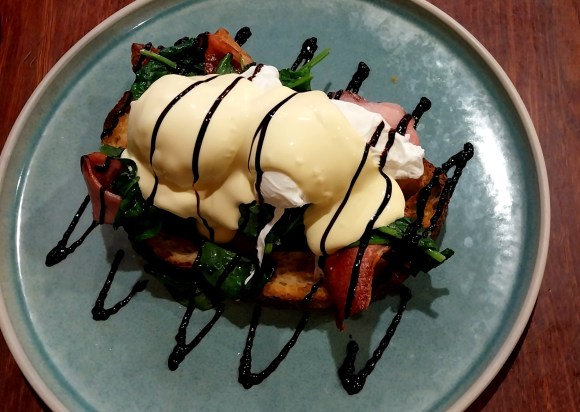
The breakfast shown above was a sight for sore eyes on arrival early one morning off a plane, very hungry, in Sydney, Australia : eggs benedict served with spinach and bacon on sourdough toast, with a balsamic drizzle.

I had wanted to try an Acai bowl for some time, and managed to do so at the Drip Bar in Melbourne, Australia. This purply-chocolate coloured acai berry smoothie is topped with fresh banana, crushed cacao, coconut, ground almonds, granola and a very generous (ahem) drizzle of peanut butter.

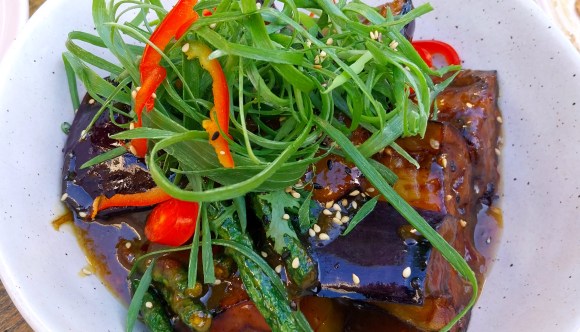
The Sunshine Coast in Queensland, Australia, saw my introduction to Asian Fusion – bringing together the sights and tastes from the culinary traditions of India, Thailand, Korea, Indonesia, China and Japan. Amongst a tasty and adventurous buffet, my fave was this Miso Caramel Eggplant shown above – chunks of roasted aubergine coated in a sticky sauce, topped with spliced snake beans, coriander and sesame.

The month of June saw a trip to France, where they do food rather well. One highlight of several is shown above – an Entree of cod and yuzu croquette, served with baby gem lettuce, and a sweetcorn and avocado salsa. I liked the Gallic flair with which the dish was presented, resembling artistic brush strokes of red pepper aioli and lemony yuzu.

In summertime in France, it is always a simple pleasure to enjoy an evening al fresco buffet with purchases from the local fromagerie and charcuterie (see above) – along with a bottle of the the local vin rouge, of course.

A July trip to Belfast provided the opportunity to visit St. George’s Market to sample the best of traditional Ulster food. A breakfast of toasted soda farl, here filled with egg, bacon, roasted cherry tomatoes and avocado, certainly satisfied the appetite.

The month of September was spent motorhoming around Cornwall in England’s south-west, sampling numerous pasties like the one shown below. This one is named Veggie Power, and has the traditional filling of steak and potato replaced by mushroom and butternut squash.

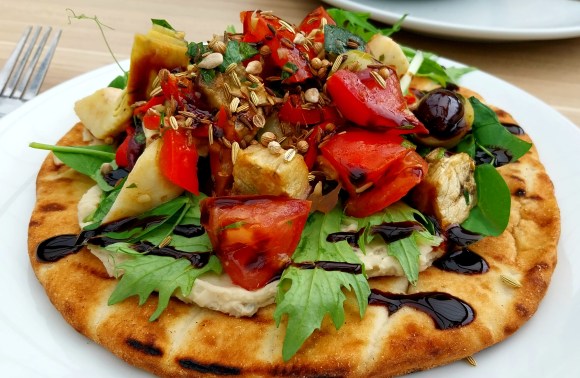
I found my visit to Cornwall’s Eden Project very inspiring, and an opportunity to learn more about sustainable food production. All the tea, coffee and chocolate now making its way into the ADK kitchen is certified Fair Trade. The dishes on the Eden menu are made from local ingredients, such as this griddled flatbread shown above, topped with white bean paste, leaves, marinated roasted vegetables, tomatoes, balsamic drizzle, herbs and toasted seeds.

Revisiting all of these meals has now made me hungry again, so I will leave it there! Thanks to everyone who has followed along, read, liked and/or commented in 2024. My travels, along with the home bakes and recipes, will be continuing into 2025 here, on Instagram and on X.

Happy New Year, everyone.

Categories
Mains Recipes

Roasted Winter Veg Curry

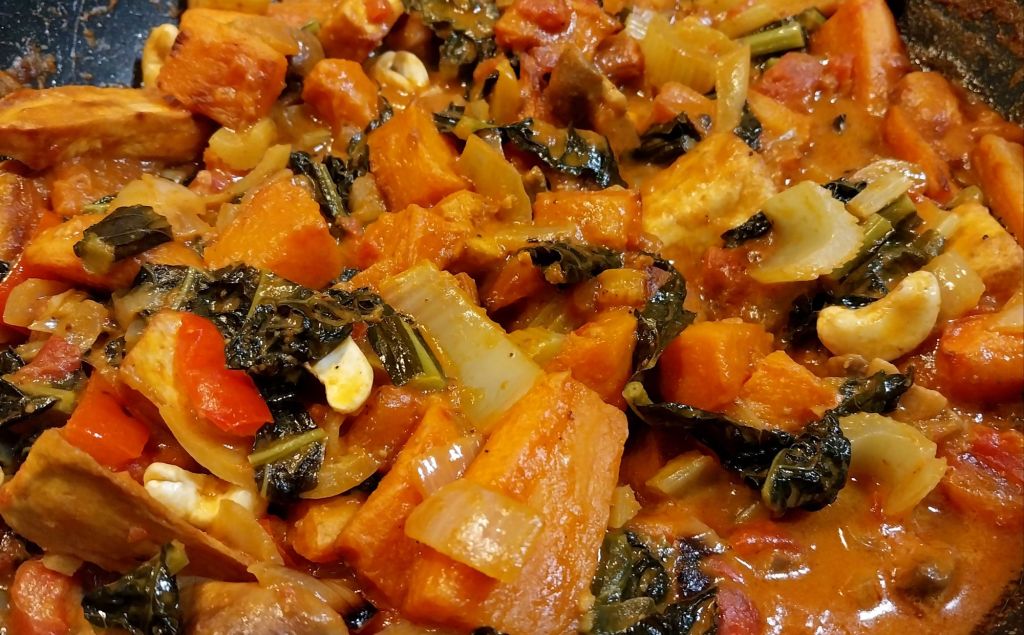
For this dish, which is suitable for both vegetarians and vegans, I’ve given a selection of seasonal squash and root veg a long, slow roast in the oven before coating it in a thick curry sauce. The roasting makes the veg soft, sweet and just a little caramelised around the edges.

We’ve just been experiencing our first few snow showers of the winter here, so all that deliciousness and comforting heat has turned out to be very timely!

Servings

4 adult portions.

Timings

1 hr to roast the winter veg, during which time the rest of the dish is prepared.

You Will Need:

  • 1/2 a butternut squash
  • 2 medium sweet potatoes
  • 2 medium parsnips
  • 3 – 4 medium carrots
  • Oil
  • 1 garlic clove
  • 3cm piece of root ginger
  • 1 onion
  • 2 tbsp curry powder
  • 2 celery sticks
  • 1/2 red pepper
  • 1/2 yellow pepper
  • 5 – 6 chestnut mushrooms
  • 1 400ml tin coconut milk
  • 1 400g tin chopped tomatoes
  • 4 – 5 leaves of cavalo nero
  • A handful of unsalted cashew nuts

Method

  1. Switch a fan oven on to 180C.
  2. Peel and roughly chop the squash, sweet potatoes, carrots and parsnips into chunks. Spread them out in a roasting dish and drizzle with oil. Place the dish in the hot oven for about an hour. Check on them every so often just to check they’re not burning, and give them a scatter with a spatula so they get evenly roasted.
  3. Meanwhile, crush the garlic and finely chop the ginger. Put both in a wok with some oil and heat. When the pan is sizzling, add in the onion, celery, mushrooms and peppers, all chopped. Sprinkle over the curry powder and toss with a spatula so all the veg is coated in a mix of the spices and oil.
  4. When the veg has softened, empty in the coconut milk and tomatoes. Give it all a good stir to mix and bring to a bubble, before turning down to a simmer. Let it slowly reduce to make a thick, spicy sauce.
  5. Shred the cavalo nero and wilt in for about 10 mins.
  6. When the tray of veg has finished roasting, take it from the oven and scrape all the lovely contents into the wok. Give it all a stir again, so that the veg chunks get coated in the thick curry sauce.
  7. Chuck in the cashews and mix, a few mins before serving. It should resemble my main photo at the top of the post.
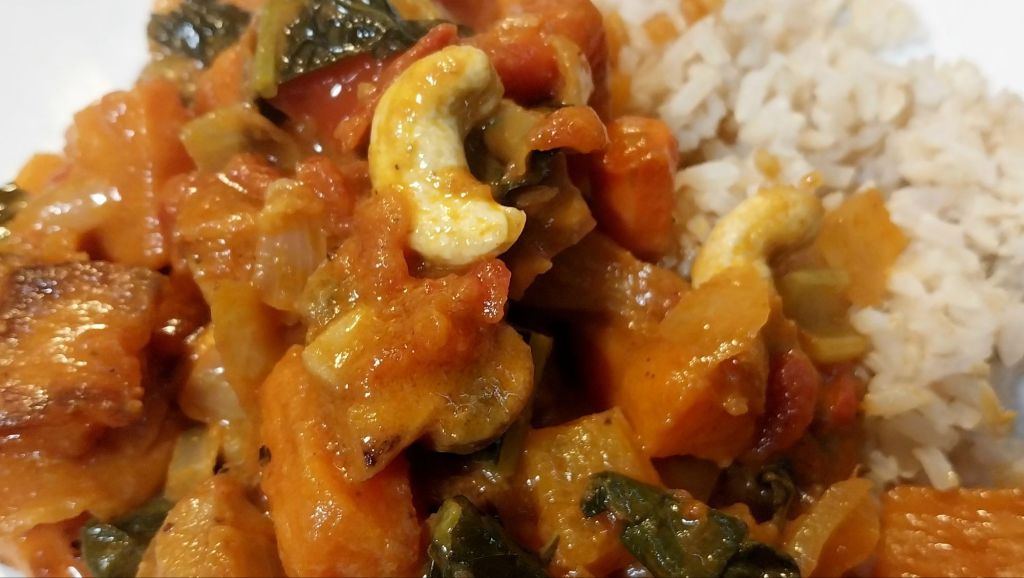
  8. Serve up with rice on the side – see below.

Customise It!

Lots of scope here – substitute other root veg like potatoes or celeriac, or other types of squash, and vary the proportions between them if you wish, as long as you have 1 large roasting pan’s worth of it all.

Use your own favourite spice combo if you wish – I used the ready mixed blend I brought back from the Souq Waqif in Doha, which I really like. Why not chuck in a few nigella seeds? Play around and have fun!

No cavalo nero? Try other greens like spinach or chard.

Time to treat you to my most streamed song of 2024, as confirmed by Spotify Unwrapped, which landed this week. I first came across this indie band while on my travels to Australia earlier this year. They make a terrific sound and, I’m sure you’ll agree, this really is a very good track. Enjoy These New South Whales with Changes.

Categories
Mains Recipes

Beautiful Borlotti

This harvest of borlotti beans, fresh from the pod (shown in my photo above) has been a very welcome arrival recently in the ADK Kitchen. I always think they are one of the most beautiful foods in their natural uncooked form.

They’re not bad cooked, either. The beans do tend to lose that magical, mottled sheen, but more than make up for it in their creamy, smoky taste. They also provide generous amounts of protein and fibre.

For this dish (shown in my photo below), I have given them a starring role in a chilli suitable for vegetarians, vegans and, indeed, anyone who enjoys a bowl of rich, warm and creamy comfort food this time of year.

Servings

4 adult portions.

Timings

The beans soak overnight, and are then boiled/simmered for at least an hour. Once these stages are complete, the rest will take about 30 mins to cook.

You Will Need:

  • 120g uncooked borlotti beans
  • cold water
  • 1 onion
  • 1 garlic clove
  • 1 tsp chilli powder
  • 1 tsp cumin seeds
  • oil
  • 1/2 a red pepper
  • 1/2 a green pepper
  • 2 celery sticks
  • 1 carrot
  • 6 -7 chestnut mushrooms
  • 1 400g carton of tomato passata

Method

  1. Wash the beans, then place in a bowl with enough cold water to cover them. Leave for 24 – 36 hours.
  2. Drain and rinse the beans under cold running water. You should find that they have doubled their weight through the water they have absorbed. Place the beans in a saucepan with enough fresh water to cover them, and bring to the boil. Reduce and simmer for 50 mins.
  3. Drain the cooked beans and wash again under cold running water. Set aside.
  4. Heat some oil in a wok, and add in the garlic, chilli and cumin. When it sizzles, add in the onion, peppers and celery, chopped into chunks.
  5. About 5 mins later, add in the mushrooms and carrot, also chopped into bitesize chunks.
  6. Stir with a spatula until all the veg is nicely softened, then add in the passata and the cooked borlottis. Top up with about half an empty carton’s worth of fresh water, and turn it up to boil.
  7. Bring to a simmer for about 15 mins, by which time the sauce will have reduced to provide a thick, creamy coating for the beans.
  8. Serve up with a portion of brown rice.

Customise It!

Replace the onion with chopped leeks, and add in some roasted squash if you wish. Shred in some spinach, cavalo nero or chard leaves.

Skip the rice and wrap a few spoonfuls up in a warmed tortilla. Perhaps with some soured cream on the side. This is making me hungry again…

It’s getting to that time of year when I receive messages from Spotify that my Unwrapped Playlist – containing my most played tracks of 2024 – is imminent. Here’s one track that will almost certainly be on it, and which seems to go well with the subject of this post: Leftfield with Pulse.

Categories
Blog

Autumn Escape

Our motorhome has been back in action this week, on an autumn trip to Cranborne Chase, in England’s south-west.

The area is designated as a National Landscape, which is the new official name given to what were formerly called Areas of Outstanding Natural Beauty.

The name may have changed, but the landscape certainly hasn’t – not for hundreds of years in fact. This makes it a perfect environment for long country walks across an expansive, rolling green terrain. Gentle climbs take you up high to reveal dazzling views, while paths weave their way through water meadows with clear trickling, bubbling streams past ancient mills. There aren’t many people around and it is really quite remote. Am I painting a clear enough picture here?

It is particularly special this time of year because, as everyone knows, the countryside generally looks even better with autumn colours.

My main photo at the top of the post shows Philipps House, dating from the early 19th Century. It is at the centre of the massive grounds of Dinton Park, which is fully open to public access. We had very clear skies, and from the highest points it was possible to see the spire of Salisbury Cathedral to the east.

The intricate network of footpaths and bridleways takes in some very old buildings and traditional pubs. This photo shows St. Mary’s Church in Dinton village, dating from the 12th Century.

This photo was taken on a walk through woods and across fields to Baverstock, where St. Editha’s Church is located. It has been here since the 15th Century, and provided a perfect lunchtime picnic spot.

We pitched our motorhome in a small site in the middle of some woods, and spent the week off-grid with no electric hook-up. It is just as well the skies were clear and the sun shone as, along with our gas tank, we were rather reliant on that solar panel on the roof 🙂 .

In such a remote location, with no shops anywhere around within walking distance, we planned in advance and took a week’s worth of food and drink. Home-made butternut chilli soup helped keep us warm in the evening.

Quiches made the week before and warmed up in the gas oven came in very handy – those 10k treks certainly give one an appetite!

The solar powered battery helped keep my phone charged overnight, which meant I could still listen to the David Bowie Playlist I’d downloaded to my phone from Spotify. No first world problems here, mate 🙂 .

I can’t quite believe that it in just a few months it will be 50 years since the release of Young Americans, which is probably my fave album of his. Here’s a great track from it: Right.

There is one more motorhome trip planned for 2024, so watch this space for developments.