Categories
Breakfast Recipes

Summer Fruit & Nut Acai Bowl

I’m home from my trip to France, to find that a spell of warm sunny weather may have finally arrived in the UK.

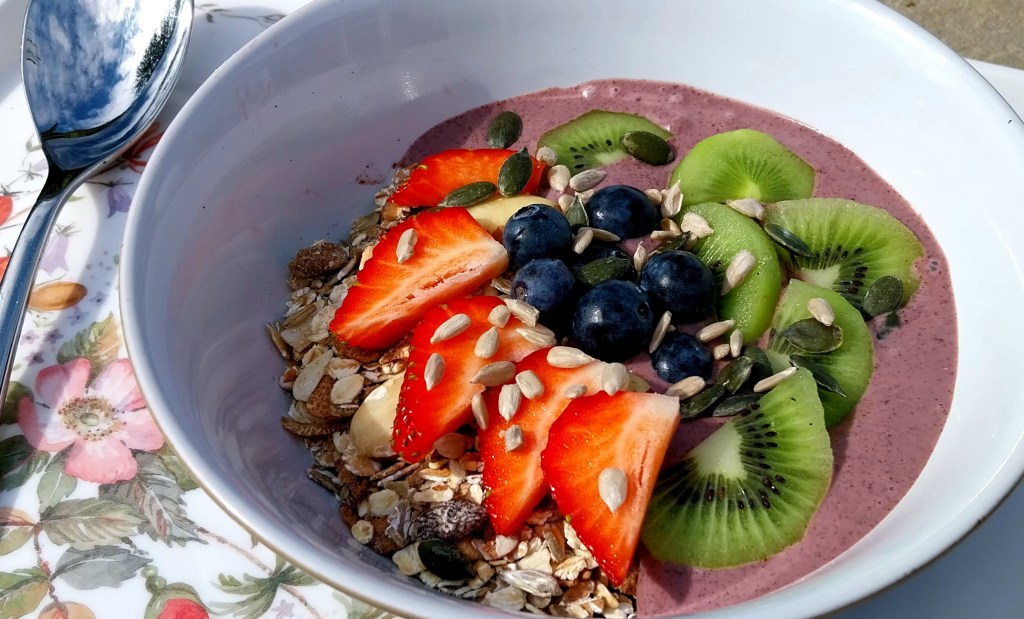
Reminded of the climate we enjoyed on our trip to Australia in the spring, I decided it was time to bring out the Acai powder I brought back in my suitcase, to make an Aussie-style smoothie bowl. Here it is, shown in my photo above, glinting in the British breakfast time summer sun.

We found Acai Bowls to be a popular choice in cafes and takeaway joints wherever we went in Australia. The Acai is usually served with combinations of cereal, fresh fruit and nuts (check out my earlier post on the crazy, yet delicious, peanut butter-infused option I enjoyed in Melbourne).

Acai (pronounced ah – sa – ee) is a dark purple berry grown in Brazil. It is rich in antioxidants, fibre and healthy fats, and believed to support heart health and cognitive function, while being low in sugar and calories. It tastes great, with a flavour reminiscent of dark chocolate, berries and red wine. It is suitable for vegetarians and vegans.

The berries do not travel well, so outside of Brazil they are sold in pulp form or as powder. I bought a pack of powder from Coles Supermarket in Melbourne, where it was available on the shelf, in several varieties. I have seen it in specialist health food shops here in the UK, but it is nowhere near as mainstream as it is Down Under.
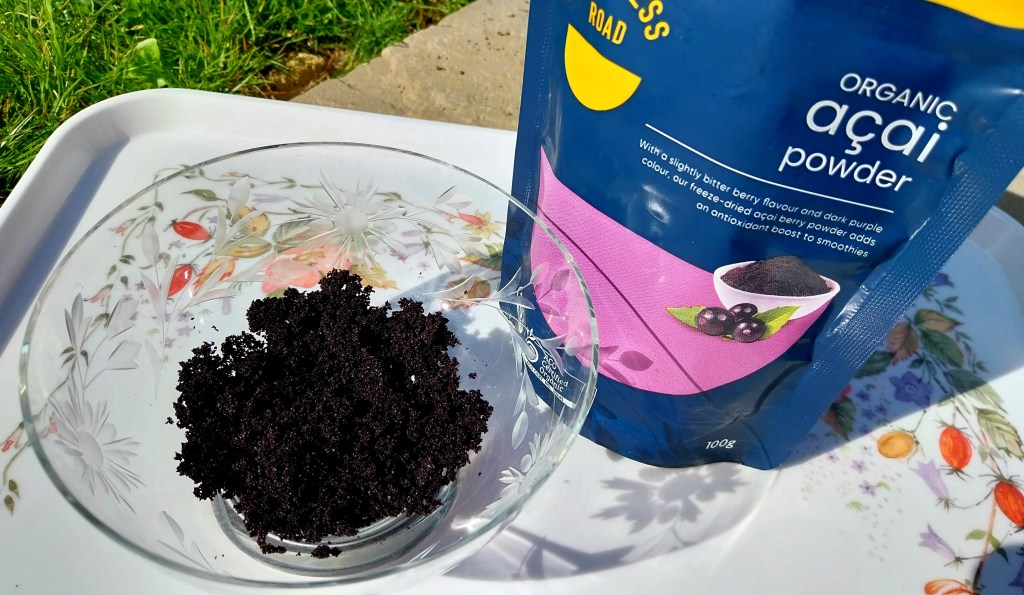
For my Acai Bowl, I blended a tablespoon of Acai powder with two bananas and 3 tablespoons of Greek natural yoghurt. After a minute or so in the blitzer, it forms a thick purple cream that can then be poured on to cereal and topped with fresh fruit. This made enough for 2 Acai Bowls.

I poured it on to muesli and added some fresh strawberry that is grown locally. Just like Cristiano Ronaldo, the blueberries and kiwi are from Portugal. The crowning touch is some toasted brazil nuts, with a sprinkling of pumpkin and sunflower seeds.

It is the time of year to relax outside in the sun listening to good music on my ear buds. This week I’ve been revisiting an old playlist featuring The White Stripes, having forgotten how good they sound. Here they are with The Hardest Button to Button.
Categories
Blog Snacks

Au Revoir, Bergerac

The time has come to leave the Dordogne after a lovely holiday, and head back to the UK.

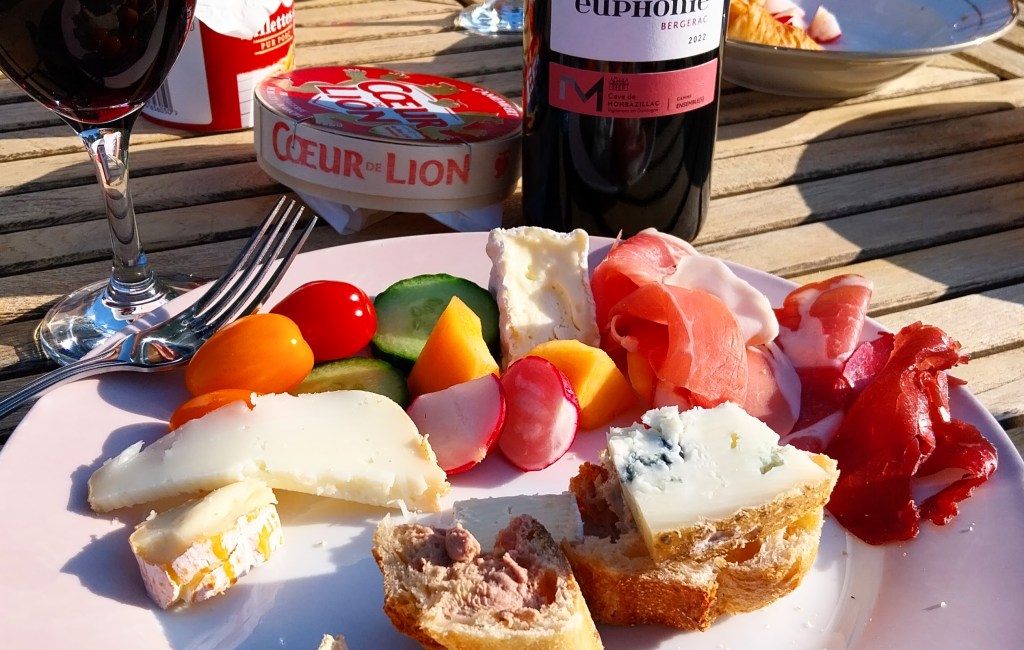
We have certainly dined well during our stay, as should be clear from my last few posts. My favourite meal in France remains a very simple one, however – a summer spread of cheese, paté, hams and salad that we have enjoyed outside in the sun most evenings, as shown in my photos above and below.

We’ve enjoyed baguettes from the local boulangerie, baked fresh and collected every morning, and best eaten the same day. They have a crisp exterior, and soft, buttery textured inner that carries a real taste.

A visit to the fromagerie is always fun, as there are so many French cheeses to try. We’ve usually opted for a cheeseboard comprising a soft, a hard and a blue: in the one below the soft is a Vieux Pané, the hard cheese a Tomme de Montagne, and the blue a Basque Bleue.

Paté de fois gras goes well spread on a hunk of baguette, and local cured hams from the charcuterie have been tastily paired with chunks of ripe, golden melon from that marché in Bergerac.

Enjoyed with a glass of Bergerac Rouge, of course. While watching the sun set.

Time to say au revoir.

I’ve downloaded my listening for the journey back from Bergerac Airport. I’ve chosen a 2023 digital remaster of New Order’s Substance album, which is sounding even greater than ever. Here’s a track to show what I mean: Confusion ’87.

Categories
Blog

Déjeuner à Mélange

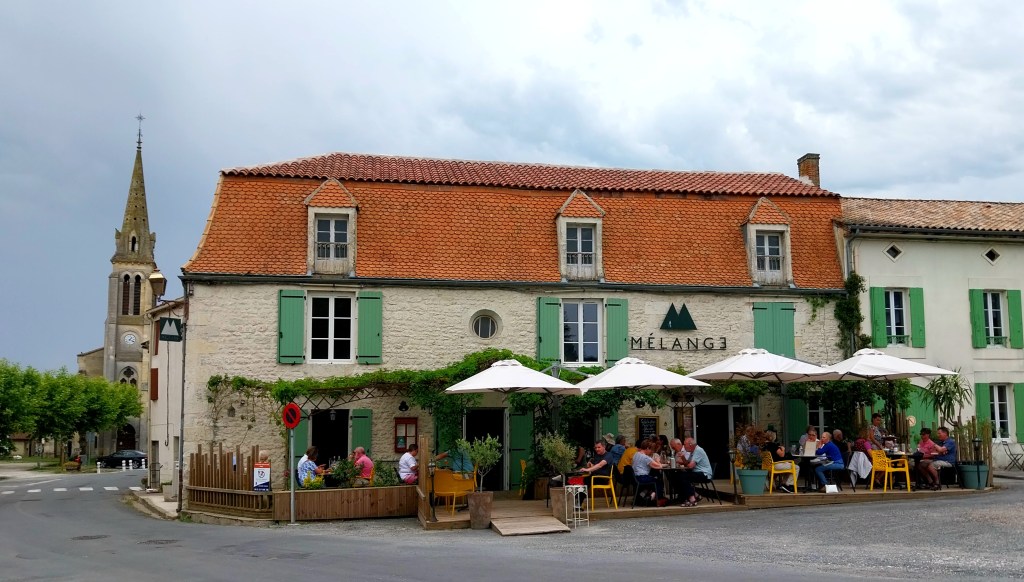
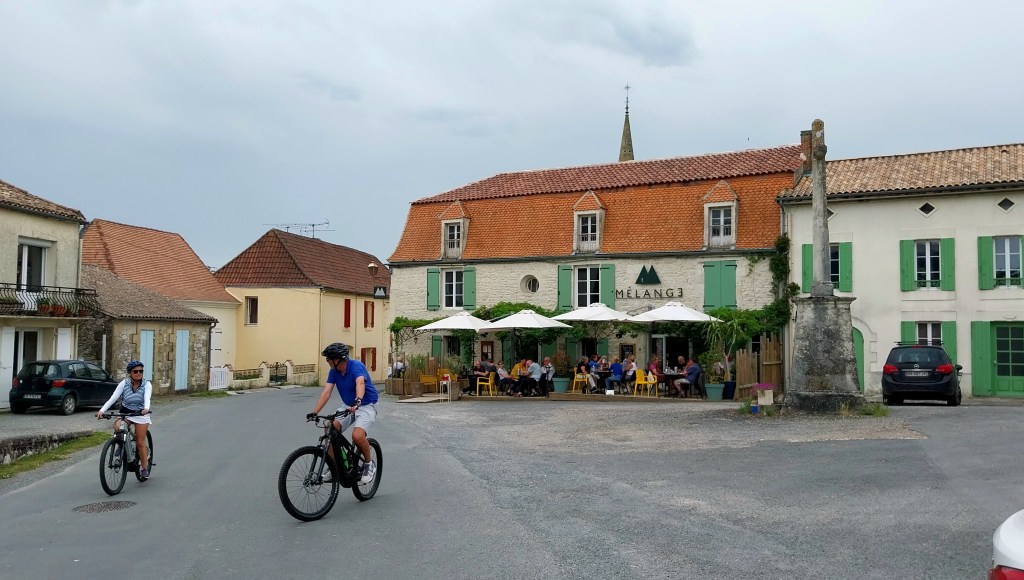
On holiday in France, and keen to experience some top regional cuisine, we book a table for 4 at Melange, a restaurant in our nearest village, Saussignac.

Like many rural villages we have seen in the Dordogne, it is small and sleepy. There is a lovely old church, a war memorial dressed for the D-Day commemorations, and a cobbled square. There is little traffic and few people to be seen out.

That changes, though, when the churchbells chime to say that midi – 12 noon – has struck, and this charming old building opens its doors.

Soon cars were arriving and all the tables on the terrace were filling up. Aren’t I glad that we booked!

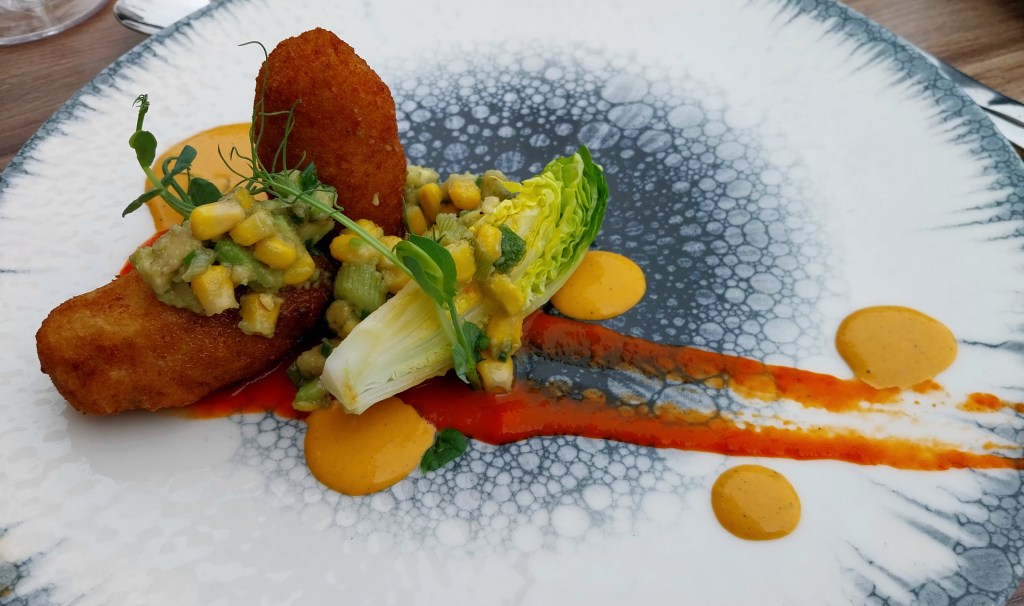
Our 3 course menu du jour was delicious, and beautifully presented. The restaurant’s chef clearly has an artistic streak, judging by the stylish way the dressings and sauces are swept around the plate to get the mouth watering. Well, this country has quite some pedigree when it comes to art: Cezanne, Matisse, and Monet to name a few. Why shouldn’t that extend to culinary creation?

For my Entree, I chose the cod and yuzu croquette, which was served with baby gem lettuce and a sweetcorn and avocado salsa. That is red pepper aioli you can see in the photo below, swept across the dish in broad brush strokes, with carefully positioned blobs of yuzu dressing.

Yuzu is something I hadn’t come across before, and I do not even recall seeing it in any of our shops. Of Asian origin, and now grown in France, it is a citrus fruit that is kind of a cross between a lemon and a mandarin orange. It’s a natural for pairing with the fish in the croquette, therefore.

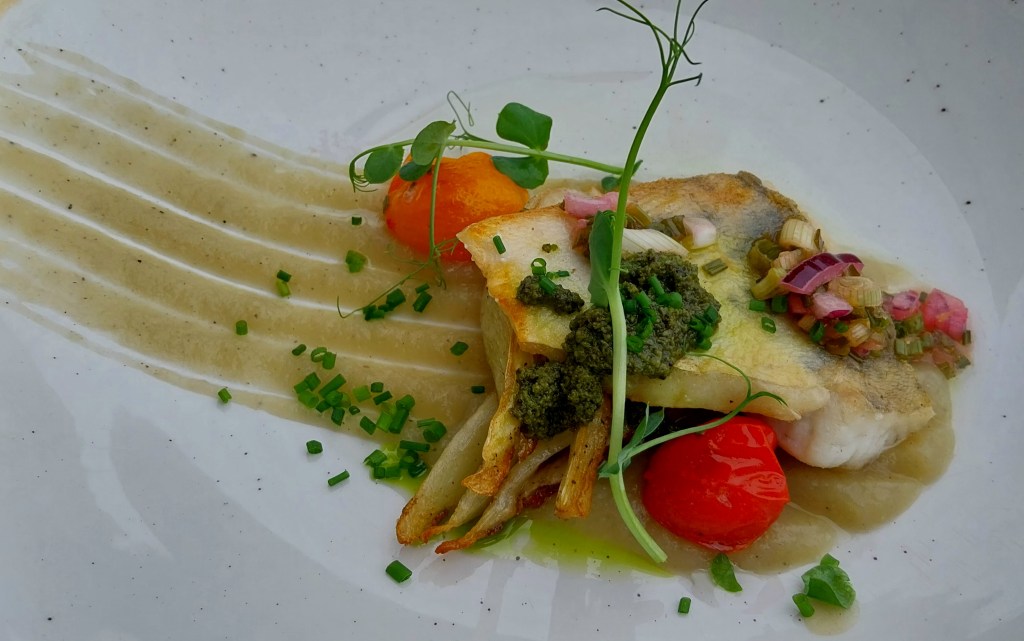
My Plat, or main course, was a fillet of sardine, served with rocket pesto, roasted cherry tomato, and chive and lemon gremolata. The fennel came en deux facons: firstly as a roasted bulb, and secondly as a puree that looks like it has been extravagantly combed across the plate with traditional Gallic flourish – see below.

The gremolata I hadn’t come across before, and I will definitely have a go at making this back in the ADK Kitchen. It is a garnish comprising seasonal European ingredients all minutely chopped: red onion, garlic, chives, citrus zest and herbs, blended with olive oil.

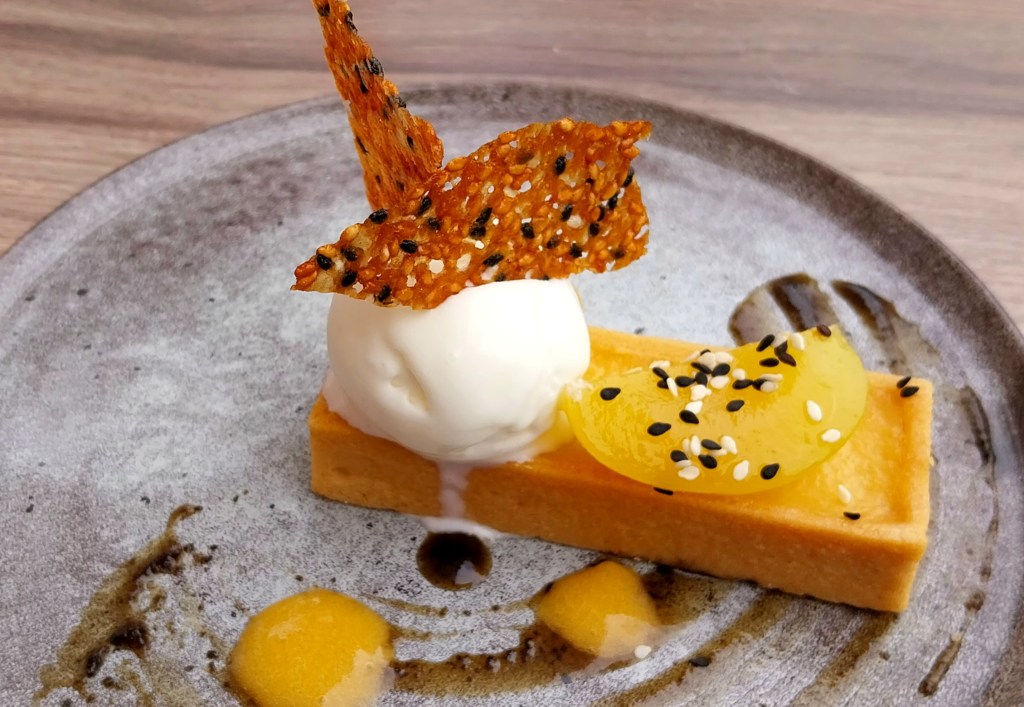
Dessert, shown below, was Tarte a l’abricot – apricot on a biscuit crumb base – with olive caramel wafers and a scoop of yoghurt ice cream.

The apricot had a real zing, and the yoghurt slightly less sweet than more traditional ice cream. The olive caramel wafers are made from pureed black olives and sugar, giving a sweet yet slightly bitter taste that I think goes well in a fruity sweet.

I rounded things off with a cappuccino that was served with a Canelé de Bordeaux, a small caramel pastry that is traditional in this region of France.

A thoroughly enjoyable couple of hours with great food, much inspiration for future cooking, and the company of family and friends. The price was reasonable also – my 3 course menu du jour was €24 (£20 or $25), which I considered fair value.

A glimpse into the unrushed life of a quiet village in the Dordogne that enjoys its food. As Dublin’s B*Witched put it, C’est La Vie !

Categories
Blog Mains

Au Marché

One of the great joys of being a foodie on holiday in France is making a visit to the local market, or ‘marché’. So, while here in the Dordogne Valley, we set out for the local town of Bergerac on market day. Some of the fresh produce we bought inspired our evening meal back at the farmhouse. More of that in a moment.

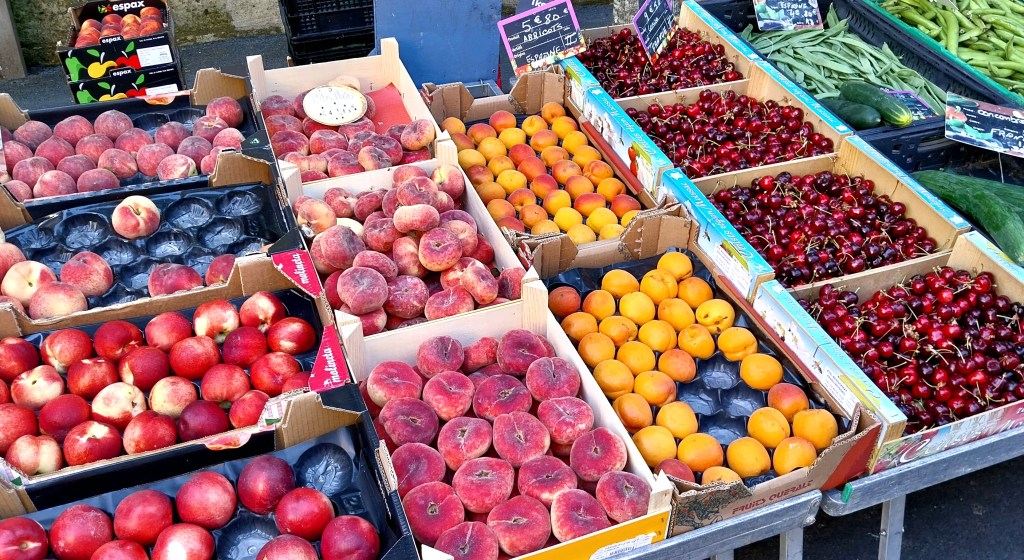
It was a beautiful warm and sunny morning as we arrived. The market was already well under way, this array of soft fruit was glinting in the sun, and business was brisk.

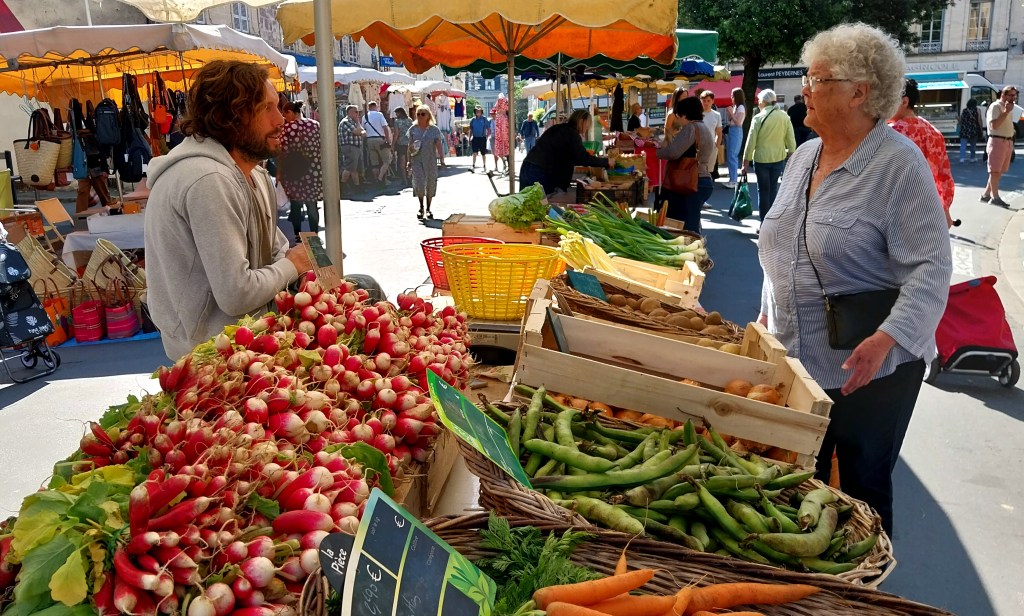
The market isn’t just about stocking up with provisions for the week, however – there’s a real sense of market day being an opportunity for local people and traders to meet and catch up. In between happily chatting with customers, this chap sold us a bag of his healthy crop of radishes. Simply washed, topped and tailed, they made a light, peppery and crunchy snack alongside cold beers.

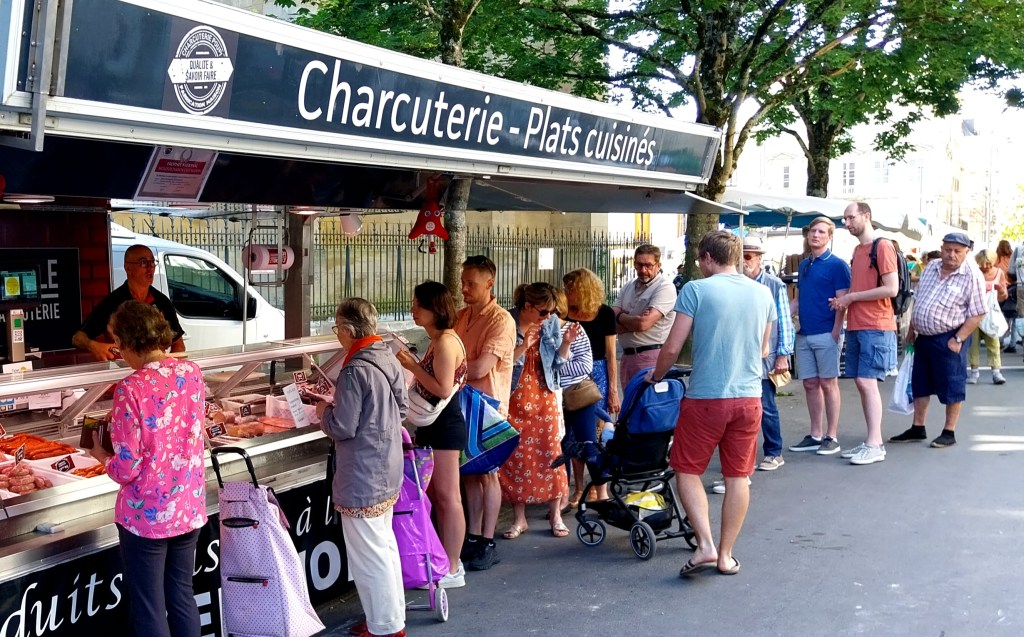
A long queue of discerning French shoppers waiting patiently to buy their food is usually a reliable sign of a good market stall. So it was with this charcuterie stand, where beef carpaccio was the ready prepared Plat du Jour. The charcuterie included local merguez sausages, which are long and thin with the texture of chorizo, and which went well later on our barbecue.

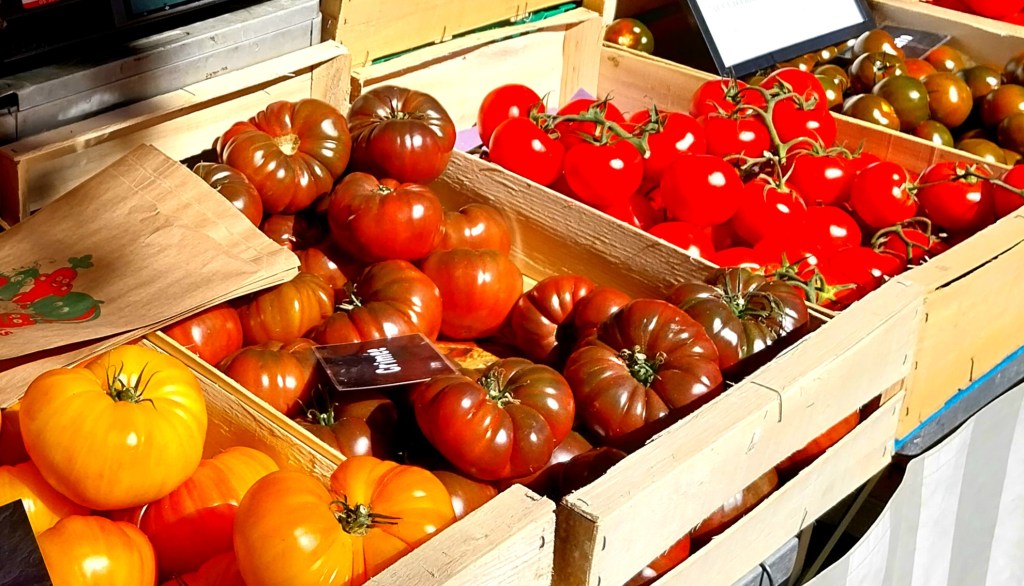
All the fruit and veg was seasonal, fresh and presented attractively. The range of tomatoes was something else, and they all looked luscious in the mid-morning sunshine.

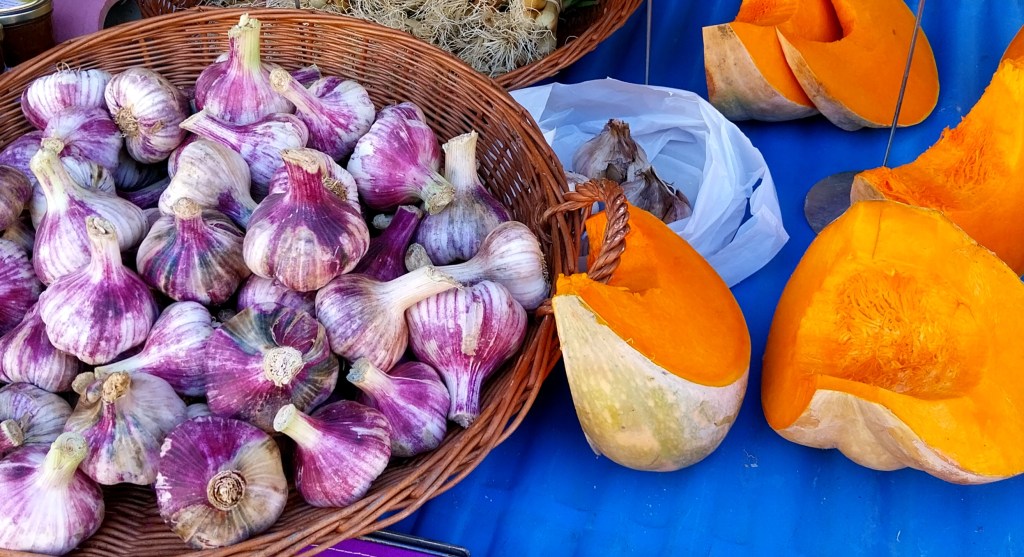
Garlic is a staple in French cooking, and I treated myself to one of these wonderful looking purple bulbs to take home. Presentation-wise, I liked the juxtaposition of vivid colours alongside these wedges of butternut squash.

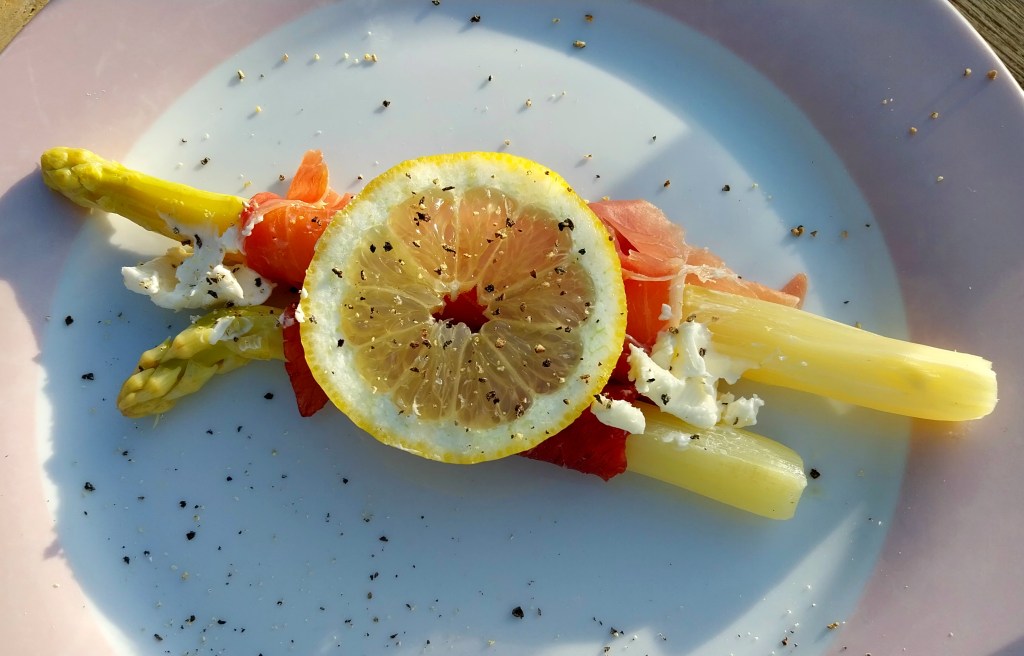
And so to that evening meal. I hadn’t come across white asparagus before, being more used to the green variety we have in the shops in the UK. It is popular in central Europe however, so I decided to try some.

It is essentially the same plant, but is grown underground, which stops it turning green. It has a slightly more intense taste, and requires a little more prep by peeling from the end of the spear tip to the base of the stalk. Like all asparagus, the woody bit at the base needs trimming off also.

I steamed the spears for 20 mins, then wrapped them in local prosciutto, and warmed them on a plate in the oven for 10 mins. They were then served with a knob of melting butter, a squeeze of fresh lemon and a few twists of black pepper.

The dish was enjoyed by our group, with a glass of chilled Bergerac Blanc on our terrace in the evening sun.

Voilà!

Time for some more French-inspired rock. This is The Stranglers with Goodbye Toulouse.

Categories
Blog Drink

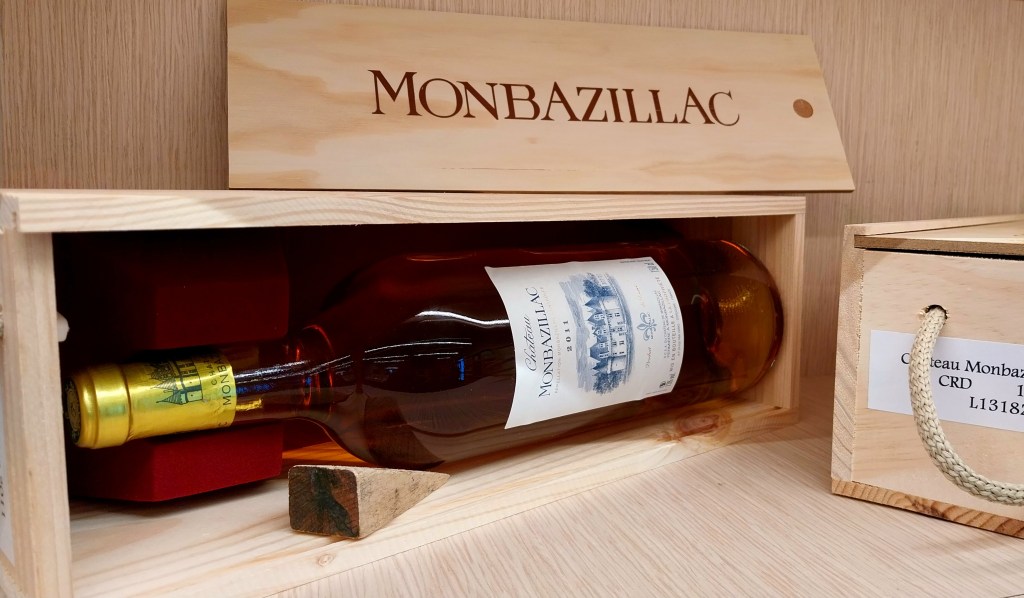
Chateau de Monbazillac

Vive la France!

This week I am off on my travels again. We are holidaying with our very good friends in the Dordogne Valley in south-west France. Expect to be hearing over the next few posts, therefore, about some of the lovely food and drink that this region has to offer.

The base for our stay is a delightful, restored stone farmhouse in the countryside, just west of Bergerac. Built in the 19th century, it retains all its character and, I am pleased to say, now has some 21st century luxuries (like wifi, ensuites and a dishwasher) incorporated.

Discovering that we are situated along the Route des Vins, we set out to find our bearings on a tour that takes in one vineyard after another. The climate and soil conditions here are near-perfect for growing grape vines, making the Dordogne Valley one of France’s prolific wine-producing regions.

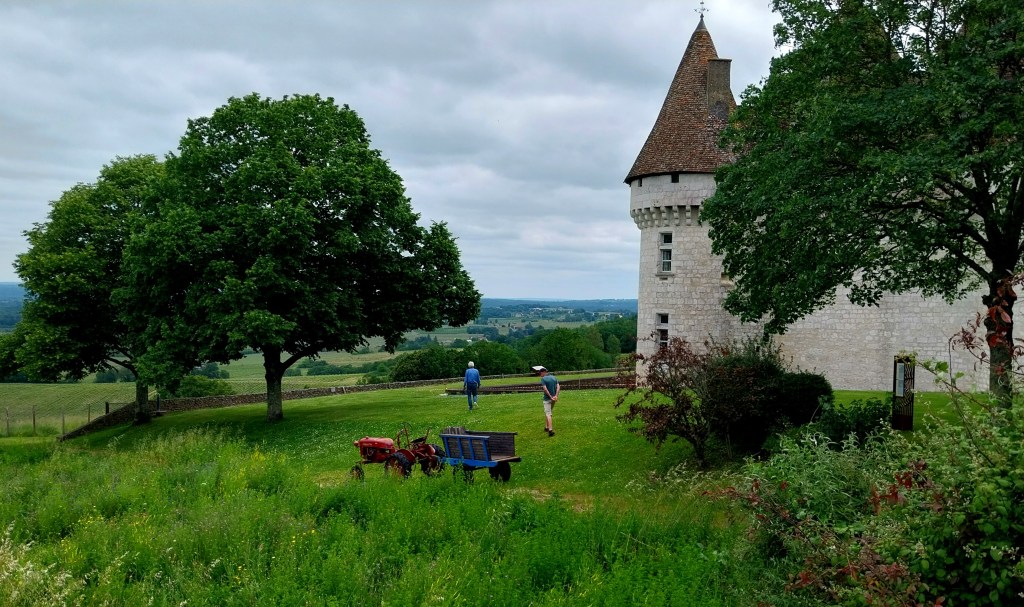
To learn a little more, we stop at one of the major vineyards along the route for a tour and some wine tasting. Chateau de Monbazillac is a microcosm of modern French history – a splendid, ornate chateau and estate that flourished in the 16th Century, before being brought down to earth by the revolting local peasants in the revolution of 1789. After some period of flux, it eventually found its feet again, being taken over by a wine producers’ co-operative that now markets its wine collectively under the Monbazillac name.

The Chateau is beautifully restored and maintained, with exhibitions on modern wine production, and glorious views out across the Dordogne Valley towards the town of Bergerac, taking in row after row of vines.

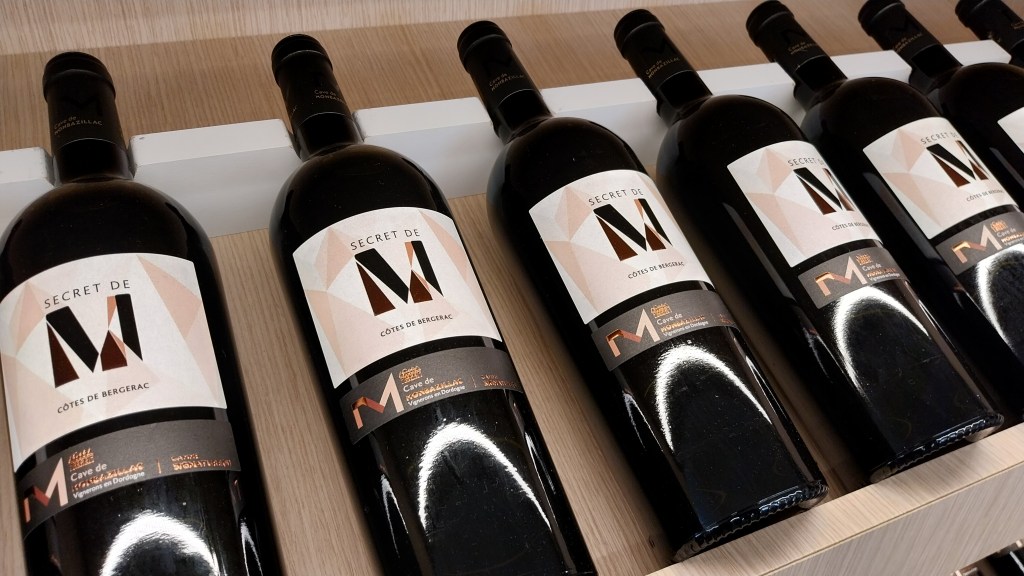
The choice of wines for our tasting took in a Bergerac blanc, a rosé, a fresh and fruity red and a deep red with the scent of oak barrels and a hint of saline on the throat. After some deliberation, our group opted to buy a bottle each of the two reds.

I can assure you these are being fully savoured on our terrace in the evening with a few platters of cheese, ham, pate and locally baked bread (I will go into further details in coming posts about that cheeseboard 🙂 )

After a relatively wet spring here, the weather is warming up, and we are looking forward to a relaxing few days of good food and wine with sunshine. Check back this weekend for a further report.

In the meantime, I shall leave you with a track that has a distinct French connection via the bassist, Jean Jacques Burnel. Here are The Stranglers with La Folie.

À bientôt!

Categories
Bakes Recipes

New Forest Buttermilk Scones

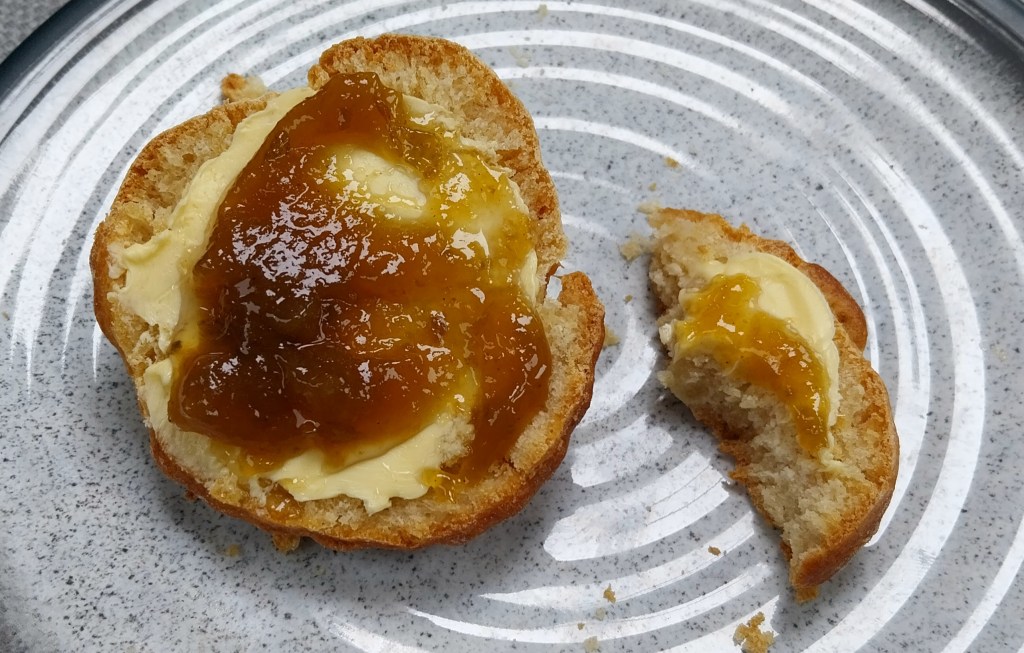
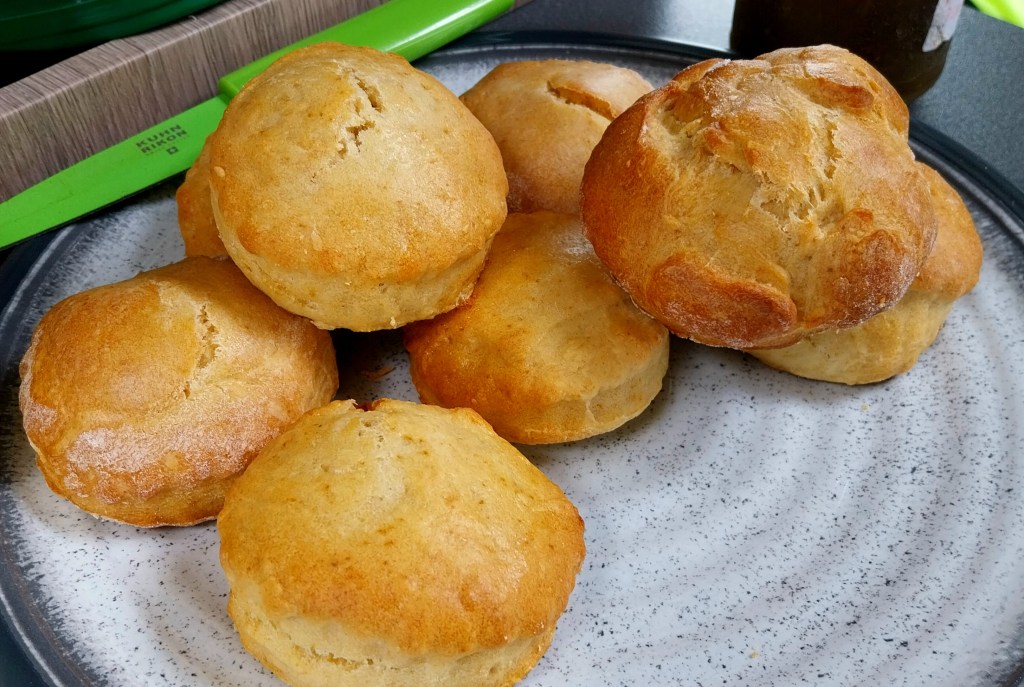
Mmm….freshly baked buttermilk scones with butter and home made plum and apple jam. Yes!

This week I found myself with a tub of buttermilk to spare. The by-product of an exercise in making butter from Jersey cream, I was vaguely aware that it could be used in baking scones.

A little further research taught me that its acidity makes it react well with bicarbonate of soda to give a light texture to baking. It also brings a slightly sour, but pleasant taste to a scone mix.

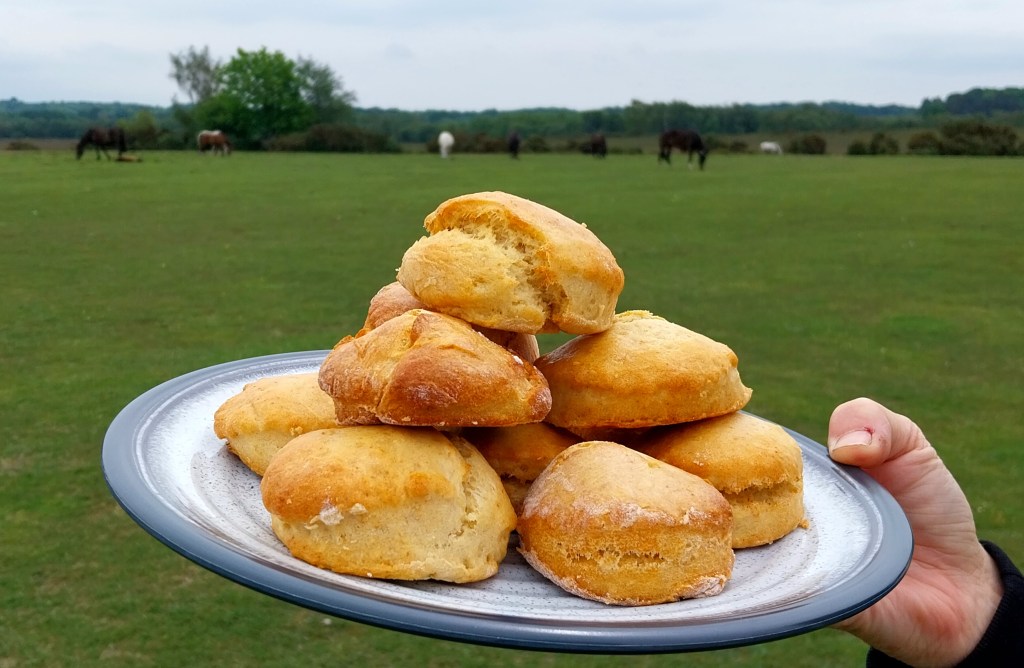
I decided to give it a go, thinking that the scones would make a tasty picnic lunch the following day, when we had planned to go cycling in the New Forest. A remote national park that has changed very little over the decades, the Forest has an extensive network of tracks exclusively for non-vehicle traffic – just walkers, cyclists and horseriders.

And so it worked out! My photos show the plate of golden brown scones, as we prepared to devour them after a morning’s cycle in the peace and solitude of the Forest. Look carefully in the background and you can see some of those famous wild ponies that roam the New Forest.

Just make sure you eat the scones before those ponies do 🙂

Servings

This made 12 scones and, with a couple of re-rolls of the remaining scone mix, another 2 – 3 on top.

Timings

15 mins to make, 20 mins in the oven at 160C.

You Will Need

  • 450g self-raising flour, plus extra for dusting
  • 1/2 tsp salt
  • 100g butter or baking spread
  • 85g caster sugar
  • 300ml buttermilk
  • 1 tsp vanilla extract
  • a splash of milk for basting

Method

  1. Switch on the oven to 160C. Sieve the flour into a large bowl with the salt. Add in the butter or spread in cubes or small pieces, and mix with an electric whisk until it has the consistency of breadcrumbs.
  2. Tip in the sugar and whisk again to mix in.
  3. Warm the buttermilk and vanilla in a saucepan on the hob for 2 – 3 mins. Then gradually add it in waves to the flour mix, turning over with a spatula after each addition to mix it in. Keep going until all the buttermilk has been incorporated, and a cohesive scone mix has formed in the bowl.
  4. Tip the mix out on to a well-floured surface. If the mix is still a little too wet to work with, don’t be afraid to sprinkle over more self-raising flour until it has a consistency that can be pressed and moulded with the fingers, and rolled out to around 2cm thickness.
  5. Press a scone or biscuit cutter into the mix to produce rounds – mine are around 7cm diameter, and this gave me enough for 12 scones. Re-roll the leftover mix and this should give you another 2 – 3.
  6. Place on a metal tray lined with baking paper. Brush each with a little milk on a pastry brush and bake for 20mins at 160C.
  7. Remove and place on a wire rack to cool.
  8. Serve with butter or spread and jam. We had ours with home made plum and apple jam, as shown in my photo at the top of the post. The scones are best eaten within a day.

Customise it!

If you can’t get your hands on buttermilk, I have read that adding 1 tbsp of lemon juice to ordinary dairy milk can be a useful substitute.

The colour of the scones reminded me of this track, so I have been playing it this week. I don’t think The Stranglers intended the song to be about making scones, or cycling amongst the ponies in the New Forest, for that matter. Never mind – here they are with Golden Brown.

Categories
Bakes Recipes Snacks

Anzac Biscuits

Anzac Biscuits are a traditional Australian sweet treat that I enjoyed on my recent travels there.

The story goes that they became popular with Australian and New Zealand Army Corps (ANZAC) soldiers in the First World War, since when they have been adopted as one of the nation’s most popular foods.

Picking up a genuine recipe (from the Aussie supermarket chain, Coles) before I left, I made a batch of the oaty, coconutty, slightly chewy delights this week, as shown in my photo above. I am very pleased with how they turned out, so I’m sharing the recipe here.

Servings

This will make 24 biscuits.

Timings

15 mins to prepare, and 20 mins in the oven at 180C.

You Will Need

  • 150g plain flour
  • 80g desiccated coconut
  • 90g rolled oats
  • 110g caster sugar
  • 55g brown sugar
  • 125g butter
  • 2 tbsp golden syrup
  • 1 and 1/2 tbsp boiling water
  • 1/2 tsp bicarb of soda

Method

  1. Switch the oven on to 180C. Line a couple of baking trays with baking paper.
  2. Put the flour, coconut, oats and sugars in a bowl, and stir to mix.
  3. Place the butter and golden syrup in a saucepan over a low heat. Stir until the butter is melted, then leave to cool.
  4. Combine water and bicarb in a bowl, then add to the flour/oats, along with the butter mixture. Stir to combine.
  5. Pick off 1 tbsp-sized portions of the biscuit mixture and roll into a ball between the palms. Place on the baking trays, equally spaced so that they have room to spread out as they melt. Flatten the tops slightly with your hand.
  6. Place in the oven for 15 mins or until baked to your liking.
  7. Once baked, let cool on the baking tray for a few moments, before transferring to a wire rack to cool.

Customise it!

If you like your biscuits particularly chewy, try reducing the brown sugar and replacing it with caster sugar. To make them crunchier, step down the caster sugar and increase the brown sugar.

From classic Australian baking to classic Australian punk. Here are Brisbane’s The Saints from back in the day, with (I’m) Stranded.

Categories
Blog Music

Northern Soul Orchestrated

This week I’ve been to see the Northern Soul Orchestrated Tour at the Royal Festival Hall in London.

Northern Soul really is the bop that just won’t drop. It’s a subculture that developed in nightclubs across the North of England in the 1960s and 70s. DJs played mostly lesser known singles and B-sides by American soul musicians that had been put out by Motown, Chess, Vee-Jay and other independent labels.

It was uplifting music, with soulful lyrics that celebrated the joy and elation to be found in everyday experiences. It resonated with northern working class life, and tapped into the Mod scene that was also prominent at the time.

Clubs like the Blackpool Mecca, Manchester’s Twisted Wheel and the Wigan Casino soon assumed legendary status on the Northern Soul scene, staging all-nighters where afficionados could forget their cares by dancing Saturday night away into Sunday morning.

The scene has never really gone away since, with the music influencing numerous others over the years, from Dexy’s Midnight Runners to Amy Winehouse and Fatboy Slim, to name a few.

The current wave of popularity began last year, when the Proms Season at the Royal Albert Hall in London held a special Northern Soul event, bringing together some fabulously talented soul singers, a rhythm and blues band and the BBC Orchestra.

The performances celebrated and breathed new life into a roster of Northern Soul classics, with orchestral arrangements by Joe Duddell and Fiona Brice. Songs included Hold Back the Night (by The Trammps), Out on the Floor (Dobie Gray), and Tainted Love (Gloria Jones), amongst others. The event was so successful it has now been taken out on the road on the Northern Soul Orchestrated Tour.

Which is how Northern Soul came to be at the Royal Festival Hall. All the hits were here, with beautiful strings, euphoric trombones, booming, passion-filled vocals and sparkling xylophones. It’s the equivalent of taking those old scratchy vinyl 7-inches and B-sides you once loved playing on a mono turntable, and hearing them afresh, performed live and completely digitally remastered.

The Night, originally by Frankie Valli & the Four Seasons, was received rapturously by the audience, as was There’s a Ghost in My House (by R. Dean Taylor). Punters were invited to dance in the aisles, and plenty obliged, many sporting 60s fashions, Small Faces haircuts, Harrington jackets and Fred Perry T-shirts.

I liked hearing Sliced Tomatoes, an instrumental originally performed by Just Brothers, now instantly recognisable as the guitar track sampled by Fatboy Slim in Rockafeller Skank.

Host and curator, Stuart Maconie, from 6 Music, introduced the 3 before 8 – the 3 tracks that signalled the ending of the all-nighter at Wigan Casino back in the day as 8am approached. I have to say, as a sleepy head who values a good night’s kip, a dancing all-nighter would have been my worst nightmare. I once tried a horror film all-nighter, having to leave to go home to bed, practically falling asleep after only the second movie, and forgoing a 1960s Peter Cushing classic (which is saying something) in the process.

So the Wigan Casino all-nighter would not have been for me – I’d have been tucked up nice and toasty in bed, well before the first round of pep pills was being handed out.

Thankfully, this show finished on the right side of midnight, allowing ample time to get to nearby Waterloo Station and then home. There was a real buzz of elation as everyone filed out of the arena.

There are so many tracks I could choose to add to the ADK Playlist, but I will settle on this one, which opened the show and typifies the Northern Soul sound. This is The M.V.P.s with Turnin’ My Heartbeat Up.

Categories
Blog Mains Recipes

Giant Filled Yorkshire Pudding

What to eat on a visit to South Yorkshire? Why, Yorkshire Pudding, of course!

No sooner am I back in the UK, than I am off on my travels again. This time it is a trip with my brother, Jim, to the World Snooker Championships at the Crucible Theatre in Sheffield.

We have been a number of times over the years, and I always enjoy it. Sheffield is a great city, with a special festival atmosphere for the spring fortnight each year when the snooker is here.

The World Snooker is an established fixture in the UK sporting calendar, with every frame being televised live by the BBC as the drama unfolds over 15 days. Holding the sport’s premier competition and season finale in a working theatre is an inspired decision. Each year the tournament throws up tension, twists and turns befitting a venue named after Arthur Miller’s classic 1953 play.

This is an intimate setting to watch professional sport, with the spectators close to the players and action. The house lights go down, and the silence descends when a match is under way, as the world’s top players try to outsmart each other in a game of great skill and strategy.

On the night before we travelled up to Sheffield, Jim served up for me the Giant Filled Yorkshire Pudding shown in my main photo at the top of the post. It is filled with a roast chicken and sausage dinner, which was delicious. I’m pleased to say he agreed to share his recipe for posting here on A Different Kitchen.

Servings

This will make 1 giant pudding, suitable for 1 adult. Simply multiply the ingredients up to make more for each guest.

Timings

10 mins to make the batter, which should be left to rest for 30 mins to 24 hrs. Then 10 mins to heat the oven and 25 mins to roast.

You Will Need

  • 1 large egg
  • 35g plain flour
  • 50ml whole milk
  • 1 tbsp oil

Method

  1. Crack the egg into a jug and sieve in the flour.
  2. Whisk until smooth, while gradually adding in the milk. At this stage, add salt, pepper and herbs if you wish.
  3. Leave for at least 30 mins but no more than 24 hours to use. Normal room temperature is fine, but if it’s hot or if in any doubt, place in the fridge.
  4. Heat an oven to 210C (230C if not a fan oven). Drizzle the oil into a 20cm diameter roasting tin.
  5. Place the roasting tin in the oven when up to temp, for 10 mins to get it nice and hot. Then pour in the batter – it will spread out across the bottom of the tin. Place back in the oven for 25 mins. Do not open the door during this period, or it will collapse!
  6. After 25 mins, check that the pudding has a good brown colour around the edges (which will have magically climbed up the sides of the tin to the rim!) and feels firm and dry.
  7. When ready, take from the oven. Top up with the filling of your choice and serve.

Customise it!

Jim’s giant pudding is filled with sausages, roast chicken pieces, roast potatoes, carrots, peas and gravy. You can use other fillings – a spicy curry might be nice. Just be wary of putting in a filling that is too liquidy, or it will soak and soften the pastry. In my photo of Jim’s, you will note that the gravy is used sparingly and is poured over the other ingredients first, rather than straight on to the pudding.

The World Snooker is now approaching the latter stages, with the Final taking place over 35 frames this coming Sunday and Monday. We won’t be in the Crucible for that, but will be at home, glued to the action on TV. If you plan to watch also, then why not treat yourself to a Giant Filled Yorkshire Pudding, like we did ? You won’t regret it.

Choice for the ADK playlist this time comes from those famous sons of Sheffield, the Arctic Monkeys. This is from their 2022 album The Car – the beautifully orchestrated Mr Schwarz.

Categories
Mains Recipes

Eggplant Parmigiana

After several weeks on the road around Australia, the time has come to travel back to the UK. We have had a brilliant time. Thanks to every one of you who has followed my posts along the way – I hope you’ve enjoyed the food, the photos and the fun, along with some great new sounds. As my tagline says: Good Food, Great Music.

One of the things I am looking forward to is getting back in the kitchen and working on some new dishes, fully armed with the ideas and inspiration I’ve taken from the food we’ve enjoyed on our travels. I have actually had a first attempt this week, from the kitchen at our temporary home in Melbourne, to prepare a meal for some guests.

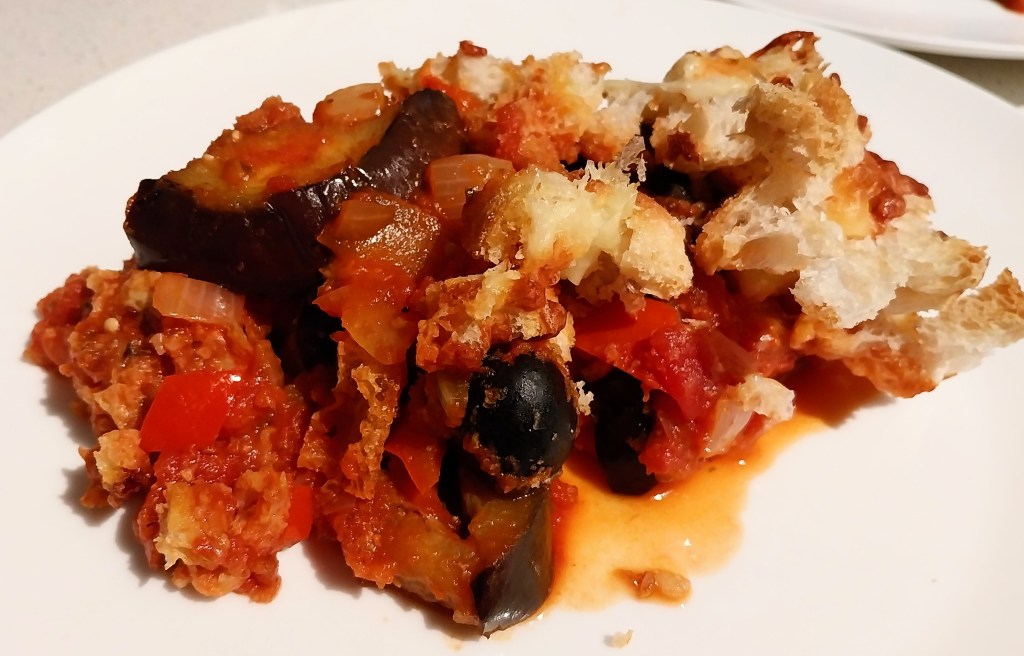
Influenced by our stay in the Blue Mountains, I was keen to create my own version of the Eggplant Parmigiana dish I enjoyed there (and which you can see a photo of by following the above link).

Parmigiana is eaten widely in bars and cafes in Australia. There are various ways in which it is served, probably the most common being as a topping over a fried chicken breast, sometimes flattened as per a schnitzel. Based on an Italian pasta sauce recipe (brought here long ago by some of the many European settlers who have made Australia their home), it isn’t difficult to see why it’s so popular, being tasty and filling.

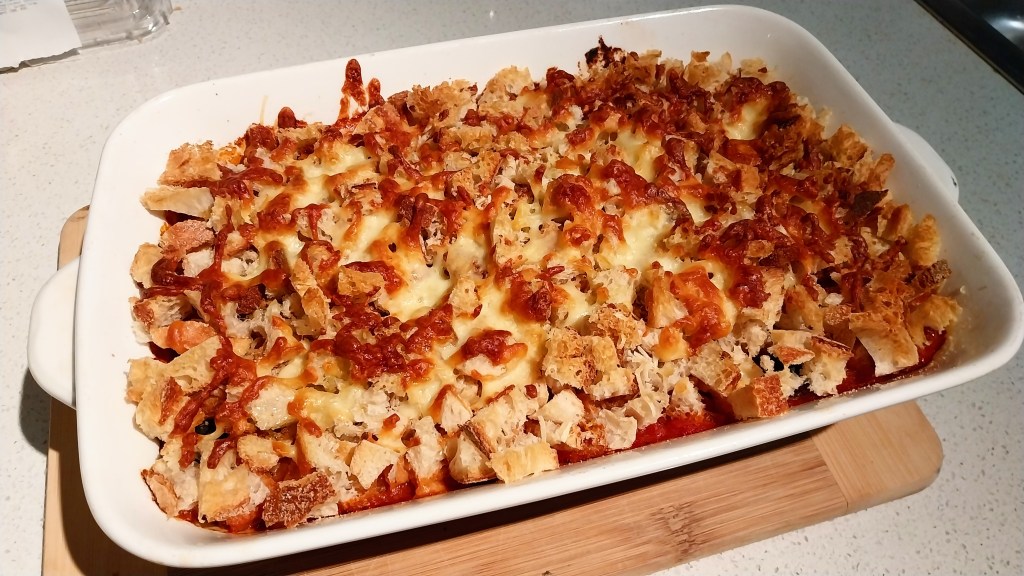
I’ve made a few changes in mine from the vegetarian version I ate in Leura: rather than serving crusty bread alongside, I have broken the bread down into croutons, mixing these with the parmesan and mozzarella to give it a crispy, toasted cheesy topping. I’ve also added black olives, which I always think go really well with a rich tomato sauce.

I’m respecting the Aussie lingo in this recipe, so stick with me as I talk about eggplant (a.k.a. aubergine) and capsicum (a.k.a. red pepper). No worries, mate.

Timings

20 mins to prepare, 30 mins in the oven at 180C.

Servings

4 adult servings.

You Will Need

  • 2 eggplants (aubergines)
  • 1 large onion
  • 1 capsicum (red pepper)
  • 2 tbsp oil, with more to drizzle
  • 1 garlic clove
  • 500g tomato passata
  • 16 – 18 pitted black olives
  • sprinkling of dried mixed herbs
  • a few twists of black pepper
  • about 1/3 of a crusty baguette
  • 50g grated parmesan cheese
  • 50g grated mozzarella cheese

Method

  1. Switch on the oven to warm up to 180C. Find a shallow casserole dish and set on one side for the moment.
  2. Cut the eggplants into diagonal slices, about 1cm thick. Fry for several minutes on each side in 1 tbsp of the oil, until softened.
  3. While the eggplants are cooking, warm the rest of the oil in another saucepan. Crush the garlic and chop the onion and capsicum, adding it all to the pan.
  4. After a few mins, pour in the passata and sprinkle in the mixed herbs and black pepper. Give it a good stir and let it simmer for about 5 – 10 mins.
  5. The eggplant slices should have softened by now. Scrape them into the tomato and veg sauce where they will continue to cook. Chuck in the olives.
  6. While you are making the sauce, you can also prepare the crouton topping. Cut the baguette into slices, and then cut each slice into roughly 1cm cubes. Put in a large bowl and sprinkle over the grated cheeses. Mix in with your hands so the cheese is nicely imtermingled with the bread.
  7. When the oven is up to temp, and the sauce is looking red and rich, it is time to assemble the parmigiana. Pour the sauce into the casserole dish, and sprinkle over the crouton topping. Drizzle a little oil over, and place in the heated oven for 30 mins.
  8. Remove from the oven. It should be looking something like mine in the photo below, and is ready to serve.

Customise it!

Serve with some boiled or steamed green veg of your choice. Add another cheese if you want – some grated blue cheese would give it another interesting taste. Keep the parmesan though, as that’s what gives the dish its name. As ever, some fresh herbs would go well – I only had dried mixed herbs to hand when I made this.

This is me signing off from Down Under. Thank you Australia, you’ve been great, and left us with lots of wonderful new memories, many of which I have shared through my recent posts. We now have an appointment with a Qantas Boeing jet to Heathrow that will last all of 24 hours! See you in a few days, with a new post from back in Good Old Blighty (jet lag permitting 🙂 ).

I’ve loved discovering many new Aussie bands and adding them to the ADK Spotify Playlist. I’ve been especially impressed with These New South Whales, so here is another from them: Cholesterol Heart (God Bless Ya).