
For these past few days, the ADK Kitchen has been passed over to my wife, Lesley, for the making of some Seville Orange Marmalade. I do, of course, have a vested interest in this, as I shall be scoffing a fair amount of it spread on toast for breakfast over the coming months (starting today, in fact – see my main photo above). Over to Lesley to explain…….
This time of year we have Seville oranges in our shops – the only time in the year when they are in season. Grown in Spain, their bitter taste and high pectin content makes the ideal marmalade – a traditional and uniquely tangy breakfast treat. I have vivid memories of my parents making jars and jars of this when I was little. It involved a major kitchen takeover at the time.
I set out to recreate it in the modern day, based on a recipe from Riverford. I was interested to see if the kitchen equipment available in the 2020s made the process any different from how it was in the 1970s. I found that using an electric slow cooker and a normal saucepan, I didn’t have to patiently keep watch over a large, boiling preserving pan for several hours, as my parents had done!
To ease on storage, I wanted to make just a couple of 1lb jars, rather than enough to last a full year – see the photo below.
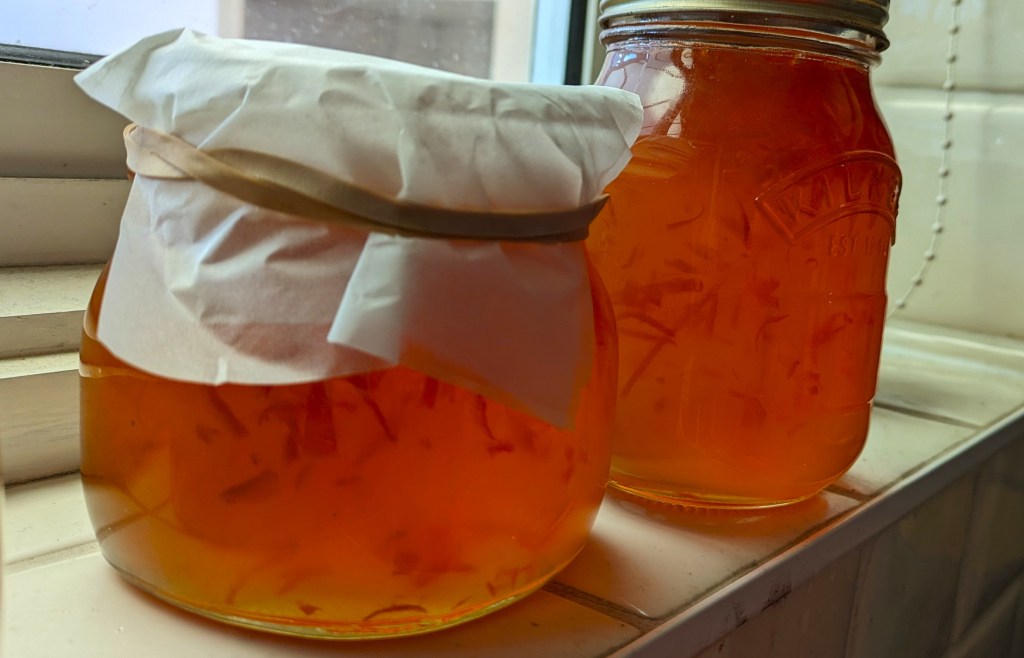
The remaining oranges in the pack have been prepped and stored in the freezer, so that I can make another batch during the year, as a special treat when the oranges are no longer in season.
Servings
This makes 2 1lb jars (or 400 – 450ml each jar).
Timings
The first stage, in the slow cooker, takes 8 hours. The second stage takes 1 hour on the hob. Then allow 24 hours to cool and set.
You Will Need
- a slow cooker with bowl of 3l capacity
- 7 or 8 seville oranges (750g)
- 1 lemon
- 900ml cold water
- 1kg granulated sugar
- muslin cloth and string
- 2 sterilised marmalade or jam jars to reuse
Method
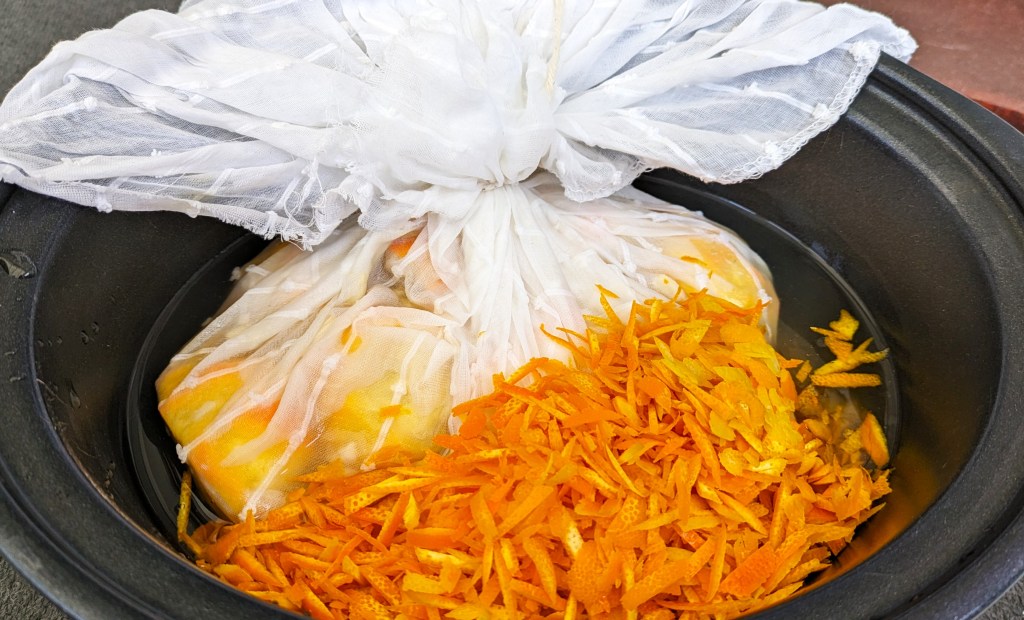
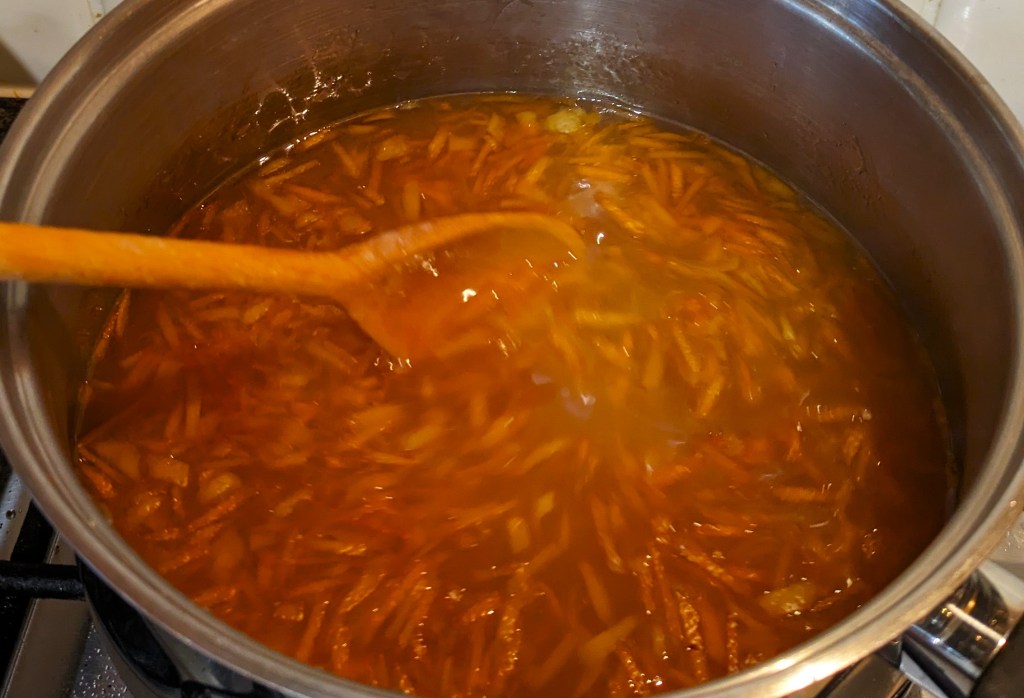
Here are some photos I took as I went along. Instructions follow, below.
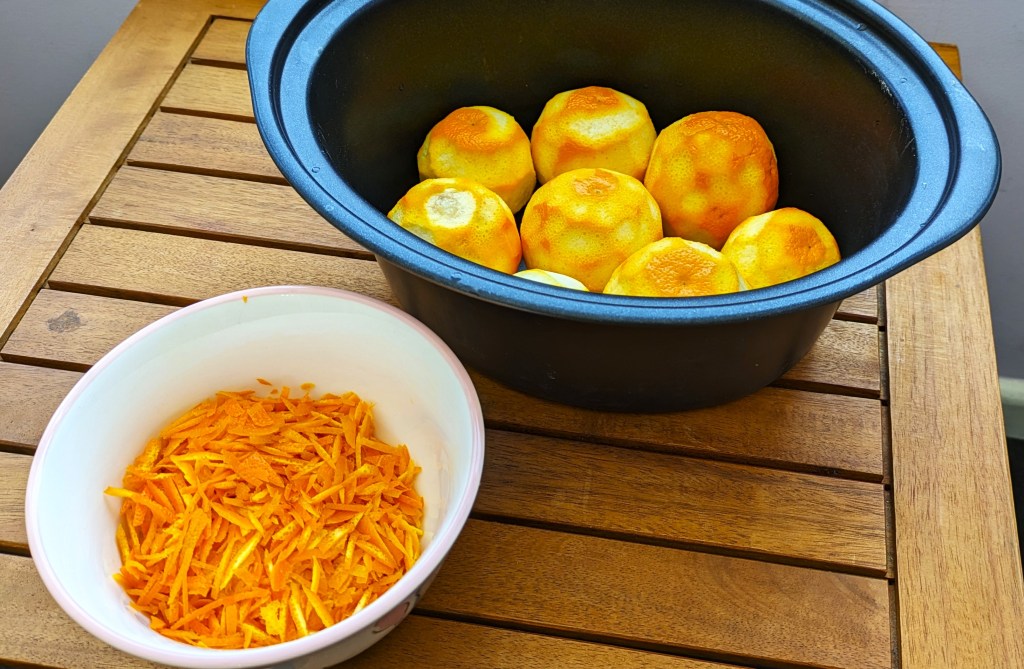
- Wash the oranges, and peel with a veg peeler. Chop the peel into shreds of the width that you like to have in your marmalade, whether fine or thick.
- Chop all the oranges and the lemon in half. Squeeze the juice from each into a bowl.
- Once the juice has been extracted, wrap the squeezed halves in the muslin cloth (I had a clean muslin curtain I had cut up) and scoop it up to make a bag of a size that will fit into your slow cooker bowl. Tie it around the neck with string.
- Put the juice, shreds and water into the slow cooker bowl. Place the muslin bag of fruit in the bowl with the neck of it draped over the side of it, held down by the lid (see photo).
- Cook for at least 8 hours on the high setting.
- 8 hours later, switch the slow cooker off and let it cool. Once cool, squeeze the rich pulpy residue, that has formed in the muslin bag, into the slow cooker bowl getting out all the lovely sticky juices formed from the pith, pips and pulp.
- Transfer the lovely orange scented juice to a normal saucepan, via a measuring jug, and place on the hob for the final high heat stage. I don’t think the slow cooker can achieve the fast boil you need for this. Add 450g of sugar for every 500ml of liquid. Begin with a low heat under the saucepan, and stir with a wooden spoon to dissolve the sugar so it doesn’t catch. You then increase the heat to a rolling boil once the sugar is dissolved – mine needed about 10 mins.
- Take a teaspoonful of the liquid and set it on a cold plate, gently pushing on it with the back of the spoon. If it wrinkles, it means the marmalade is at its setting point, which is what you are aiming for. If it isn’t wrinkling, test again (and again if necessary) every few minutes, until the wrinkling point is reached – this means it will set and be spreadable.
- Immediately remove from the heat and leave to stand for 15 mins. This short cooling time will mean the shreds will be evenly distributed in the jar and not all rise to the top.
- Taking care, spoon or pour the hot liquid into the sterilised jars, and screw on the lids (if you don’t have lids, use a piece of greaseproof paper cut into a circle on the surface of the marmalade, and another piece held on by an elastic band). Leave to cool until the next day.
- Open the jar at breakfast time, spreading the marmalade on toast with some butter and take in that orangey scent.
Thank you Lesley. I’ve just made a fresh pot of tea and popped another slice of harvest grain in the toaster. Lesley’s choice of track for the ADK playlist is very apt – Labelle with Lady Marmalade.
 A Different Kitchen