Categories
Breakfast Recipes

Spiced Port & Cranberry Compote

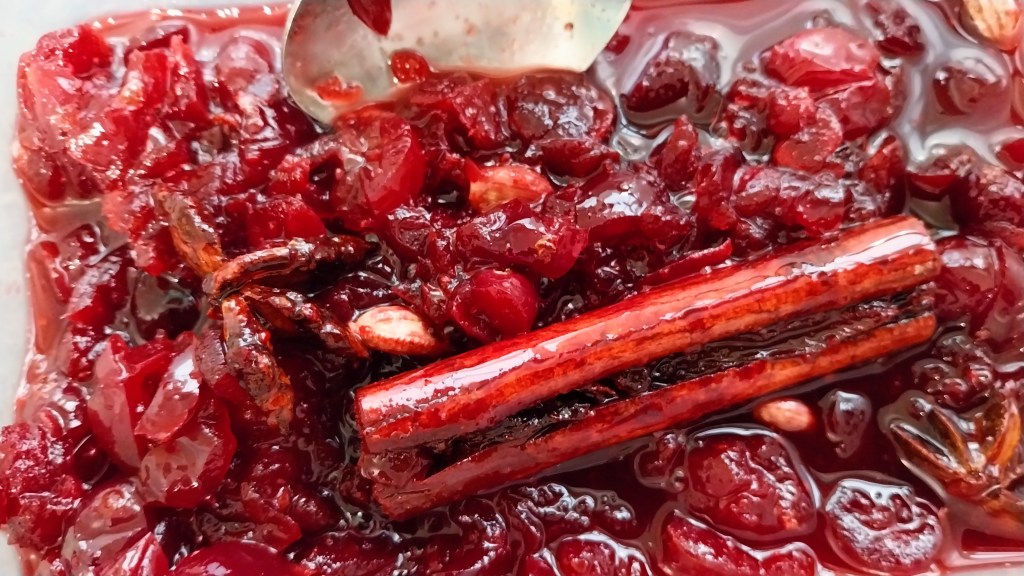
It’s nearly Christmas, and today I’m sharing the fruity breakfast topper I’ve made to last the family over the holidays. It’s made with fresh cranberries, oranges, sugar and spices, and comes with a heavenly taste and fragrance that’s sure to conjure up a festive mood. It is designed for spooning over muesli, or stirring in to porridge.

Christmas on a spoon!

The compote contains a glass of Port. Well, we wouldn’t want you to lose out on those healthy polyphenols over the holiday period now, would we?

Servings

You should get about 8 – 10 servings from this.

Timings

10 mins to prepare, 20 mins to boil/simmer.

You Will Need

  • 250g fresh cranberries
  • zest and juice of 2 oranges
  • 1 glass of Port
  • 75g light brown sugar
  • 1 cinnamon stick
  • 3 star anise
  • 5 cardamom pods

Method

  1. Put all the ingredients in a saucepan and bring to the boil. Reduce to a simmer and leave for 20 mins to reduce/thicken.
  2. Er, that’s it. Leave to cool and keep in the fridge, then stir a dessert spoonful in to a bowl of muesli and greek yoghurt, as shown in the photo above. It is also great stirred in to warm porridge.
  3. You can leave in the spices, as they will continue to flavour the compote. The cinnamon and star anise mustn’t be eaten, however, so be sure to pick around them when you are filling your spoon.
Customise It!

The first time I made this, I used a glass of sherry instead of the Port and it was fine. Feel free to swap in your favourite tipple of choice, or leave it out if you prefer.

It has to be a Christmas track this week for the ADK Playlist. If you are looking for some quality festive listening that’s a little different from the fare commonly served up in shops and on commercial radio, check out Tracey Thorn’s 2012 album, Tinsel and Lights. Here’s a lovely track from it called Like A Snowman.

Have a great Christmas everyone. See you back here next week for another serving of kitchen fun and madness.


Categories
Blog Breakfast

Solstice at Stonehenge

Fancy an online breakfast watching the sun rise over Stonehenge on the Winter Solstice this Friday? Read on.

We’re approaching that time of the year when those of us here in the northern hemisphere experience the shortest day. The Winter Solstice is a special time at Stonehenge, which I visited during my recent motorhome trip to England’s west country.

Now a World Heritage Site, Stonehenge is a very mysterious place. Historians still do not fully know how or why our Neolithic ancestors built this grand arena of standing stones some 5,000 years ago, when tools were primitive and scientific knowledge rare. However, the stone circle manages to correctly align with the movement of the sun at two key points in the year, every year – sunrise on the Summer Solstice, 21 June, and sunset on the Winter Solstice, 22 December.

The mystery has imbued the place with a magical significance. Coachloads of people from all over the world visit the stones every day of the year, to stand and gaze up in awe and wonder as to their original purpose (see my photo at the top of the post). And on the Solstice, many people make a pilgrimage here to witness the event for themselves.

To give a sense of the mystery, I took some photos of the scene under a turbulent, evolving sky. All of the shots in this post were taken within a span of around 15 mins, while I walked around the stones. A cold wind was whipping across the exposed landscape, the quality of light was changing, and the clouds gathered and churned. My final photo below shows how the scene can suddenly turn very dark and brooding. Quite an atmosphere.

This Friday, I’ll be settling down with a breakfast bowl of Brainfood to watch English Heritage’s free, live streaming of the sunrise from Stonehenge, here. Expect things to kick off after 7.00am, with the actual sunrise forecast for 8.09am. All times are GMT, so check the corresponding time for wherever you are in the world. North America, you may need to set an alarm!

Comments below will be open if anyone wishes to chat, while I’ll also be on my Twitter/X channel @differentkitch.

There aren’t many hippie artists on the ADK Playlist, but I think the nature of this post, and the time of year, justifies the addition of this track: Jethro Tull with Ring Out, Solstice Bells.

Categories
Bakes Recipes

Cranberry, Oat & Yoghurt Muffins

It’s that one time in the year when the UK’s lovely friends and allies over there in the US and Canada share with us your precious treasure of fresh cranberries. Thank you!

The rest of the year, we have to make do with jars of Ocean Spray Sauce. Not that I am complaining about that, though – they are a reliable addition to the winter dinner table. We also have dried cranberries, of the sort I used to make Cranberry & Pistachio Cookies, for example. However, none of these ever tastes quite the same as the fresh article.

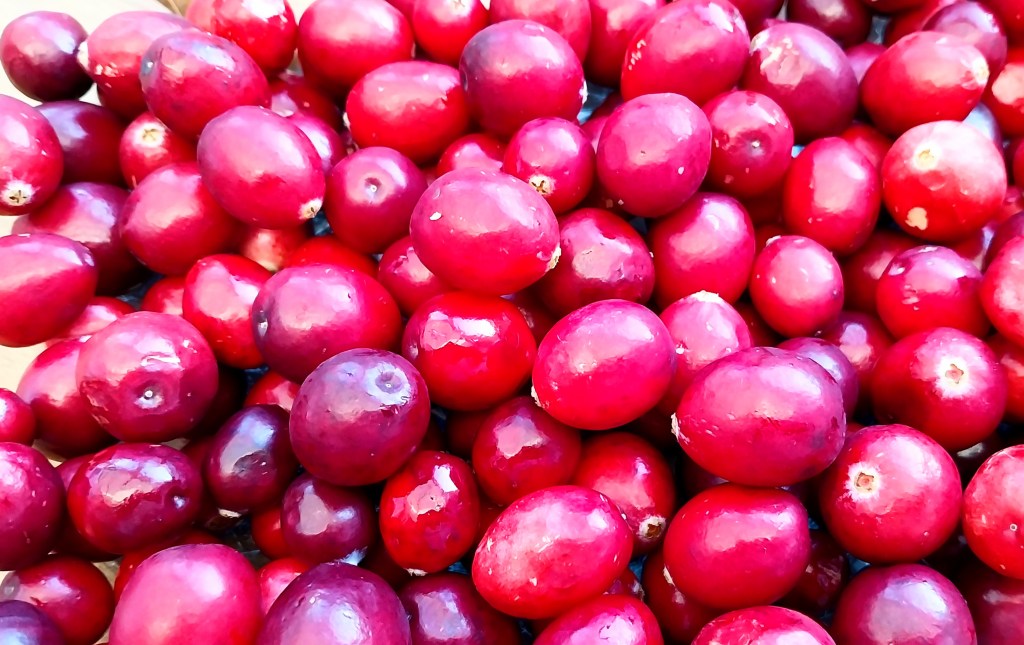
So how excited was I this week, when I saw packs of fresh cranberries imported from America, sitting there in Sainsbury’s fruit and veg section, nestling up alongside the blueberries. I quickly threw a couple of packs in the trolley and began making plans.

Here I am sharing with you my fresh cranberry, oat and yoghurt muffins – just follow the recipe below. I like these because they bring out the natural sourness in the berries, which we can’t usually taste as the processed varieties have been sweetened before they reach us. That sourness is enhanced by the bitterness of the yoghurt, while there is also a chewy, nutty bite in the rolled oats.

The light brown sugar provides a complementary sweetness in the cake mixture, making for an overall, pleasing blend of flavours on the tongue. What’s more, as the fresh cranberries burst with the baking, they infuse the muffin with juice that will keep the cake moist. Irresistible!

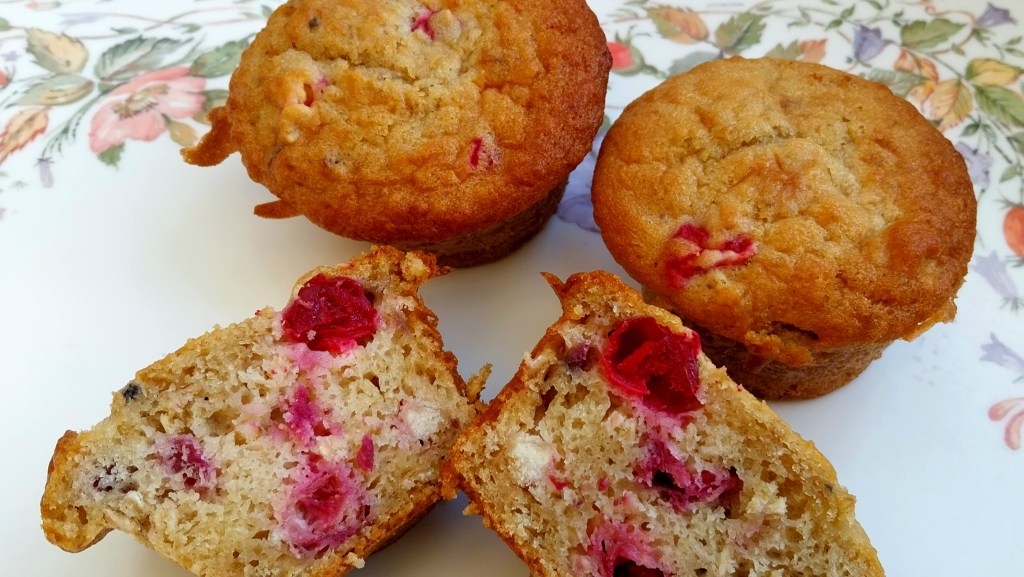
See my main photo above for the muffins, including one I cut in half to show the richness of the filling. A highly satisfying, healthy muffin to be enjoyed at breakfast, as a snack or a dessert.

So, to all our North American friends – as you can see, we are taking care of your special gift to us, and turning them into healthy, tasty treats. Please keep these little fellas coming!

Servings

This will make 12 muffins.

Timings

10 mins to prepare, 20 mins to bake at 180C.

You Will Need

  • 200g plain flour
  • 1 tsp baking powder
  • half tsp salt
  • 85g rolled oats
  • 140g natural yoghurt
  • 1 tsp bicarbonate of soda
  • 1 egg
  • 120g light brown sugar
  • 140g fresh cranberries
  • 90ml milk
  • 90ml veg oil

Method

  1. Switch on the oven to 180C. Prepare a muffin tray or mould.
  2. Sieve the flour, baking powder and salt into a bowl.
  3. Pulse the cranberries in a food processor with blade fitted, for a few seconds, 2 or 3 times. Light chopping will help them fully bake and soften in the muffins. Tip into the bowl of flour and stir so the fruit is coated.
  4. In a separate bowl, combine the oats with the yoghurt and bicarb. Leave for a couple of minutes, then stir in the egg and the sugar. Finally, stir in the milk and veg oil.
  5. When the oven is up to temp, combine the wet ingredients with the dry, and stir until no dry ingredients are visible. Spoon in to the muffin tray/mould, and place in the oven for 20 mins.
  6. When they are looking browned, as in my main photo above, remove to a wire rack to cool. Enjoy!

Customise It!

If I was making one change to this, I would swap in broken pieces of white chocolate for some of the cranberries, at a ratio of up to half and half. That also helps bring out the sweet and sour contrast.

There really can be only one band to accompany this post, so I’m adding this track to the ADK Playlist. Limerick’s own The Cranberries with Dreams.

Categories
Blog Breakfast

Brainfood

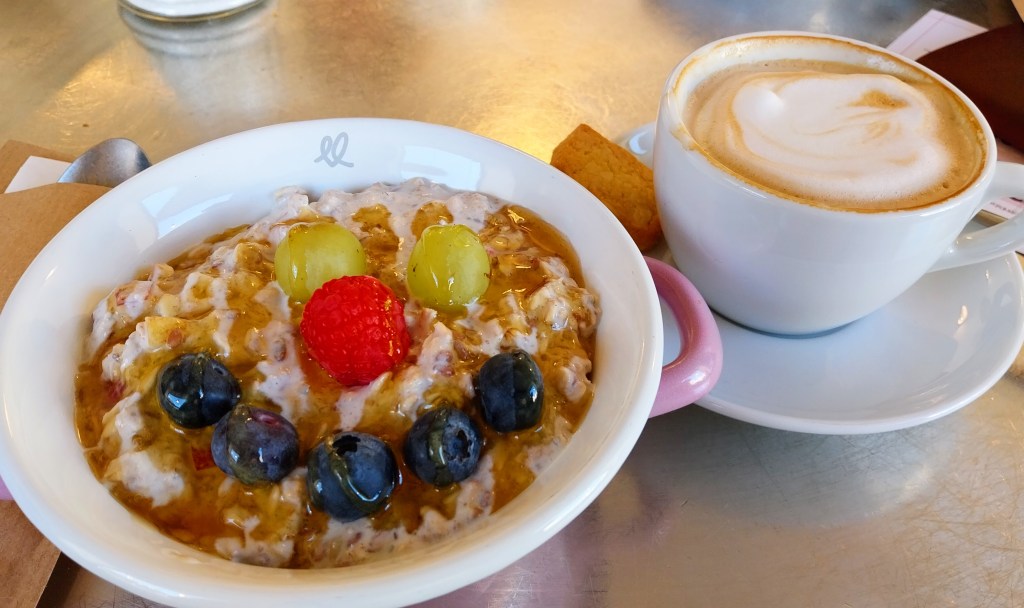
If there’s anything guaranteed to give your sense of wellness a morning boost, it’s a breakfast of genuine Bircher Muesli, served with a fresh fruit topping in the form of a smiley face 🙂

I’m due to catch a plane back to London shortly, after a thoroughly enjoyable stay in Ljubljana, Slovenia, and then Graz, Austria. I’ve enjoyed some great, tasty fare while here and, before leaving, wanted to find an authentic dish based around fruit and veg.

I’m pleased to say I found it on our final morning, with a party of 4 of us meeting for breakfast in a branch of Graz’s Martin Auer delis. Billed on the menu as Brainfood, it featured oatmeal, wheat, rye flakes and linseed that had been soaked overnight in natural yoghurt. Pieces of freshly chopped apple and nuts were then stirred through. Grapes, blueberries and a raspberry had been added to make the smiley face, and honey drizzled over.

The invention of Bircher Muesli is attributed to Swiss medic Maximilian Bircher-Brenner around 1900, when he put together a mix of oats, grains, seeds and fruit for his patients. These ingredients have various health benefits – oats contribute to lowering cholesterol, for example. The name of Brainfood is likely to stem from the dish being slow to digest, meaning one stays feeling fuller for longer. Hunger is therefore less of a distraction from accomplishing one’s daily tasks and challenges.

I certainly enjoyed it, alongside the cappuccino shown in my photo. I’ll be expecting now to easily conquer the killer sudoku I’ve saved to do on the flight home!

This is me signing off from Austria. It’s been a great trip, catching up with family and friends and sampling some authentic food and drink. My next post will be from back in the UK.

Hey, with my newly heightened intellectual faculties, I’ve just worked out that the word Brainstorm is only a couple of letters away from being Brianstorm. Regular readers will know that I need little excuse to feature the Arctic Monkeys on ADK. So here they are.

Auf Wiedersehen!

Categories
Blog Mains

Gösser und Gulasche!

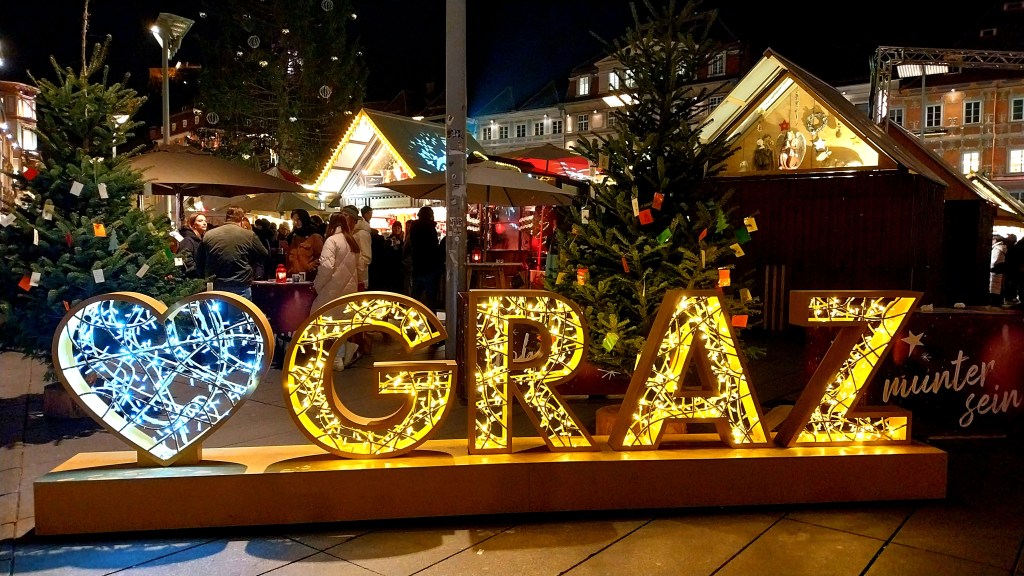
While here in Graz, we have moved indoors from the freezing, yet festive Christmas Markets (see Walk Out To Winter) for our next tasting of traditional Austrian food and drink. We are now at the Gösser Bräu, a long established beer hall and restaurant over towards the River Mur in the west of the city centre.

Originally the site of the Gösser brewery, it has been serving traditional Austrian fare since 1902, along with some terrific beers. The place has a warm, modern and stylish interior, but still carries the look and feel of a classic European, high-ceilinged beer hall, with the chink and clatter of glasses and echo of lively chatter from the bench tables, mainly occupied by large groups of friends.

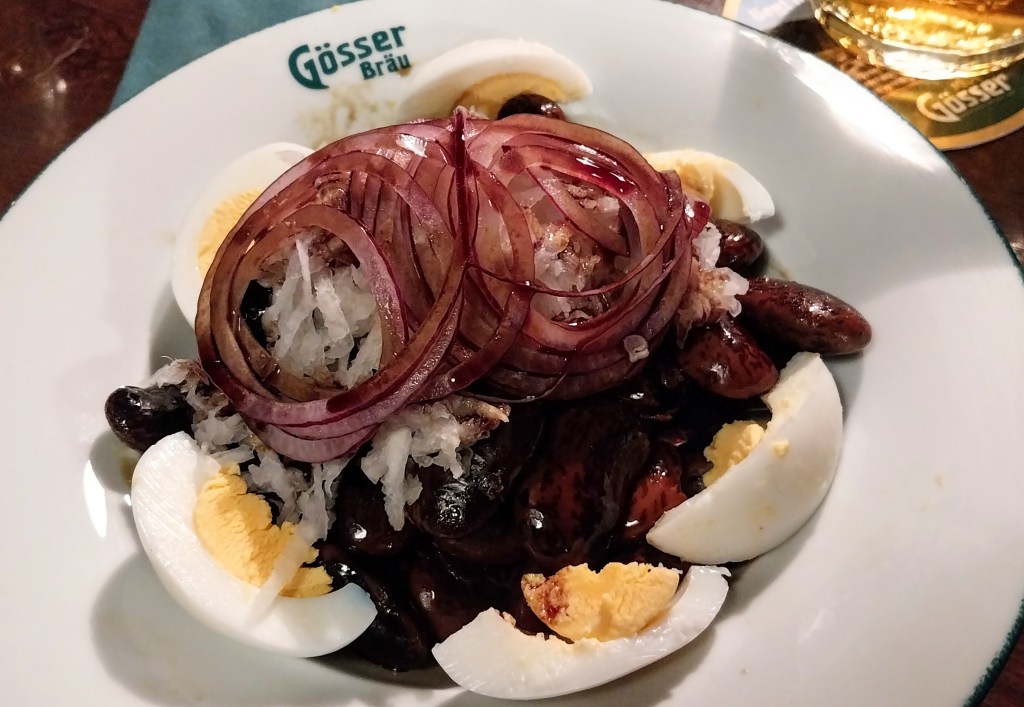
There were 6 hungry people in our party, all in search of some warming, filling and tasty rustic fare. My starter was a dish I have had before in Austria and really wanted to have again on this trip. It is Styrian Bean Salad, a regional speciality from this part of Austria. It consists of dark pulses the size of butter beans, tossed in green, nutty-tasting pumpkin seed oil. The salad is topped off with grated white radish, raw red onion rings and segments of hard boiled egg.

It was as delicious as I remembered it.

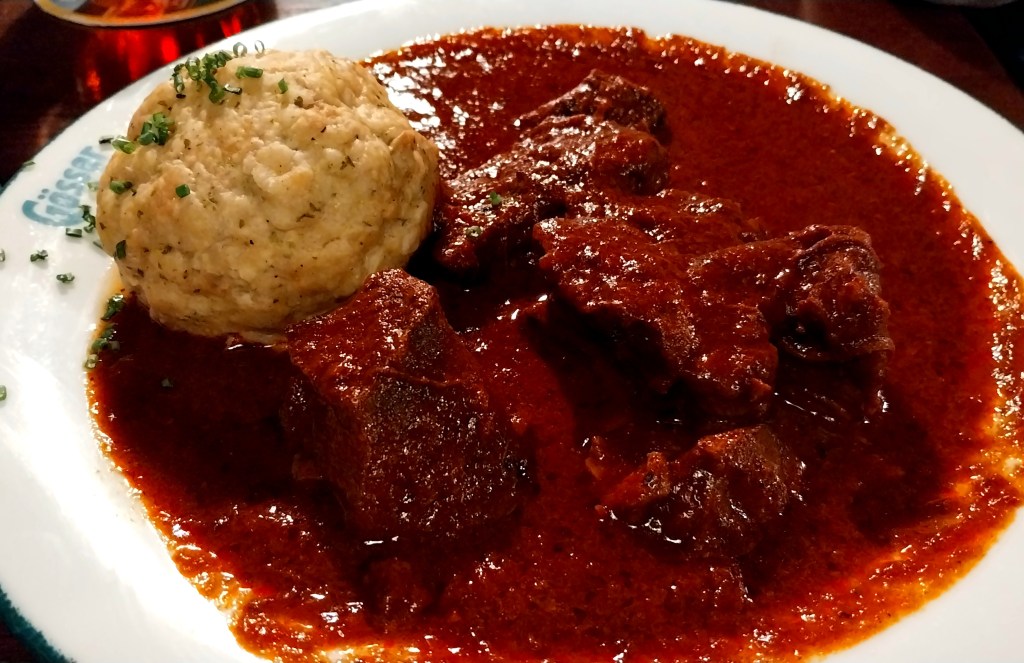
For mains, the Gulasche (or Goulash), was a popular choice with our group. It is shown in my main photo at the top of the post – a hearty dish comprising chunks of tender, slow cooked beef in a rich gravy, served with a Semmelknödel, a bread dumpling. I have only ever eaten dumpling on a very few occasions, and here it was skilfully prepared and cooked, with a mild herb flavouring. It held its shape when sliced and did a grand job soaking up the tasty gravy.

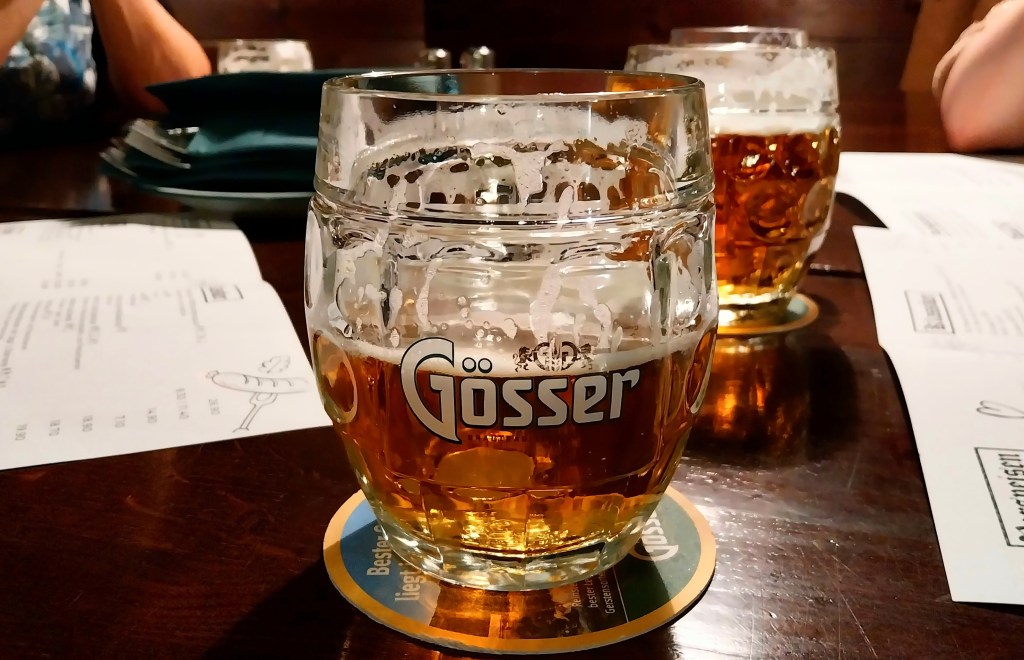
The beers are excellent. I chose the Bock beer that is brewed specially for Christmas and holiday occasions, having had a reliable recommendation on this (thank you, Kelvin!). It is a little stronger than their usual beer and packs a memorable, caramelish taste. I was enjoying it so much that, er, most of it had gone by the time I remembered to take a photo for the blog (whoops).

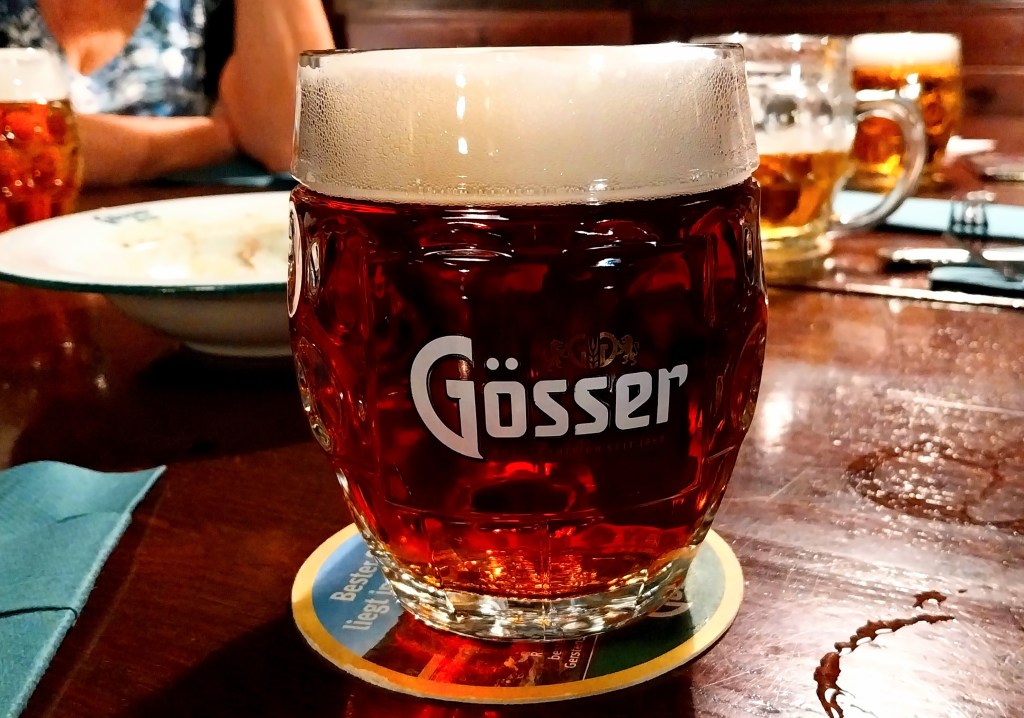
I noticed they were also serving a darker beer, so tried some of that. I liked the colour, which was somewhere between brown and ruby, and the thick foamy head. Predictably, the taste was maltier than the Bock.

Both made a really enjoyable accompaniment to the Goulash. It says a lot that everyone was sufficiently full to render a perusal of the dessert menu unnecessary.

My final challenge, before leaving Austria for home, is to find some traditional local fare that is oriented around fruit and veg. Tune in to my next post to see how that search goes.

In the meantime, with all this snow around in Austria, I can’t think of a better time to add a track to the ADK Playlist by these Scottish and Northern Irish alt-rockers. I saw them live at the time the album A Hundred Million Suns was released, and this is one of the many tracks I enjoyed. Here’s Snow Patrol with Engines.

Categories
Blog Snacks

Walk Out To Winter

After a fab few days in Slovenia, we have now arrived in a very chilly Austria, to meet up with a group of friends and family experiencing the Christmas Markets in the city of Graz.

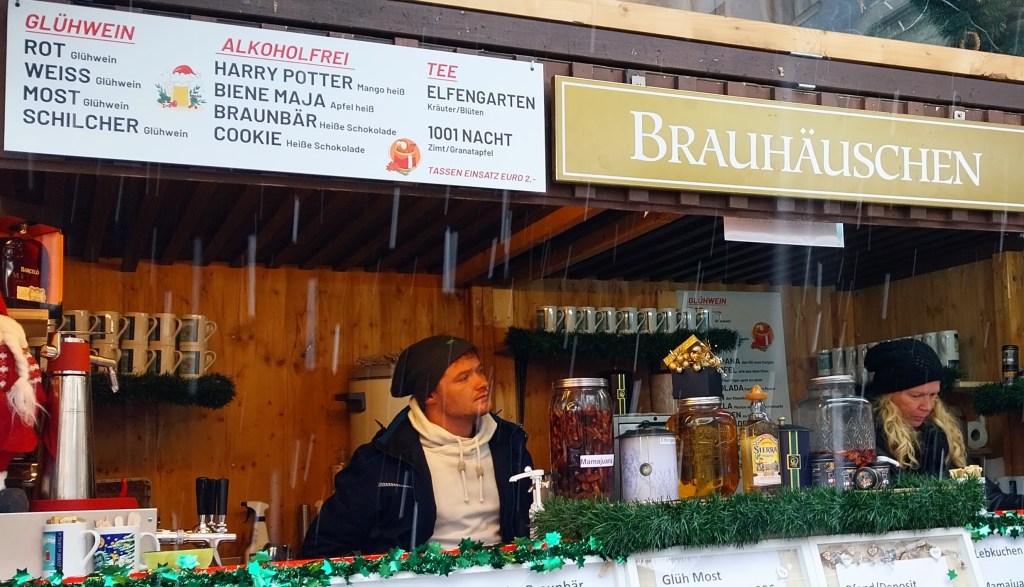
With the start of Advent, wooden chalet stalls have popped up all over the city’s main public squares, selling a range of hot drinks to help insulate visitors against the effects of the freezing cold. A typical range is shown in my photo below.

I tended to stick with the Rot Gluhwein – a ceramic mug of hot red wine flavoured with cinnamon, nutmeg and cloves – though there were also white and rose varieties available. The non-alcoholic offering included herbal and fruit teas, and the tantalisingly named Harry Potter – a hot mango punch.

I also enjoyed a hot chocolate, which was precisely that. I may have been expecting a mug of creamy cocoa, but what arrived had the volume and texture, no less, of a large, melted bar of dark chocolate in a cup. Needless to say, I had no trouble polishing that off.

The food options were simple, tasty and filling. Staples like Bratwurst (they really do love their sausages in this part of the world), or Kasekrainer (sausages with an inner lining of melted cheese), sizzled on the hot griddle in the chilly evening air – usually served up with a generous portion of Pommes (fries).

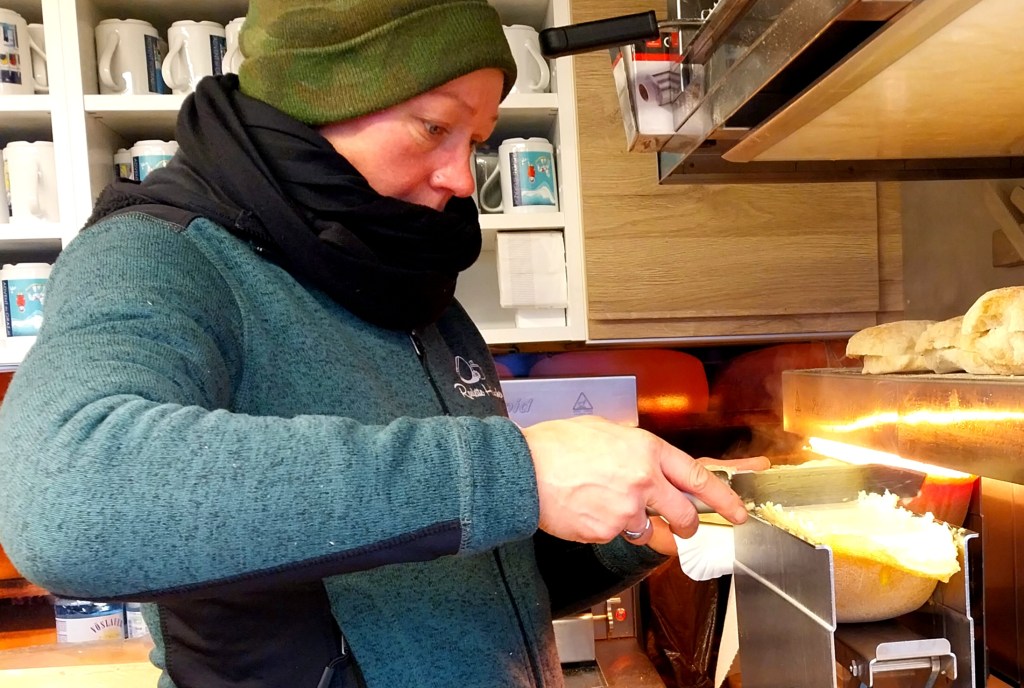
My favourite though was at the Racletthauschen. A log of Swiss Raclette cheese is placed under a flame until the top layer melts. The server then scrapes it off (see below) and spreads it on a slice of lightly toasted Ciabatta bread.

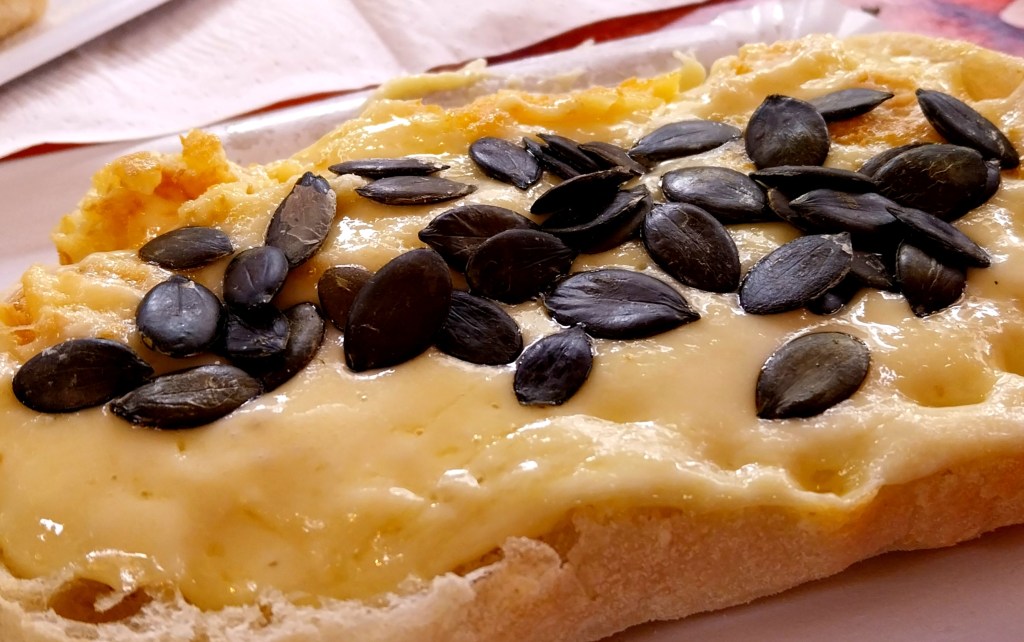
The choice of toppings included herbs, bacon lardons or prosciutto. I chose Kurbiskerne – roasted pumpkin seeds – adding a nutty crunch to the salty, melted cheese.

A delicious snack, washed down (of course) with another mug of Gluhwein.

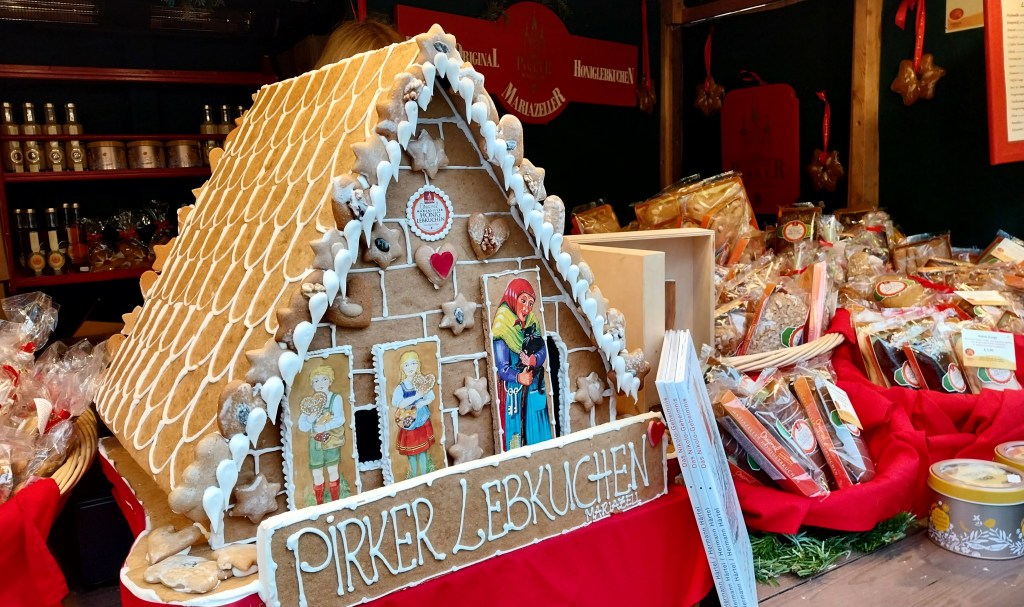
The Markets are delightful to stroll around, enjoying the sights, sounds and scents of the seasonal displays, such as the gingerbread, below…

The choice of colourful ceramic decorations for the Christmas tree is bewildering…

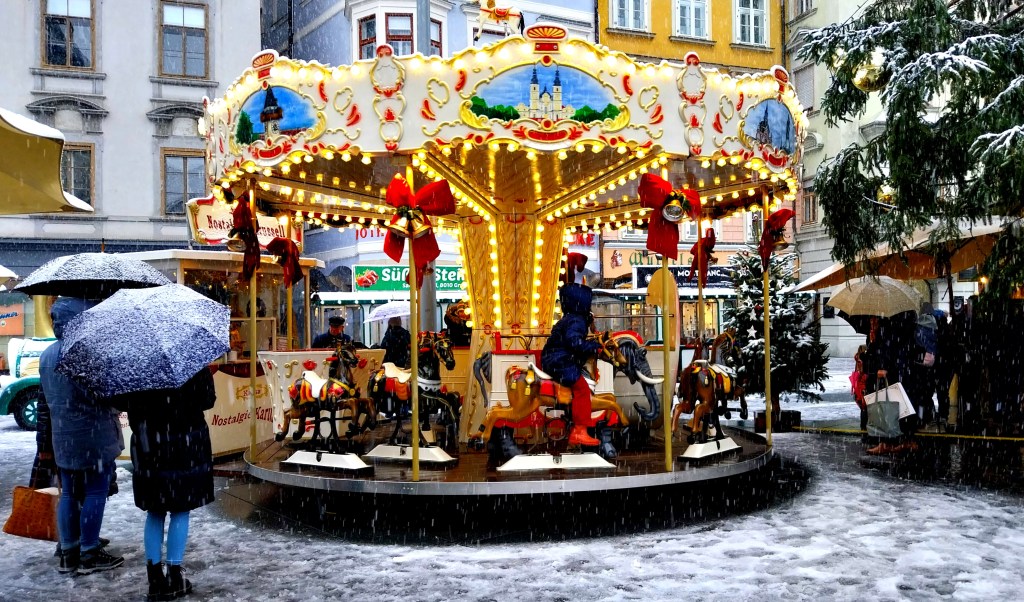
The Austrians make it an event for the whole family, as this old, classic European fairground attraction shows. The traditional waltz music emanating from the barrel organ made for a perfect soundtrack.

I have really enjoyed my visit to the Graz Christmas Markets. Although we have had ice and snow, and the temperature has remained around freezing point, in some strange way I did not actually feel the cold – a combination of warm clothes, ample Gluhwein, simple and satisfying hot food, the festive cheer of the surroundings, and the bonhomie of family and friends.

The Raclette experience has inspired me particularly – it never occurred to me before to sprinkle roasted pumpkin seeds on melted cheese for a tasty snack, but this is something I shall try to recreate at home in the ADK kitchen, whenever I have pangs of hunger. Maybe, to get the full authentic Austrian effect, I will even turn all the heating off, don my hat, scarf and gloves, and raise a tea cup of mulled wine in salute to the citizens of Graz. Prost!

Here are Aztec Camera with Walk Out To Winter.

Categories
Blog Mains

Sweet and Sauer

This is a meal which I always enjoy when I visit Central Europe, because they do it very well. So, while here in Ljubljana, classy capital of Slovenia, I just had to look for it on the menus of the local restaurants and bars.

We chose a local restaurant named after a Slovenian poet, Valentin Vodnik, immortalised in a statue at the Central Market nearby. The place specialises in Slovenian cuisine, and featured just the type of dish I was looking for on its menu.

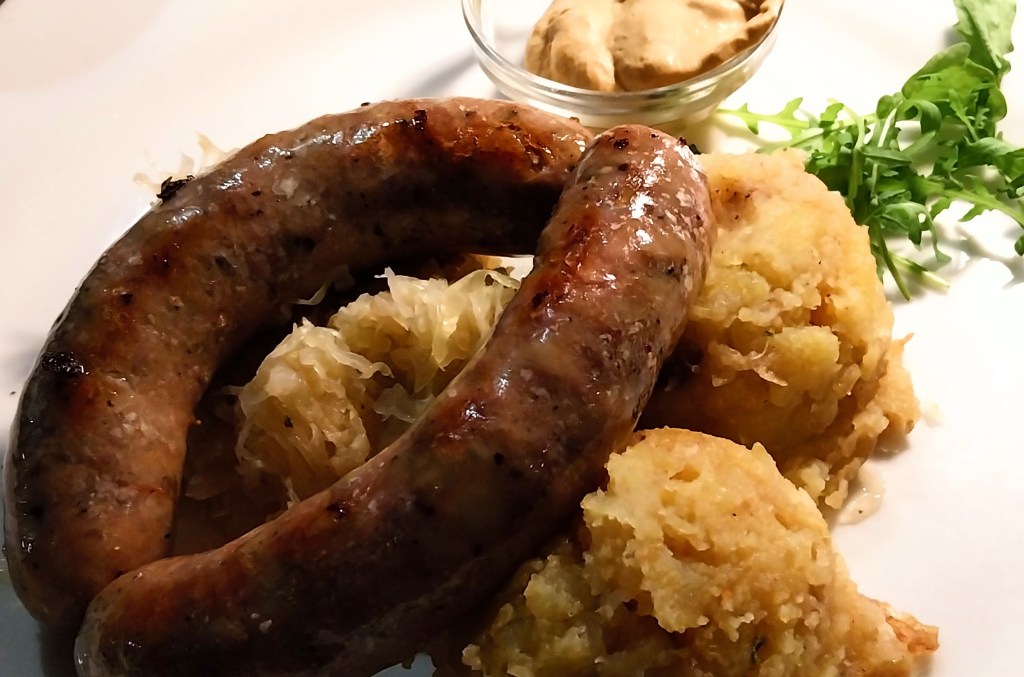
My meal is shown in the photo above. Two meaty, very traditional sausages served with sauerkraut. Sauerkraut is fermented, soured cabbage, and this serving was finely shredded and gently salted. In texture, it is not unlike the thin, fried onions that you might serve with a hot dog, but with a milder taste.

The sweet, to complement the sour, comes in the form of sweetened mustard, which I’ve found is a traditional accompaniment to sausage, or bratwurst, in Germany, Austria, Switzerland and, now, Slovenia.

The plate is completed with potatoes that, miraculously, somehow manage to be both roasted, yet served scooped and mashed (see my photo – don’t ask me how).

There is really only one choice of drink to accompany this meal, and that is a large glass of draft beer from local Slovenian brewer, Union. The glasses bear their name and their logo of the dragon, which is the city emblem of Ljubljana.

A wonder of a meal featuring local Slovenian cuisine, that I thoroughly enjoyed.

All this talk of sauerkraut has reminded me of a great track by this band. I will leave you with Portishead, and Sour Times.

Categories
Blog Desserts

Take It Slo

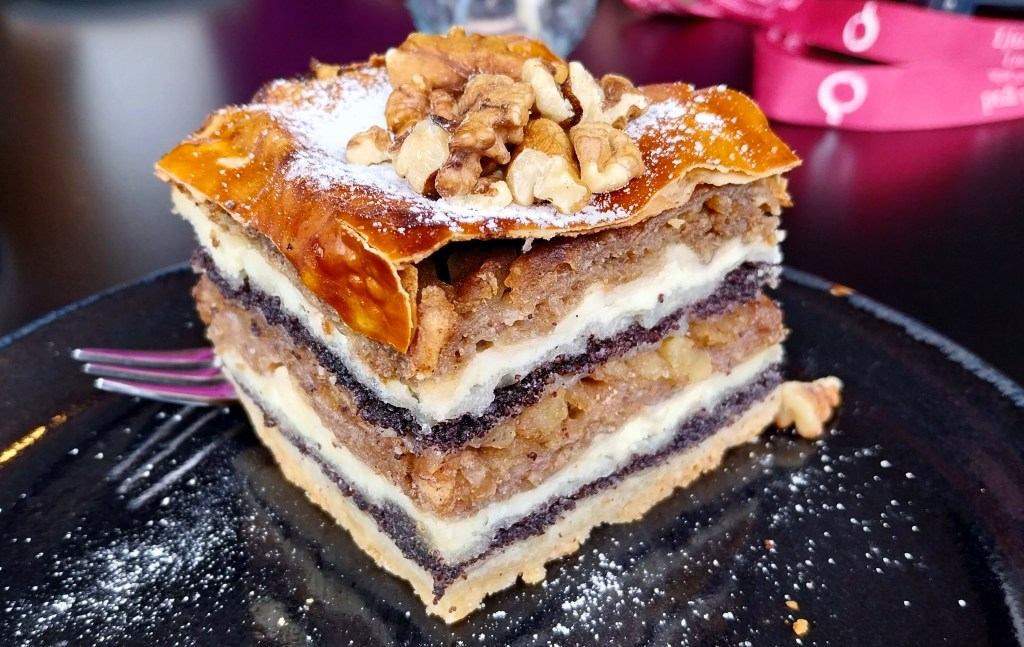
I am in Slovenia in Central Europe for a few days. I’ve been enjoying the Christmas market stalls and bars, and generally getting in the festive mood sampling delights like Gibanica, above.

For the benefit of those who may not know, Slovenia is a European country bordering Austria, Croatia, Hungary and Italy. It has been an independent state since 1991, following the break-up of the former Yugoslavia. Its capital, Ljubljana, is a compact and classy European city, with a medieval castle on a hill, an old town, cobbled squares and ornate bridges crossing a winding river. It is easy to walk around in a day, and can be reached in under three hours from London.

While here, it doesn’t take long to realise that the Slovenians really appreciate their regional food and drink. Gibanica, shown in my main photo above, is a traditional Slovenian cake, made with alternating layers of pastry, spiced apple, cream cheese, poppy seeds and crushed nuts.

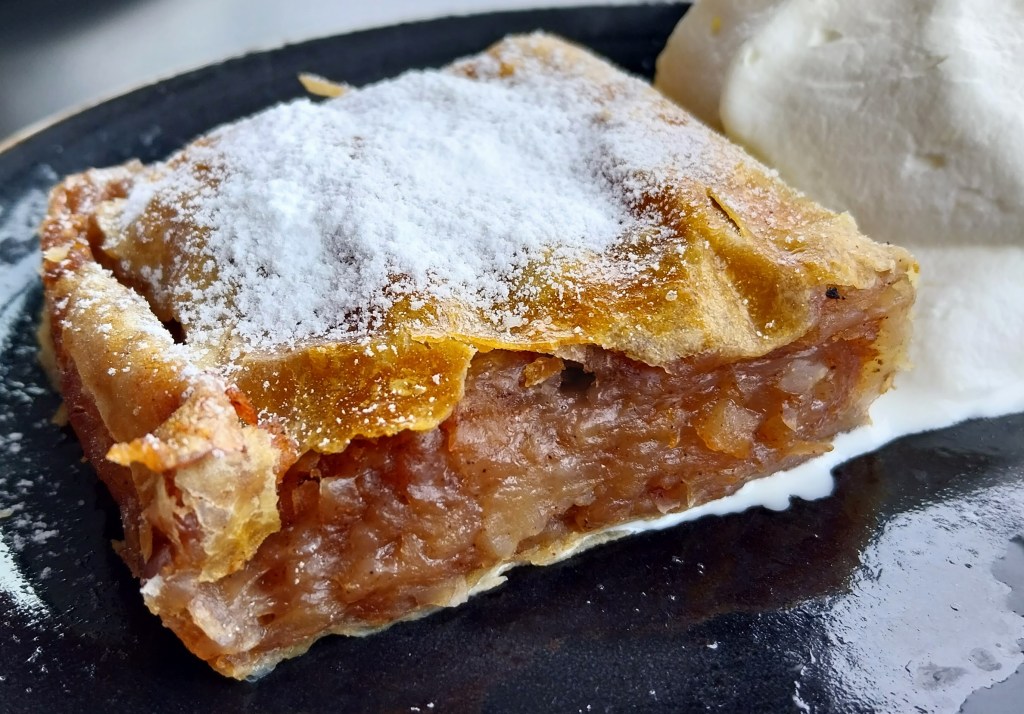
You can also be pretty sure that the Apple Strudel will be good quality – see the portion I enjoyed below.

The cafe where we savoured these is in the courtyard of Ljubljana’s 14th Century Castle, now restored into a cultural centre with cinema, several museums, restaurants and shops. Perched on a hill, it has superb views for miles around. I climbed the many steps of the spiral staircase inside the ancient clock tower, not only to work off the Strudel, but to take advantage of the viewing platform at the top. I was rewarded with this view – the layer of morning cloud lifted to reveal the snowy peaks of the Alps to the north-west.

I expect there will be more to come from Ljubljana before moving on, so keep tuned for future posts.

In the meantime, I now know the answer to the question posed by the Black-Eyed Peas: Where Is the Love? Answer: It’s in sLOVEnia, of course!

Categories
Mains Recipes

Slow Cooked Beef and Stilton

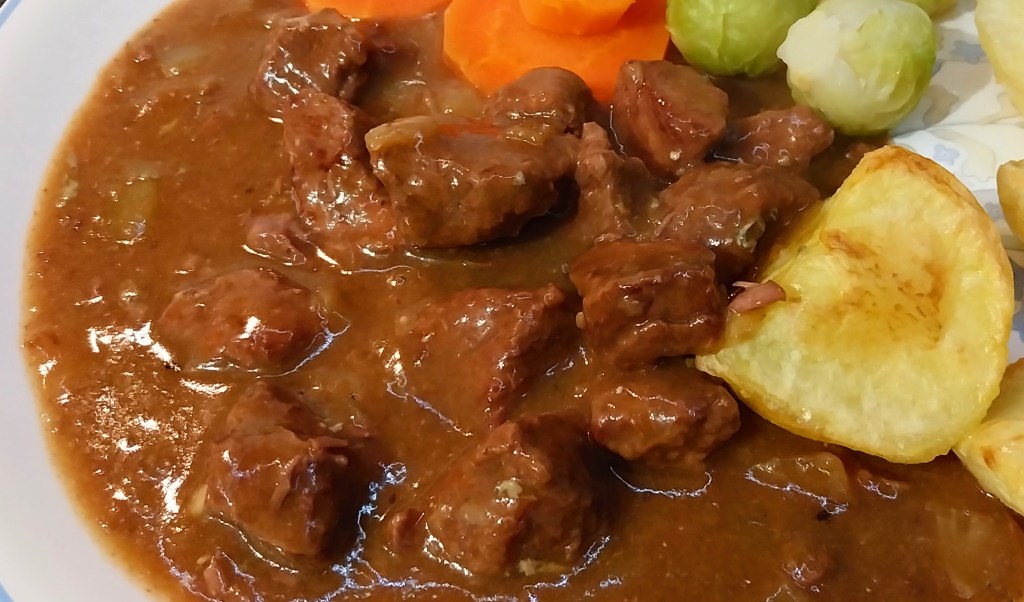
I first tasted the combination of beef and stilton cheese some years ago, as a hot filling in a Cornish Pasty. I thought the taste was divine and have been a fan ever since, enjoying it in casseroles as well as pies. Stilton adds a salty sharpness to the beef juices, making a rich and creamy gravy to coat and complement the tender and succulent beef.

What better dish to make, therefore, as the next in my slow cooker season.

Servings

6 adult servings, alongside your choice of veg.

Timings

20 mins to prepare, and 4 – 5 hours bubbling away in an electric slow cooker.

You Will Need

  • 700g braising beef, cut into chunks
  • a few spoonfuls of plain flour
  • salt and pepper
  • oil
  • 1 large onion
  • 1 clove garlic
  • 1 litre of beef stock
  • 1 large glass of red wine
  • 200g stilton cheese
  • some cornflour and tap water

Method

  1. Turn on the electric slow cooker to the high setting.
  2. Sprinkle the flour, salt and pepper on a dish, then roll the pieces of beef in it till they are coated all over.
  3. Warm some oil in a frying pan and fry the beef until the pieces are seared all over. Transfer to the slow cooker bowl.
  4. Crush the garlic clove and add to the remaining hot oil in the pan. Chop the onion and add also. Stir until softened, then add to the slow cooker bowl.
  5. Pour the stock and wine into the hot pan, and heat until it is bubbling. Pour over the beef and onions in the slow cooker bowl.
  6. Leave the slow cooker on high for around 30 mins, then reduce to the medium setting. Let it bubble away for 4 – 5 hours.
  7. Using a fork, pull out a piece of beef to check that it is cooked. It should be tender and flake apart when pressed with the fork.
  8. Cut the stilton into pieces and then crumble with your fingers into the slow cooker. Stir gently so that the pieces begin to melt into the gravy, thickening it as they go.
  9. If you wish to make the gravy thicker, mix up a couple of teaspoons of cornflour with the same amount of tap water, and stir to dissolve. Add into the gravy. You can repeat this again if necessary, to reach the thickness you desire.
  10. Serve with your choice of roasted, boiled or steamed veg. Mine in the photo is served with roast potatoes, boiled brussels sprouts and carrots.

Customise It!

If you wish, you can add veg directly into the slow cooker, and they will take on the flavours of the beef gravy as they cook. Root veg, such as carrots, swede, parsnips and celeriac will work well. You could also serve the dish with rice instead of roast potatoes, to soak up all that rich, stilton sauce.

Don’t worry if you do not have an electric slow cooker. You can use a casserole dish instead, and cook it in the oven. Start off with the oven at 180C, then reduce it to 160C at step 6 above.

It’s getting to that time when I receive my playlist from Spotify with all my most-played tracks of the year. This is one that will almost certainly feature, as I’ve listened to it many times. It’s by New York band Yeah Yeah Yeahs: Heads Will Roll.

Categories
Bakes Recipes

Fruity Coconut Flapjack

I enjoy the flavour of toasted oats in baking. I brought a bag of medium oatmeal back from my recent trip to Scotland, and used it to make the flapjacks shown in my photo above.

They are based on a recipe by Paul Hollywood, of Great British Bake-Off fame, and combine the oatmeal, which is quite finely ground, with rolled oats. The theory is that the two different thicknesses of oat adds chewiness. It also helps the flapjack mixture meld together, rather than descending into a collection of crumbly clusters, as flapjacks sometimes have a tendency to do.

Most importantly, they taste great, the golden brown oats mixing in with coconut, ground almonds, raisins and cranberries.

Servings

Makes 16 square flapjacks.

Timings

15 mins to prepare, 25 mins to bake at 180C.

You Will Need

  • 150g medium oatmeal
  • 150g rolled oats
  • 50g desiccated coconut
  • 50g ground almonds
  • 50g dried raisins and cranberries
  • 200g baking spread
  • 75g caster sugar
  • 160g golden syrup

Method

  1. Grease and line a baking tin – the one I used is 20 cm square. Turn on the oven to 180C.
  2. In a bowl, mix together both varieties of oats with the almonds, coconut and dried fruit.
  3. Put the spread, sugar and syrup in a saucepan and warm on the hob until it has dissolved into a sweet, sticky sludge. Pour into the bowl of oats and mix well, till there are no dry ingredients showing.
  4. Scrape into the prepared tin and level the surface. Bake in the oven for 25 mins.
  5. Remove from the oven – the top should be golden and there should be signs of toasting at the edges. Leave to cool in the tin.
  6. While it is cooling, cut with a sharp knife into 16 squares, while still in the tin. When completely cool, you can then lift out each square to serve.

Customise It!

Add other dried fruit, like chopped apricots, in place of some of the raisins and cranberries, or possibly also some ground toasted nuts or seeds. Don’t add more than the overall quantity of 50g however, otherwise the mixture will be more prone to crumble apart.

I said I’d feature a track by The Chats, the Australian punk trio I saw supporting Queens of the Stone Age last week. They are a lot of fun and don’t take themselves that seriously – a cartoon-like Aussie punk version of The Monkees. Check out some of their videos on You Tube. Here they are with Smoko.