Categories
Mains Recipes

Vietnamese Rice Soldiers

I first came across Vietnamese Rice Soldiers on my travels to Australia, where there is a varied range of Asian cuisine and the quality is high.

Initially I thought they were uncooked sausages when I saw them in a deli takeaway. I soon learned that in fact they contain a mix of finely chopped protein, veg, herbs or spices, with rice or noodles, all wrapped up in a piece of transparent, edible rice paper. They are eaten cold as finger food, with a sauce for dipping, and usually accompanied by a stir fry side or noodles.

I sampled them in a restaurant in Little Vietnam, the name given locally to Victoria Street in Melbourne, and immediately became a fan! I brought home a pack of rice papers and am now able to make my own at home. Here is a photo of my latest batch:
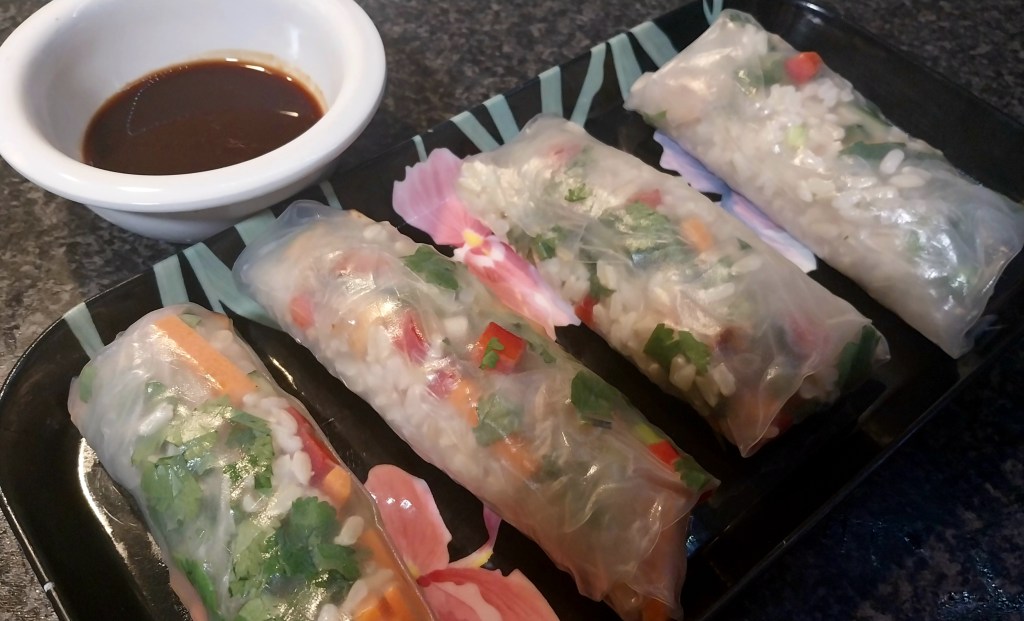
A pack of rice papers is essential if you want to give these a try. I bought mine (below) in Aussie supermarket chain, Coles. Availability will depend on where you are in the world, but in the UK I have seen some smaller packs in M&S. The best bet may be a specialist Asian food store or online.
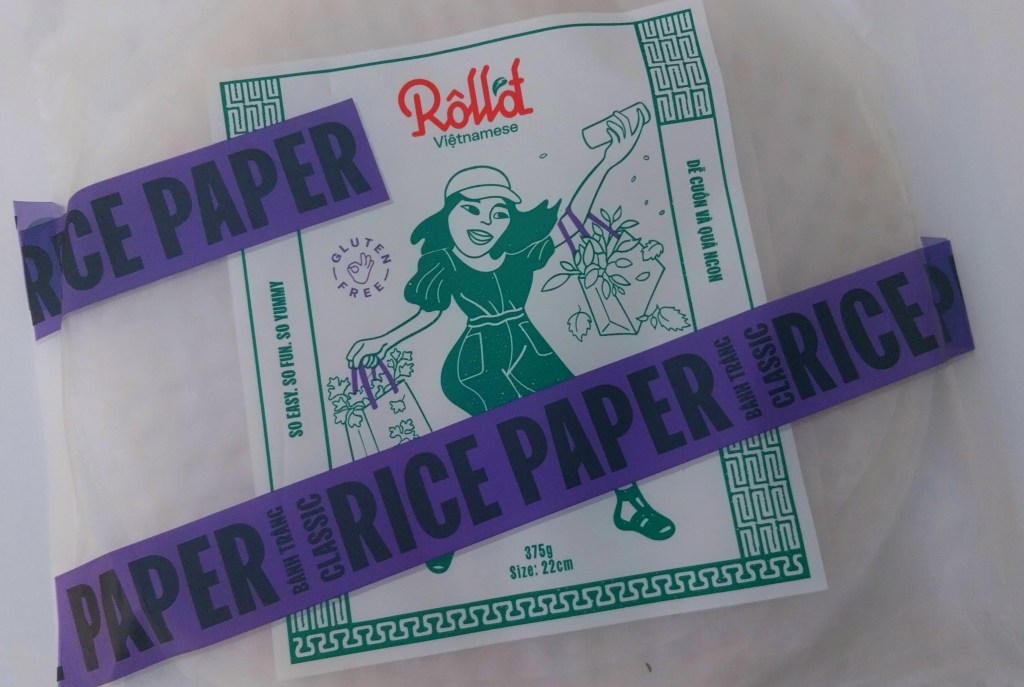
They are made from simply flour, salt and water, requiring just some fresh, lukewarm water to rehydrate and make them soft and flexible.

Servings

This made 8 soldiers. At 2 per serving, that makes 4 adult portions.

Timings

30 mins to chop and prepare the filling. Rolling up takes seconds. The soldiers can be made up in advance and kept in the fridge for a day or two.

You Will Need:

  • 8 circular rice papers
  • a shallow dish filled half with just boiled water, and half with water cold from the tap (so that overall the water is lukewarm, around 50C)

    For the filling:
  • 120g boiled rice, cooled
  • 1 marinaded chicken breast, cooled
  • 1 carrot
  • around 10cm length of cucumber
  • 2 – 3 scallions/spring onions
  • half a red pepper
  • small bunch of coriander/cilantro

    For the dipping sauce
  • 2 tbsp chilli paste
  • 1 tbsp each of soya sauce, rice vinegar, honey and orange juice
  • a good squidge of tomato passata.

Method

  1. Chop the carrot and cucumber into tiny little batons. Chop the other filling ingredients into small pieces and lay everything out on a board.
  2. Take one of the rice papers and submerge it in the lukewarm water. It will begin to soften and take on a slightly, sticky, stretchy feel. Lay it down on a chopping board and put a line of rice across the middle.
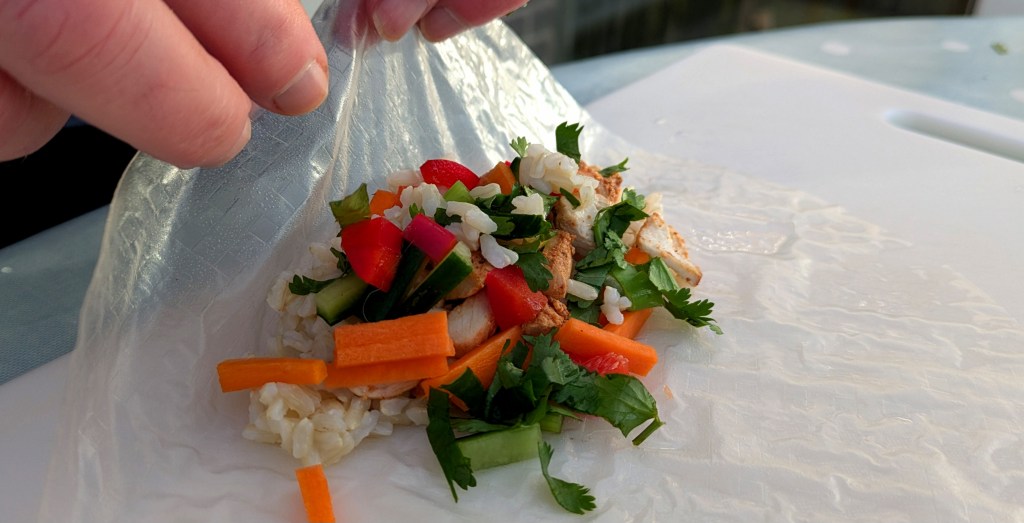
  3. Lay a line of chicken pieces on top of the rice, then follow with the carrot, cucumber, scallions, coriander and pepper. Use a little judgment here – you want the soldier to be well-filled but not overstacked.
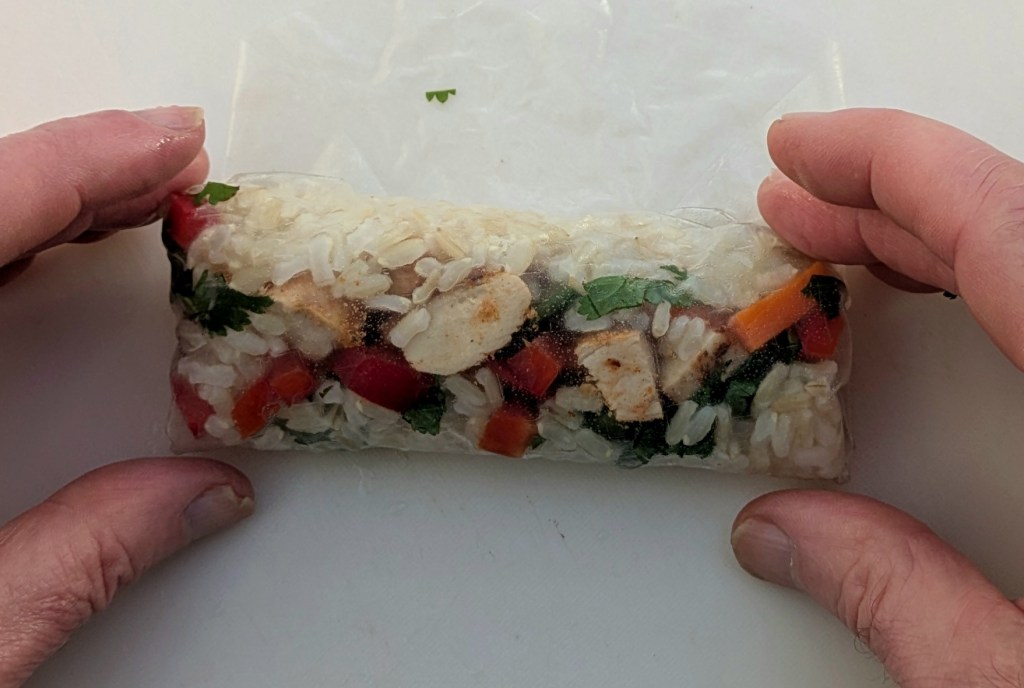
  4. Lift the flap of the rice paper nearest you and fold over the filling. Tuck in both sides, then roll the whole soldier forward until you have a sealed parcel. Check out my photos below, showing the rolling up in action! Set aside on a tray.
  5. Carry on until all the soldiers are made up.
  6. Put all the dipping sauce ingredients in a clean, screw top jar with lid on. Give it a good shake to combine, then pour into a serving bowl. The soldiers can be dipped into the sauce, or alternatively, once you’ve bitten off the top, spoon it on and let it drizzle down to mingle with the filling. Yum!
Customise It!

Vary the protein to include small pieces of fish, or use chopped cashews if you want to go vegan. A sprinkle of sesame seeds would be an excellent idea. Swap in fine, vermicelli noodles or bean shoots for the rice. Finely chopped root ginger, corn, celery are also options. As always on A Different Kitchen, use your imagination and go with the ingredients you like.

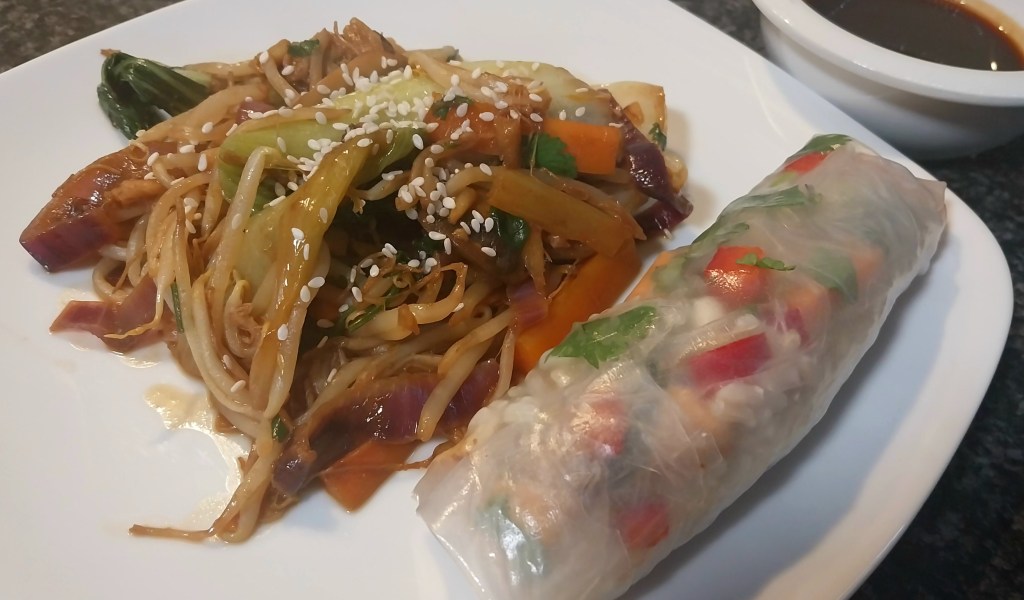
I served these with a side of stir fried bean shoots, pak choi, root ginger, garlic, red onion, carrot and mushroom topped with a sprinkling of sesame seeds (as shown in my main photo at the top of the post). For the stir fry sauce I simply made up more of the dipping sauce and poured that in. Hey – keep things simple!

It’s Superbowl weekend once more, and I am looking forward to staying up late this Sunday to watch the game. I can’t see any other outcome than the Kansas City Chiefs winning again, as they seem to be invincible when it comes to play-off season. Apologies to any Philly Eagles fans, but who knows, maybe you will surprise me?

Here’s a piece of classic Americana – Tom Petty with Running Down a Dream. Enjoy the Superbowl, everybody.
Categories
Mains Recipes

Eggplant Parmigiana

After several weeks on the road around Australia, the time has come to travel back to the UK. We have had a brilliant time. Thanks to every one of you who has followed my posts along the way – I hope you’ve enjoyed the food, the photos and the fun, along with some great new sounds. As my tagline says: Good Food, Great Music.

One of the things I am looking forward to is getting back in the kitchen and working on some new dishes, fully armed with the ideas and inspiration I’ve taken from the food we’ve enjoyed on our travels. I have actually had a first attempt this week, from the kitchen at our temporary home in Melbourne, to prepare a meal for some guests.

Influenced by our stay in the Blue Mountains, I was keen to create my own version of the Eggplant Parmigiana dish I enjoyed there (and which you can see a photo of by following the above link).

Parmigiana is eaten widely in bars and cafes in Australia. There are various ways in which it is served, probably the most common being as a topping over a fried chicken breast, sometimes flattened as per a schnitzel. Based on an Italian pasta sauce recipe (brought here long ago by some of the many European settlers who have made Australia their home), it isn’t difficult to see why it’s so popular, being tasty and filling.

I’ve made a few changes in mine from the vegetarian version I ate in Leura: rather than serving crusty bread alongside, I have broken the bread down into croutons, mixing these with the parmesan and mozzarella to give it a crispy, toasted cheesy topping. I’ve also added black olives, which I always think go really well with a rich tomato sauce.

I’m respecting the Aussie lingo in this recipe, so stick with me as I talk about eggplant (a.k.a. aubergine) and capsicum (a.k.a. red pepper). No worries, mate.

Timings

20 mins to prepare, 30 mins in the oven at 180C.

Servings

4 adult servings.

You Will Need

  • 2 eggplants (aubergines)
  • 1 large onion
  • 1 capsicum (red pepper)
  • 2 tbsp oil, with more to drizzle
  • 1 garlic clove
  • 500g tomato passata
  • 16 – 18 pitted black olives
  • sprinkling of dried mixed herbs
  • a few twists of black pepper
  • about 1/3 of a crusty baguette
  • 50g grated parmesan cheese
  • 50g grated mozzarella cheese

Method

  1. Switch on the oven to warm up to 180C. Find a shallow casserole dish and set on one side for the moment.
  2. Cut the eggplants into diagonal slices, about 1cm thick. Fry for several minutes on each side in 1 tbsp of the oil, until softened.
  3. While the eggplants are cooking, warm the rest of the oil in another saucepan. Crush the garlic and chop the onion and capsicum, adding it all to the pan.
  4. After a few mins, pour in the passata and sprinkle in the mixed herbs and black pepper. Give it a good stir and let it simmer for about 5 – 10 mins.
  5. The eggplant slices should have softened by now. Scrape them into the tomato and veg sauce where they will continue to cook. Chuck in the olives.
  6. While you are making the sauce, you can also prepare the crouton topping. Cut the baguette into slices, and then cut each slice into roughly 1cm cubes. Put in a large bowl and sprinkle over the grated cheeses. Mix in with your hands so the cheese is nicely imtermingled with the bread.
  7. When the oven is up to temp, and the sauce is looking red and rich, it is time to assemble the parmigiana. Pour the sauce into the casserole dish, and sprinkle over the crouton topping. Drizzle a little oil over, and place in the heated oven for 30 mins.
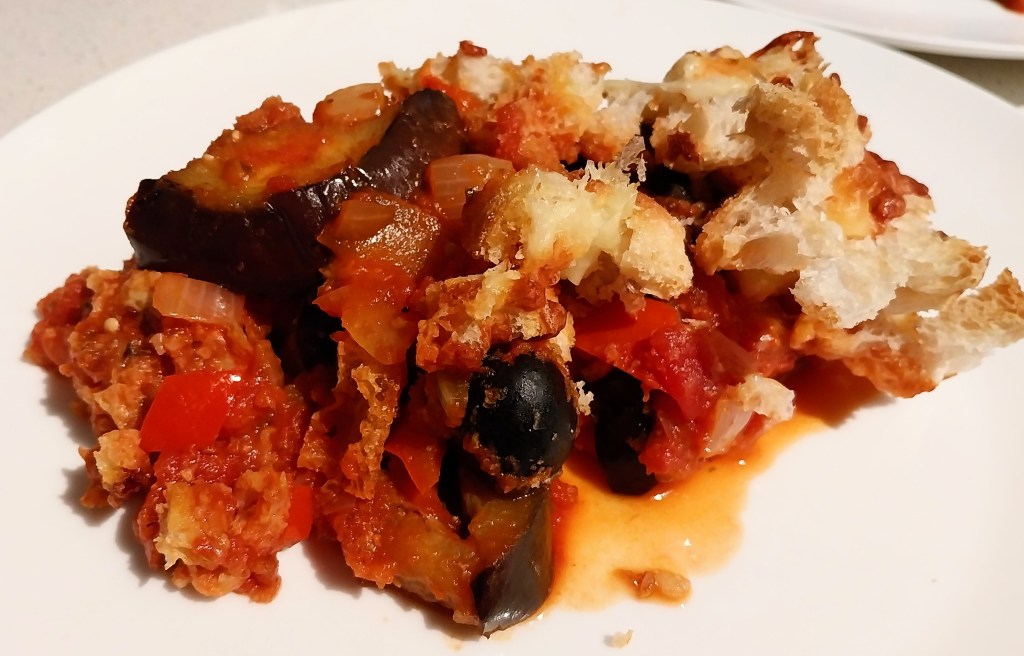
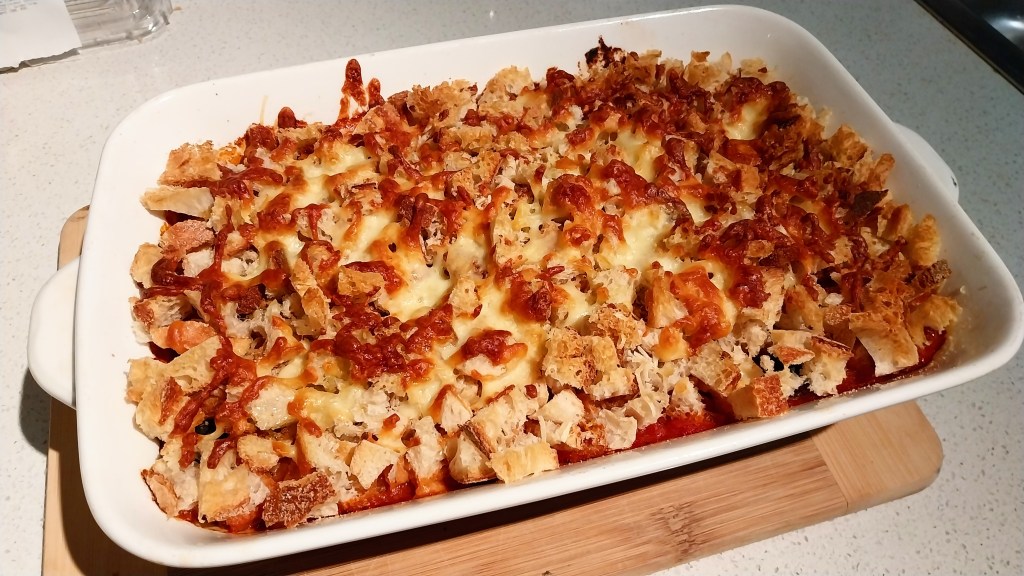
  8. Remove from the oven. It should be looking something like mine in the photo below, and is ready to serve.

Customise it!

Serve with some boiled or steamed green veg of your choice. Add another cheese if you want – some grated blue cheese would give it another interesting taste. Keep the parmesan though, as that’s what gives the dish its name. As ever, some fresh herbs would go well – I only had dried mixed herbs to hand when I made this.

This is me signing off from Down Under. Thank you Australia, you’ve been great, and left us with lots of wonderful new memories, many of which I have shared through my recent posts. We now have an appointment with a Qantas Boeing jet to Heathrow that will last all of 24 hours! See you in a few days, with a new post from back in Good Old Blighty (jet lag permitting 🙂 ).

I’ve loved discovering many new Aussie bands and adding them to the ADK Spotify Playlist. I’ve been especially impressed with These New South Whales, so here is another from them: Cholesterol Heart (God Bless Ya).

Categories
Blog Desserts Snacks

Peanut Butter Acai Bowl

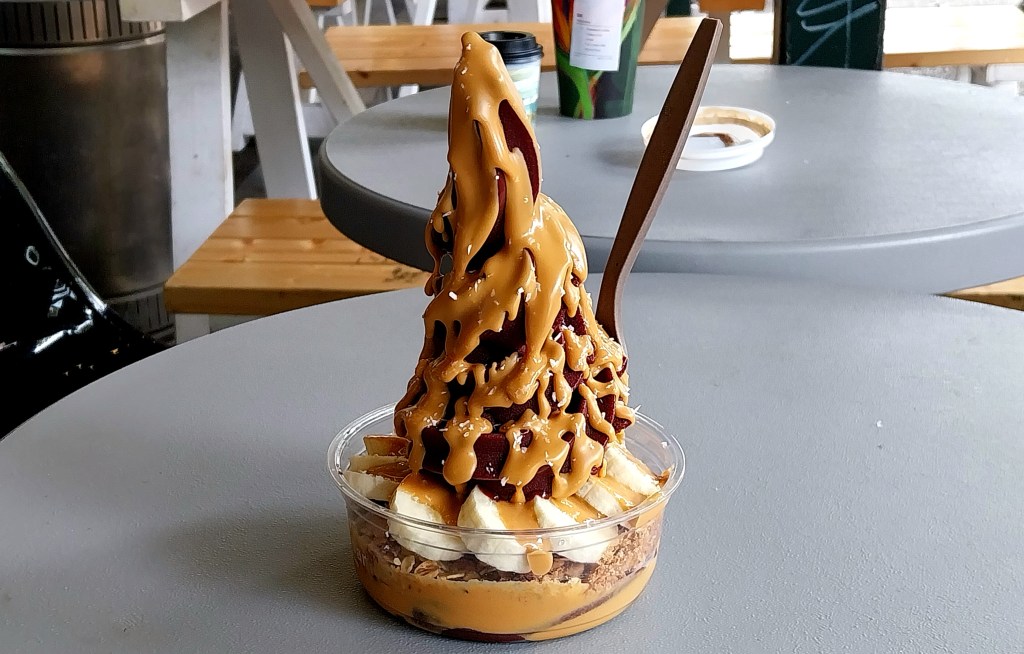
Is it a peanut butter Christmas tree? A model of Mount Everest sculpted out of chocolate ice cream, perhaps?

Understandable, if that’s what you’re guessing is in my photo above. You’d be wrong, however – it is in fact an Acai Bowl. I bought this at the Drip Bar in Melbourne. The purply-chocolatey coloured acai is topped with fresh banana, crushed cacao, coconut, ground almonds, granola and a drizzle of peanut butter.

Some of you will be very familiar with acai, and some may never have heard of it. Acai (pronounced ah – sa – ee) is a berry that is produced in Brazil. It is rich in antioxidants, fibre and healthy fats, and believed to support heart health and cognitive function, while being low in sugar and calories. It is also suitable for vegetarians and vegans. It therefore ticks all the boxes to be called a surefire superfood.

What’s more, it tastes really good! At the risk of sounding like some sozzled sommelier, I would describe the taste as having dark chocolate tones, with deep red wine and a hint of blueberries. When you hear that description, it’s hard not to at least give it a try.
In the UK, my experience is that acai is still mainly the preserve of specialist juice bars and health food shops. An internet search reveals that there are slightly more outlets than I was aware of, but it is still nowhere near the mainstream in the way it is here in Australia. Most towns have a cafe or takeaway in the high street selling a variety of acai bowls, with chains established for the purpose, such as Oakberry and Yo-Chi.
As far as I understand, the acai is blended with chopped banana and yoghurt (or coconut milk for a non-dairy version), giving it a rich texture with a beautiful purplish colour. It is eaten ice cold, swirled in a bowl, looking like ice cream or sorbet with toppings added. Fresh fruit is most common, while sprinkling over granola or muesli makes it an option for breakfast.

A danger with acai bowls is that the base is topped up with treats high in sugar or non-healthy fats, that cancel out the health benefits of the acai itself. However, this doesn’t need to be a problem as long as the toppings (such as a good quality peanut butter) are added with thought and moderation.

The berries do not travel well, so outside of Brazil they are sold in pulp form or as powder. I have bought a pack of powder from Coles Supermarket, where it was available on the shelf, in several varieties. I will be taking it home to make some acai bowls of my own. I also have an idea to sprinkle some into the mix when baking, to make blueberry and acai muffins. Watch out for future posts!

Due to its health benefits, great look and taste, I feel it is only a matter of time before more of us are eating acai as part of a normal diet. Do let me know, via the comments below, if you have tasted acai, and what you thought of it. I am interested to hear how readily it can be found and eaten in your part of the world.

Here’s a Melbourne band that was recommended to me by the assistant in a cool vinyl records shop and cafe in the Hawthorn district of the city (a big shout-out to Alley Tunes). This band play experimental electronic music, and go by the name of Big Yawn. Here they are with Ragazzo.

Categories
Blog Snacks

Picnic at Hanging Rock

On my travels around Australia, I have been reading the famous story Picnic at Hanging Rock, by Melbourne’s Joan Lindsay. When I learned that Hanging Rock is, in fact, a real place about an hour’s drive north of Melbourne, I jumped at the chance to visit.

What’s more, being a dedicated foodblogger, I made sure our party of 4 took a picnic 😋. More about that, and the unexpected guest who turned up to it, in a moment.

The result of major volcanic activity thousands of years ago, Hanging Rock is bigger than I had anticipated. On arrival, one is greeted by vertical rock faces shooting up through the ferns and eucalypts.

The steep path winding to the summit traverses crevices and tunnels through a haphazard jumble of rocks and massive boulders, resting just wherever the volcanic eruption threw them as lava, all that time ago.

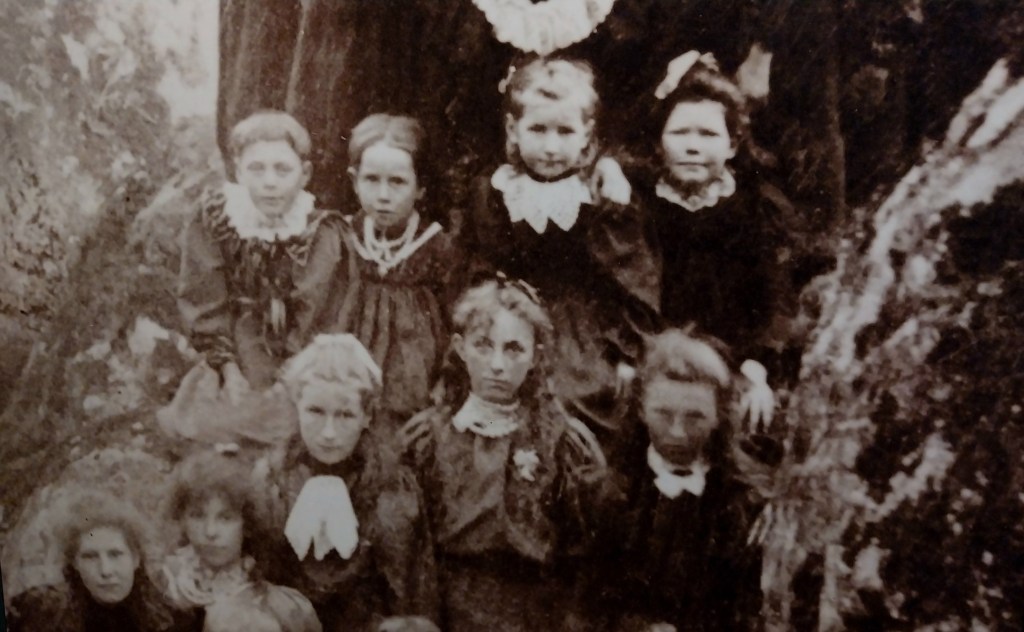
It is very easy to get lost, which is why it makes such a fitting setting for the famous story (which has also inspired a film and TV drama series of the same name). In summary (and without any plot spoilers), Picnic at Hanging Rock tells of a group of schoolgirls from a local college, who picnicked here on St. Valentine’s Day in the year 1900. Some of the girls then set off on a walk to the summit, and mysteriously go missing, never to be seen again.

While published as fiction, the author was very coy about whether it may actually be based on true events. Consequently, a whole legend has grown up around the place.

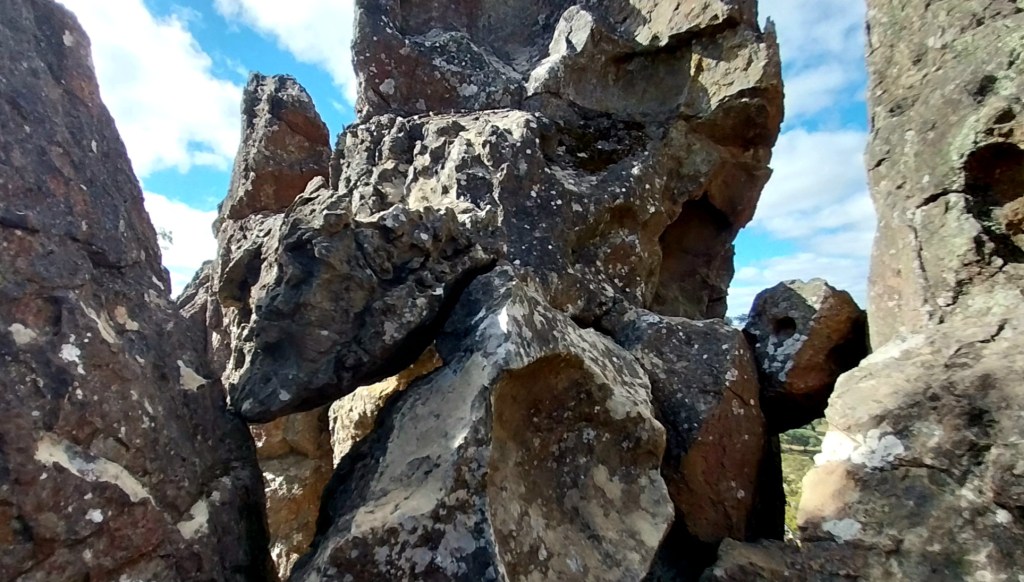
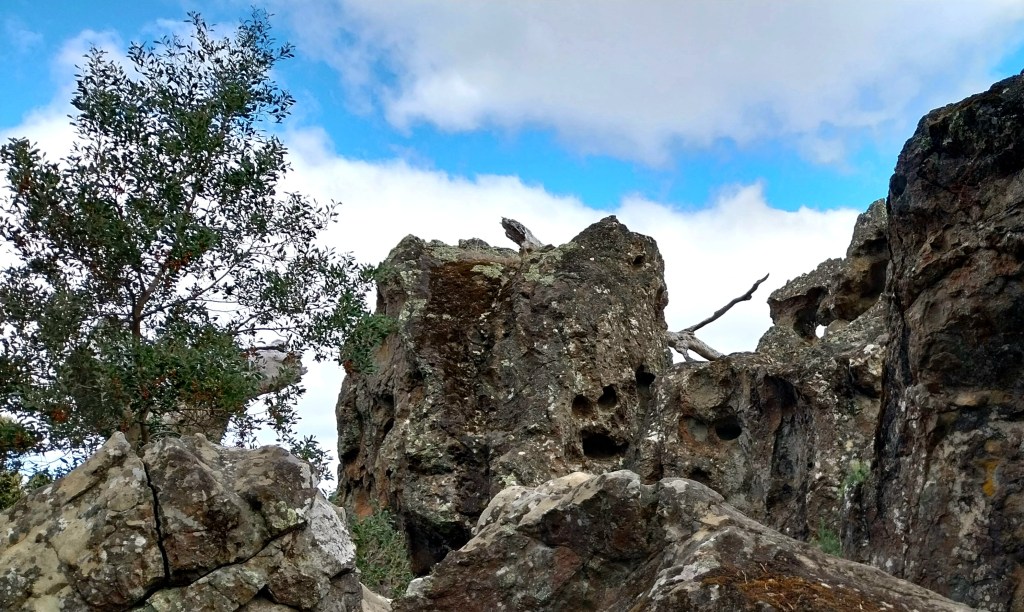
Some visitors have reported feeling the presence of the missing girls as they climb the Rock. Certainly, with a little imagination, the angles, pock marks and shadows in the rocks can give the impression of faces, with eyes and mouths, watching as you clamber over the stones.

I’m including a few photos, and will let you make up your own mind about that.

The eerie display in the Visitor Centre does its best to ramp up the feeling of unease.

And so to the picnic. We chose mainly local food from the surrounding Macedon Ranges area. I bought this savoury cheese and spinach muffin at the Trading Post in Mt. Macedon. It had the texture of a scone, with roast pumpkin (it’s coming into autumn here) and feta.

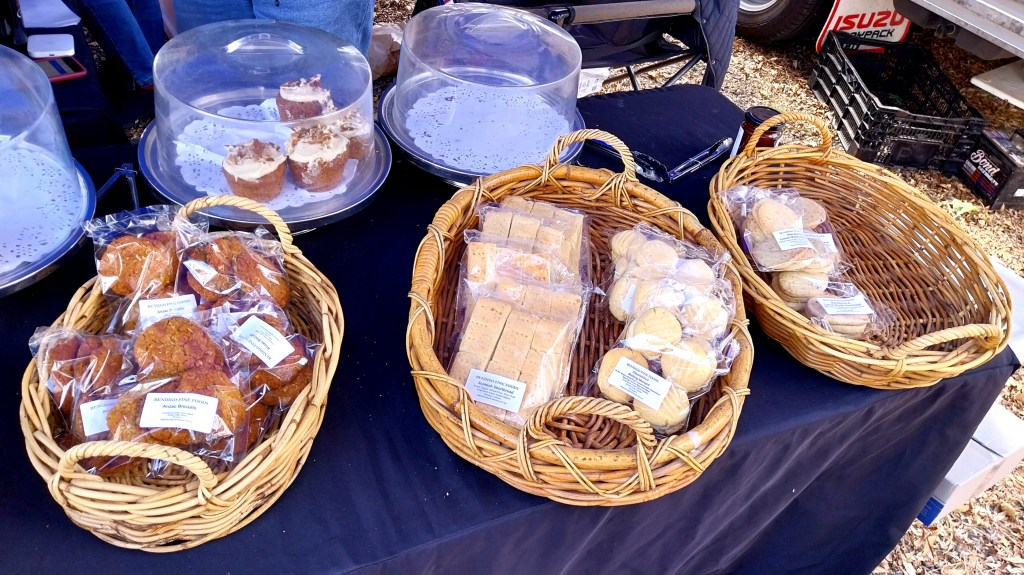
We stopped off along the way at the Farmer’s Market in Kyneton, and picked up some treats made in a Bendigo bakery: Anzac biscuits (an Aussie staple with coconut and chewy oats), and shortbread made with lemon myrtle (a bush plant) and chopped macadamia nuts.

We also had local olives and cheese from the King Island Dairy. The picnic reached a hurried end, however, when this intrepid kookaburra began showing too much interest in our spread for my liking.

I reckon he was after the hot cross buns 😉

The view from the summit over north Victoria is reward for the climb.

Hanging Rock is both beautiful and mysterious. With the lingering scent of eucalyptus on the gentle breeze, it needs to be experienced with all the senses.

Musical choice this time is a suitably haunting duo by Aussie pop royalty Nick Cave and Kylie Minogue: Where the Wild Roses Grow.

Categories
Blog Mains

G’day Melbourne

This week we’ve been enjoying the food and cafe culture in Melbourne, having flown here from the Sunshine Coast for the next stage of our travel around Australia.

Coffee is a central part of the Melburnian way of life – the many, many independent coffee shops across the city doing a busy trade every morning.

The regular fix for me on this trip has been a creamy hot latte. The main photo above shows the barista at work while I waited for my drink to be made at a cafe in the Glenferrie district.

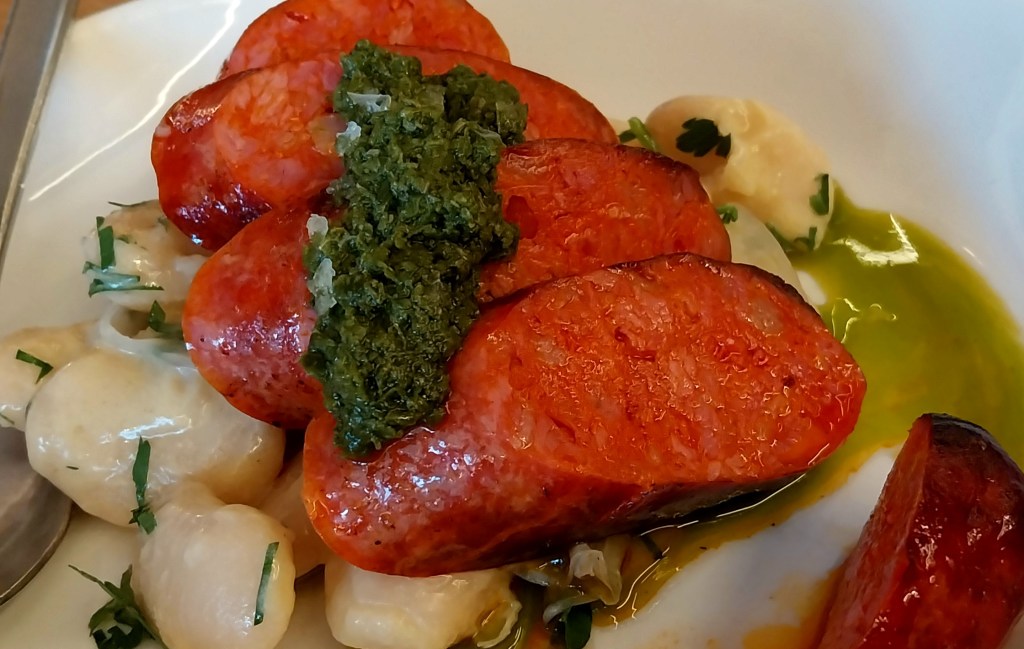
We’ve also been sampling some modern Australian cuisine at a restaurant called Mister Sandrino in Hawthorn. This pairing of locally made chorizo and lima beans, with a fresh parsley pesto-like dressing, tasted great.

On the same menu, we chose the classic Aussie fish, barramundi. It came with a crispy, edible skin, which I liked, and found interesting as I usually just discard the skin on a fillet of fish. Served also with slices of crispy pancetta and a pea puree, it complimented the soft, just-cooked flakiness of the tasty fish.

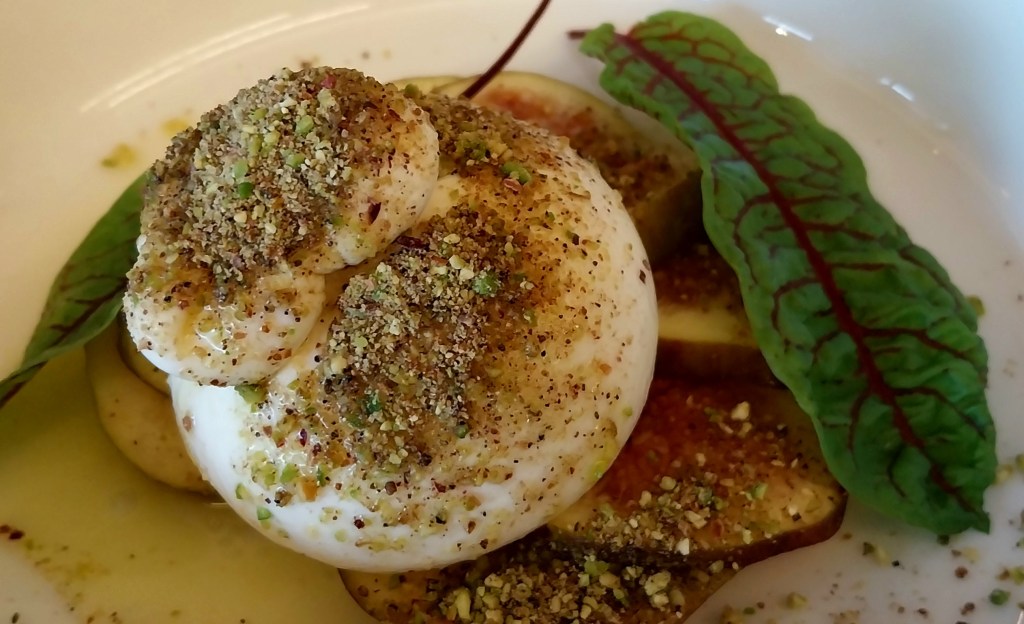
Another imaginative combination I liked was this creamy buffalo mozzarella, with dusting of pistachio crumb, served with figs and salad leaves.

I find it very inspiring to see how innovative chefs from other cultures come up with new ways of cooking and pairing ingredients. You never know – you may see some of these ideas reflected in future creations from the ADK kitchen!

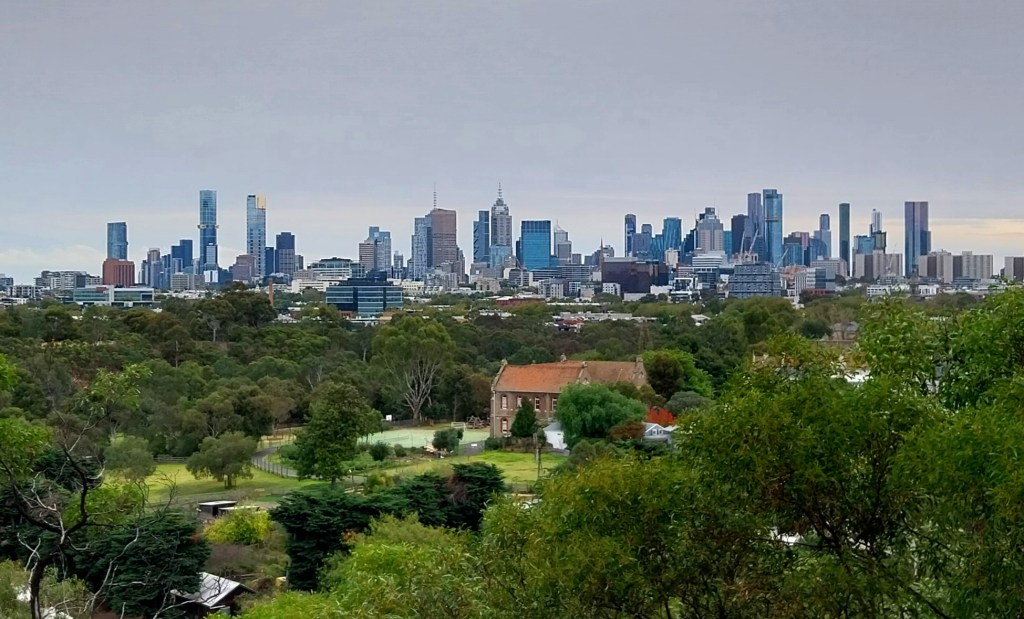
While on a theme of taking a fresh look at things, here’s a photo I took one evening of the Melbourne city skyline, from high up above the banks of the Yarra River.

Time to feature an indie band from Melbourne whose raw sound I’ve come to like. This is Drunk Mums with New Australia.

Categories
Blog Drinks

Paint Me Down (Under)

I want to share with you some of the great art in public places I’ve come across in Australia.

For reasons I can’t quite explain, my experiencing of art is inextricably connected with the consumption of coffee and pastries. Visit to a gallery? Sooner or later my wristwatch will be telling me it’s time to visit the coffee shop. Walking on a public art trail? I guarantee at some point there will be a minor detour to take in that nice, funky looking cafe over there. More about Australia’s cafe culture in a moment – let’s first take a look at some of the art.

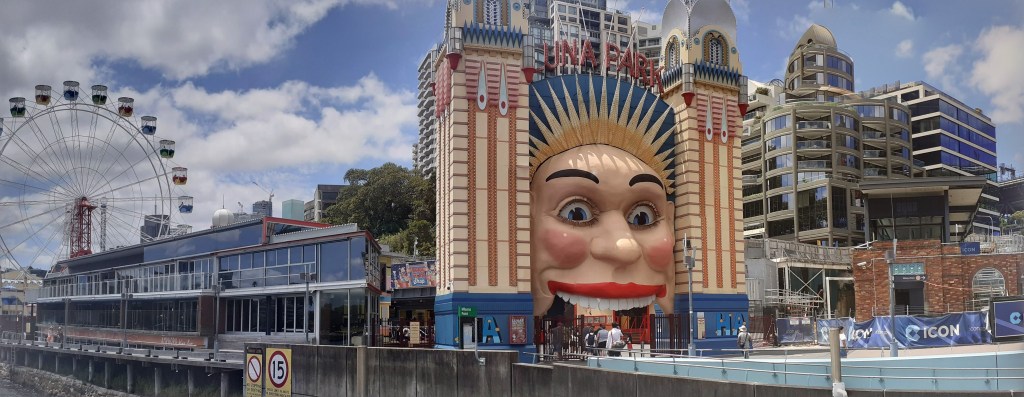
I’ll start with the art deco entrance to Luna Park, Sydney’s retro amusement park that dates back to 1935, shown in my main photo above. It is a joy to behold – the huge grinning face is visible all the way from the other side of Sydney Harbour, getting progressively larger as you approach it on the ferry. If you look closely you will see visitors walking through the mouth to enter the amusement park, giving a sense of its vast scale.

My next photo below was taken at the graffiti wall which lines the promenade at Sydney’s famous Bondi Beach – a place where chic boutiques and upmarket cafes co-exist with the bohemian grunge of the local surfing community. Our visit here soon led to a visit to one such cafe (see, what did I tell you), from which we enjoyed the free entertainment provided by the surfers. This was easily the best surfing I have ever seen – well-poised riders catching a wave for a good 10 – 15 seconds before diving neatly into the water, then doing it all again.

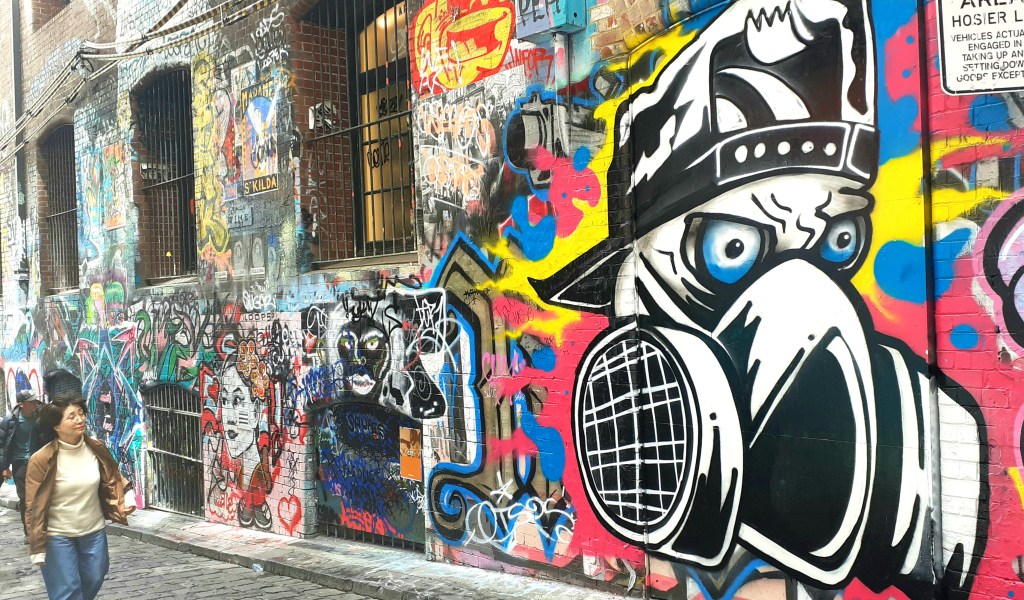
Back in Melbourne, Hosier Lane is known as Spraycan Alley, making it a popular tourist attraction – see below. It is positioned in the Lanes and Arcades quarter chock full of fiercely independent cafes. A visit to at least one of these is inevitable (for me, that is) when in this part of town.

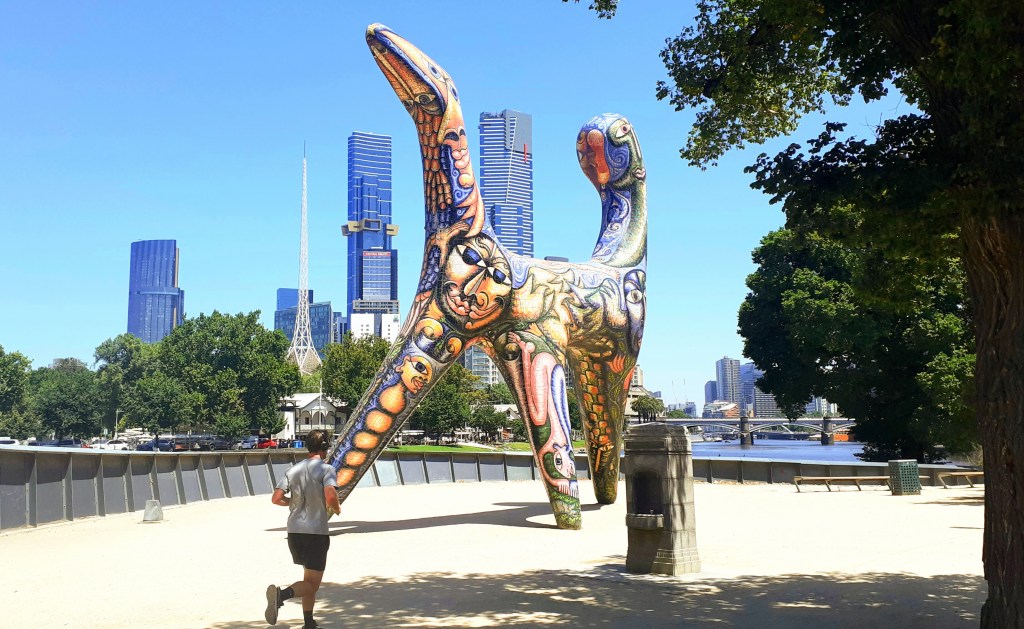
Indigenous art influences are strong wherever we go. The tall three-legged, two headed Angel (by artist Deborah Halpern) is situated in Birrarung Marr, the public park that stretches out along the River Yarra from Federation Square to the home of the Tennis Open.

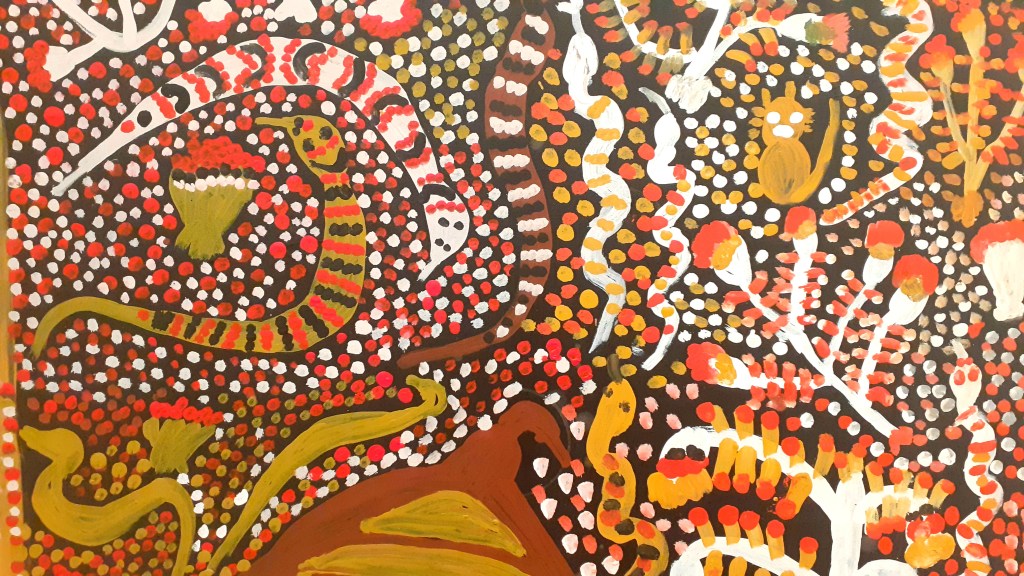
Again in Melbourne, the whole of the ground floor of the Ian Potter Centre (free to enter) is given over to indigenous people’s art. The paint used is generally derived from rocks, minerals and clay, giving it an earthy feel, and a colour palette based around an ochre spectrum. The abstract designs and patterns evoke the meditational nature of the aboriginal philosophy known as the Dreaming. My photo below is an example, by artist Willie Gudabi.

And so to the world of coffee and pastry that I associate with these images. Cafe culture is big in Australia. They are nearly all independents – you will only very occasionally see a Starbucks or other chain. Baristas take their work very seriously, and the making of a hot drink has itself been elevated to something of an art form. I can honestly say I have never had a bad cup of coffee since arriving in Australia.

At first the coffee menus were like a different language, but I now understand my way around them. There is no such thing as an americano – it is a long black and, if you want it white, you ask for a small jug of milk (specifying whether it should be hot or cold, and dairy, oat or other) on the side. A batch brew is a filter coffee, and a cold drip is an iced version – usually a latte served over ice cubes and, in some places, a scoop of ice cream.

Cappucino and flat whites are as you would find in the UK but, surprisingly, decaff is nowhere to be found on the menus. Seemingly this is because the serious coffee aficionados do not consider it to be a credible option. While there is no doubt that Australia makes great coffee, I do think this is one area where the approach is a little out of step with modern times.

So boil the kettle, or fire up your espresso machine, and fetch a nice coffee while enjoying these images. Which one is your favourite and why? Please feel free to leave a message in the comments section below, if you like.

The title of this post has probably given away the latest track I’ve chosen for the ADK Playlist. Paint Me Down is not one of Spandau Ballet’s biggest hits, but I have always really liked Martin Kemp’s bass line, which kicks in right at the start and stays prominent thoughout. Take it away, lads..

Categories
Bakes Blog Snacks

Viva Vegemite!

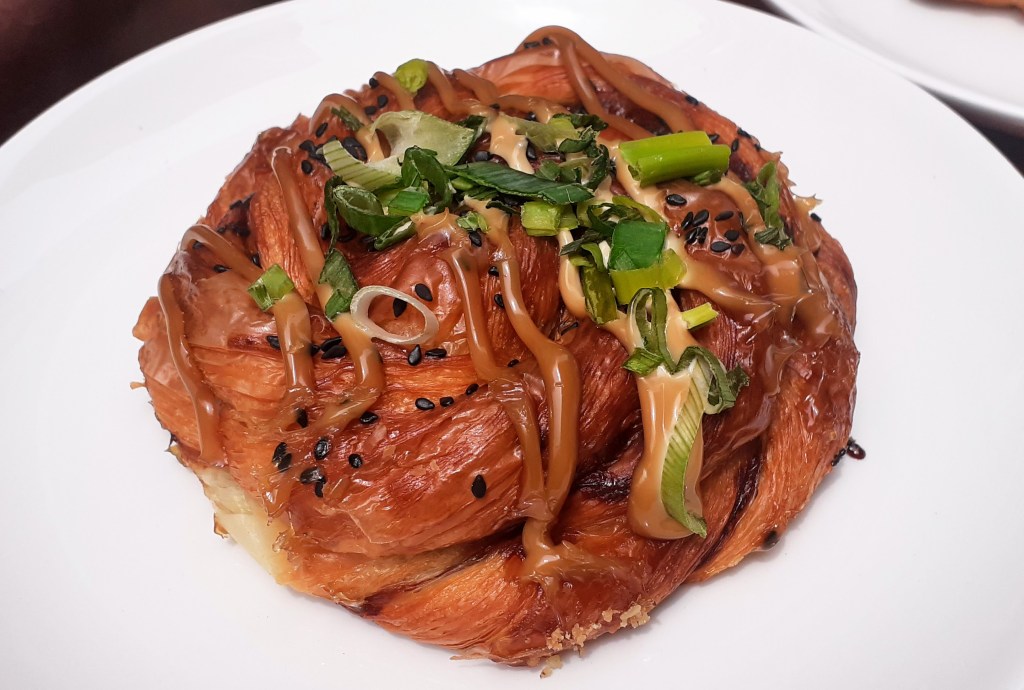
My Lonely Planet guide book to Australia advised that one of the foods I must try when I was here was Vegemite. I have followed that advice and very much enjoyed this institution of an Aussie delicacy, in many forms. The most memorable is the Vegemite Knot pastry, shown above, more of which I shall explain in a moment.

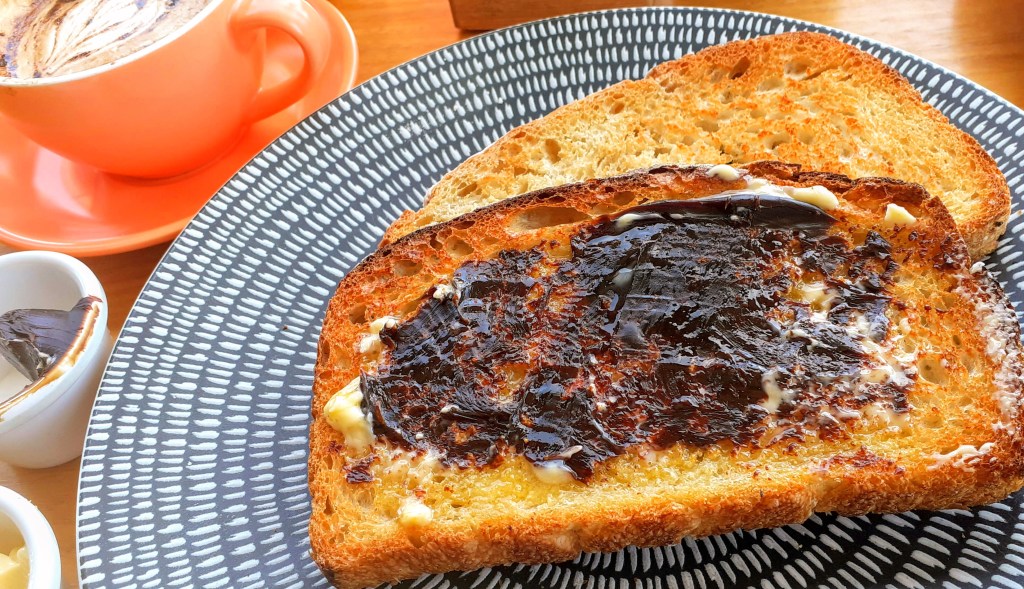
My first encounter with the stuff was in a road side cafe on Phillip Island in Victoria. Having stopped for a coffee (a long black with milk on the side – they do not do americanos here), I noticed that the snacks menu included two thick slices of sourdough toast, with butter and Vegemite. Sounded too good to turn down, so in a few moments the plate shown below arrived.

I soon learned that serving on thick buttered toast is a really good way to enjoy it. The dark, rich spread combines with the butter to make a salty, malty, creaminess that sinks into the warm toast, and complements the crispy crust. The taste is similar to the Marmite that we have in the UK, but much more buttery and creamy, and easier to spread.

Shortly after this, I invested in my own jar at Coles, one of Australia’s major supermarket chains, and the above has become a regular form of breakfast!

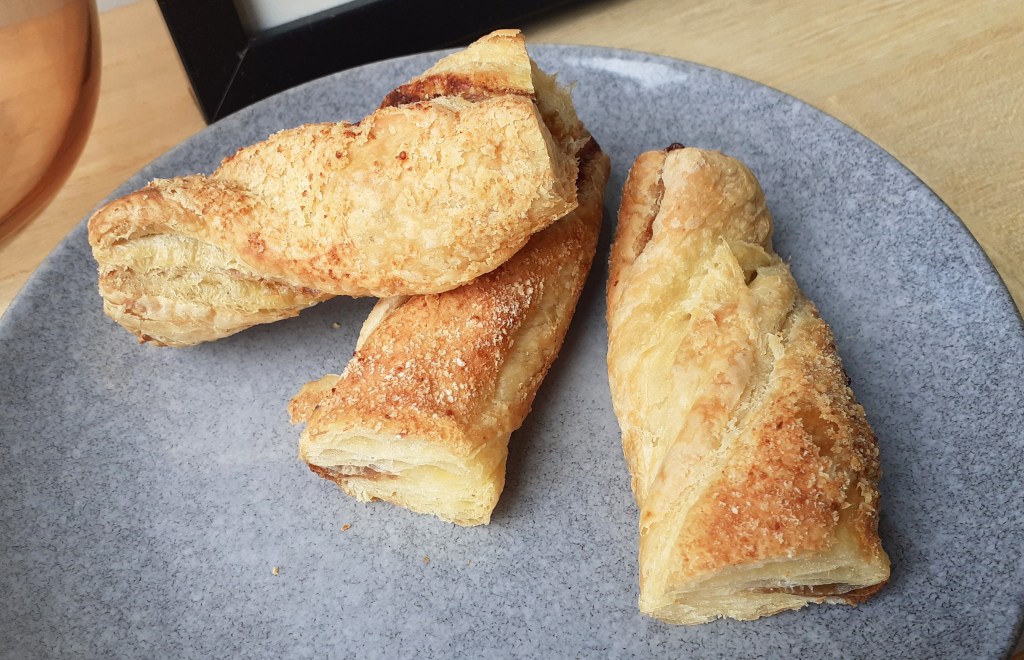
Vegemite is made from yeast extract and is a good source of B vitamins. The culinary ingenuity of Australians has led to it being incorporated into more and more foods and dishes, including marinades, stocks, soups and stir fry sauces. Savoury bakes are also fair game, see my photo below – cheese and vegemite twists, anyone?

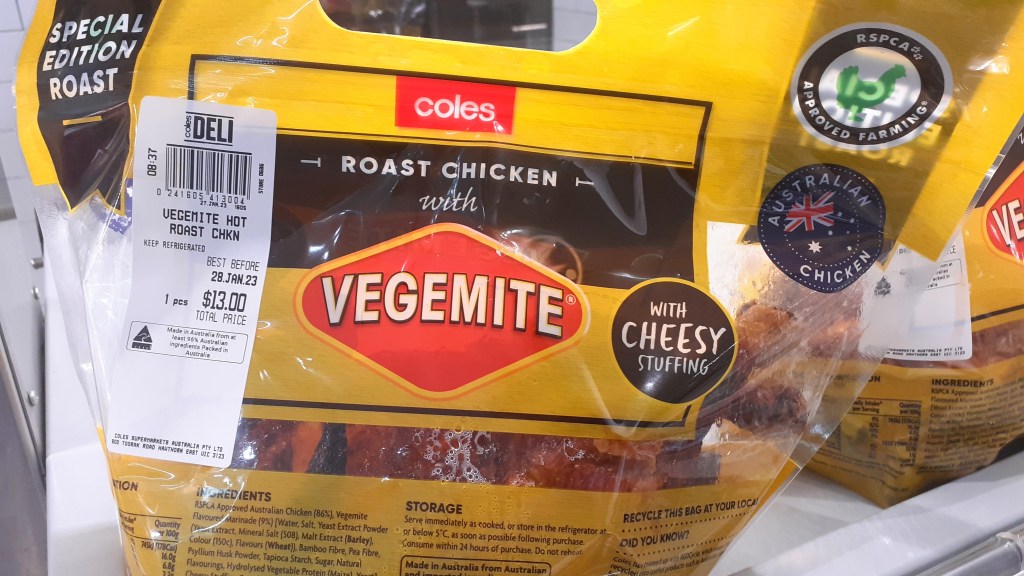
Or possibly even a flavouring for roast chicken? This was on sale, hot, in Coles:

And so to the photo that started this post – the Vegemite Knot. I found this in Rollers Bakehouse, a great cafe in Manly, by Sydney’s north beaches. Someone has made the inspired decision to combine Vegemite in a creamy, almost caramel-type sauce and drizzled it on choux pastry, topped with chopped scallions (spring onions) and what I think are chia seeds. It tasted unique and wonderful, managing to be both sweet and savoury at the same time.

Suitably inspired, I will be taking a jar of Vegemite home with me and plan to experiment with its use in baking. My current thoughts are to adapt my tried and tested recipe for National Trust scones, to include cheese, Vegemite and possibly some local water cress. Watch this space for a future post!

Choice of music for the ADK Playlist has to be the only track I know that famously references the Vegemite sandwich. Here’s Melbourne’s own Men at Work with Down Under.

Categories
Blog Mains

Little Vietnam

Victoria Street, in Melbourne’s inner city east, is known locally as Little Vietnam. It has earned this name through the number of Vietnamese restaurants and food stores that stretch out along both sides – a reflection of the sizable Vietnamese community that has settled in the city over recent generations.

I haven’t eaten Vietnamese before, so took the opportunity to try it out. A little research identified Van Mai as a good place to visit, and I’m pleased to say I would recommend it.

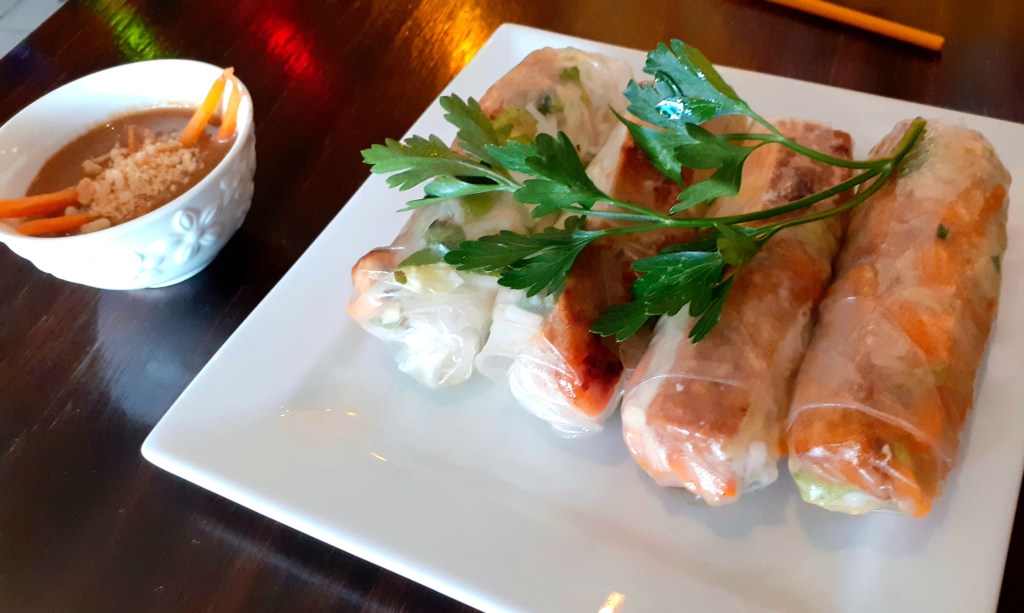
As a starter, we shared a plate of Rice Paper Rolls. I had seen these in some Vietnamese street food stalls in the city, and fancied trying them. Visually, they resemble sausages (see photo below), the contents wrapped in edible, transparent rice paper. Unlike sausages, however, they are eaten cold. The fillings included shredded carrot, beansprouts and crispy chicken, with fresh coriander. They were served with a dipping sauce that had a satay flavour.

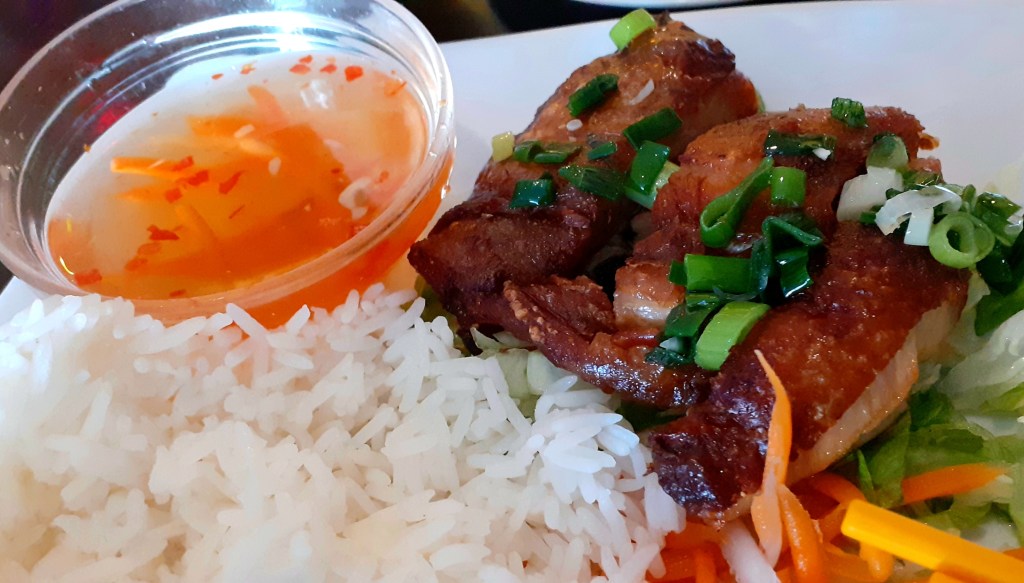
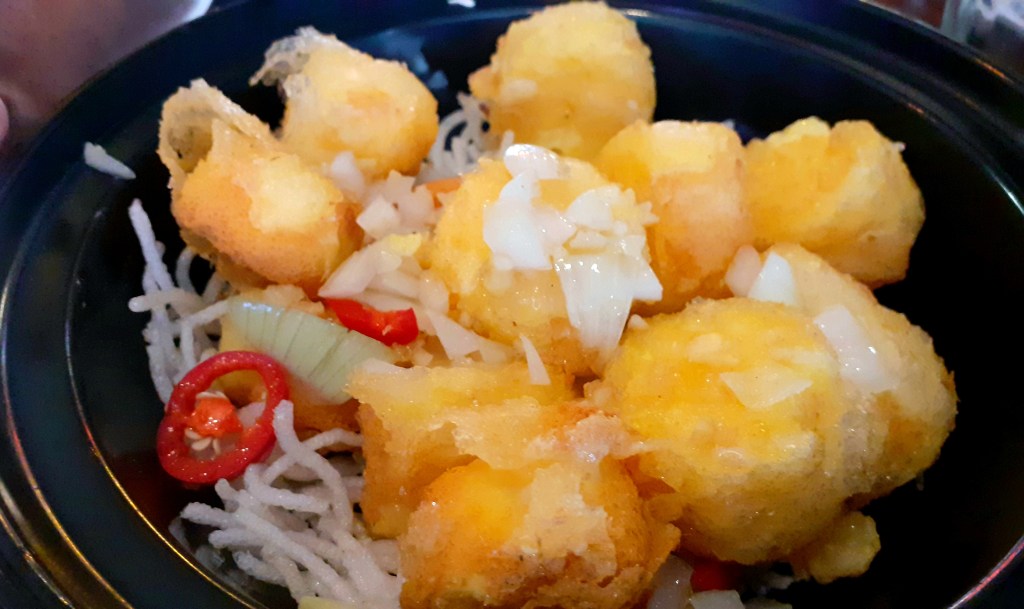
For mains we chose three dishes. My main photo at the top of the post shows Crispy Chicken with Steamed Rice, served with vegetables and a chilli and ginger dipping sauce. We also tried the Salt and Pepper Tofu, deep fried and presented on a bed of crispy vermicelli (see below).

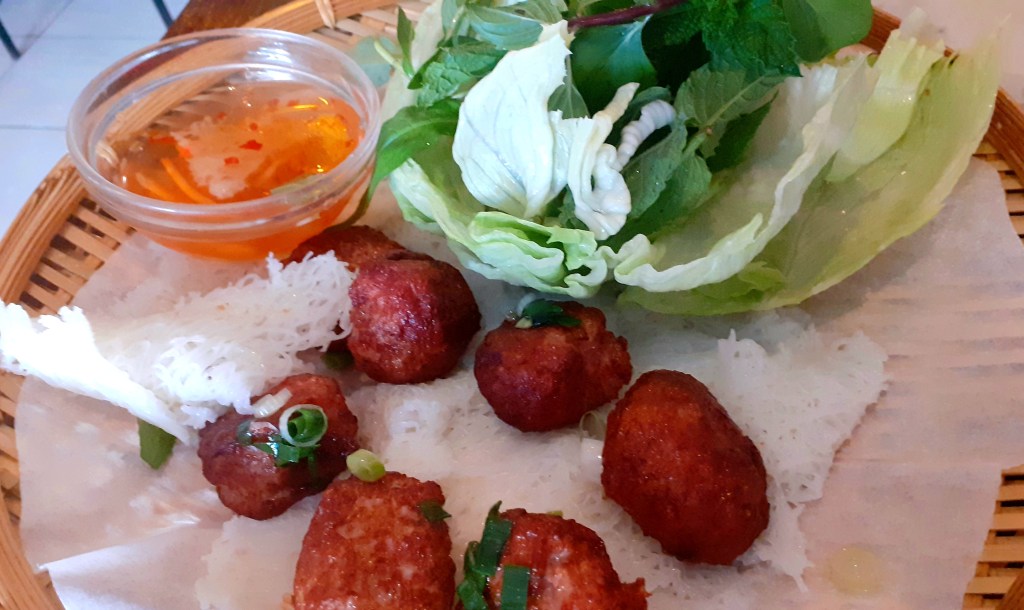
Our third dish was Steamed Fine Rice Vermicelli with BBQ Pork Balls. This was served with fried onions and shallots, fresh mint and crushed peanuts (see below).

This dish was eaten by handrolling the food in large crispy lettuce leaves, and dipping the parcel in a bowl of fish sauce.

I liked the food very much, particularly the pairing of hot and spicy with fresh, uncooked ingredients like lettuce, hand-torn mint and coriander. I also had fun eating with my fingers, though my hands were very sticky by the end of the meal.

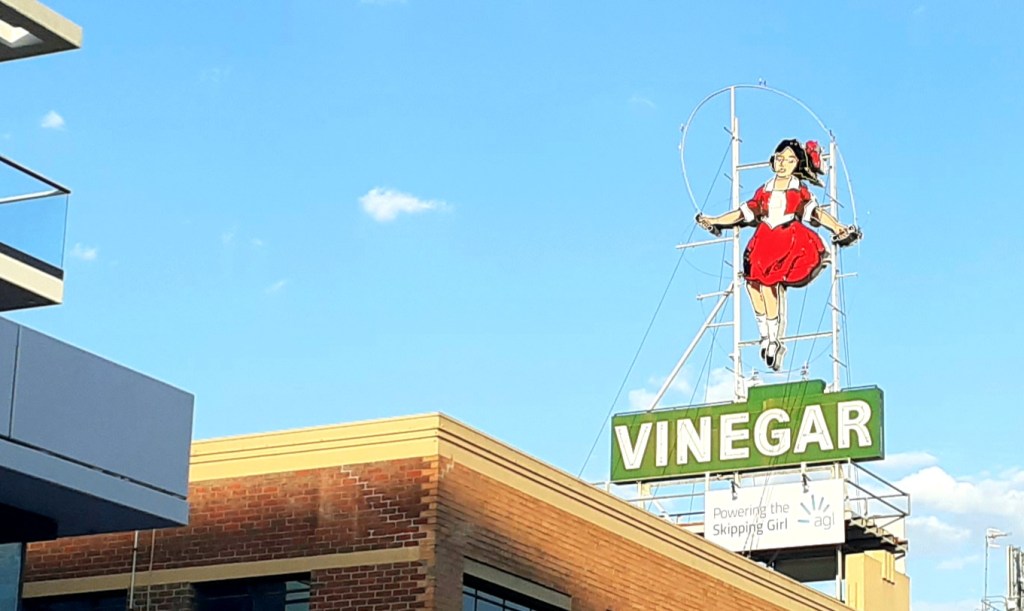
Another joy of visiting Victoria Street is the sight of the Skipping Girl – a much-loved Melbourne icon dating back to the 1930s. It was the city’s first neon sign, advertising the Skipping Girl Vinegar brand. Walk down the street after your meal to see her as dusk is falling – she will be illuminated and, magically, skipping.

For the next track on the ADK Spotify Playlist we take inspiration from the Skipping Girl. This is Malcolm McLaren with Double Dutch.

Categories
Bakes Recipes

The Perfect Lamington

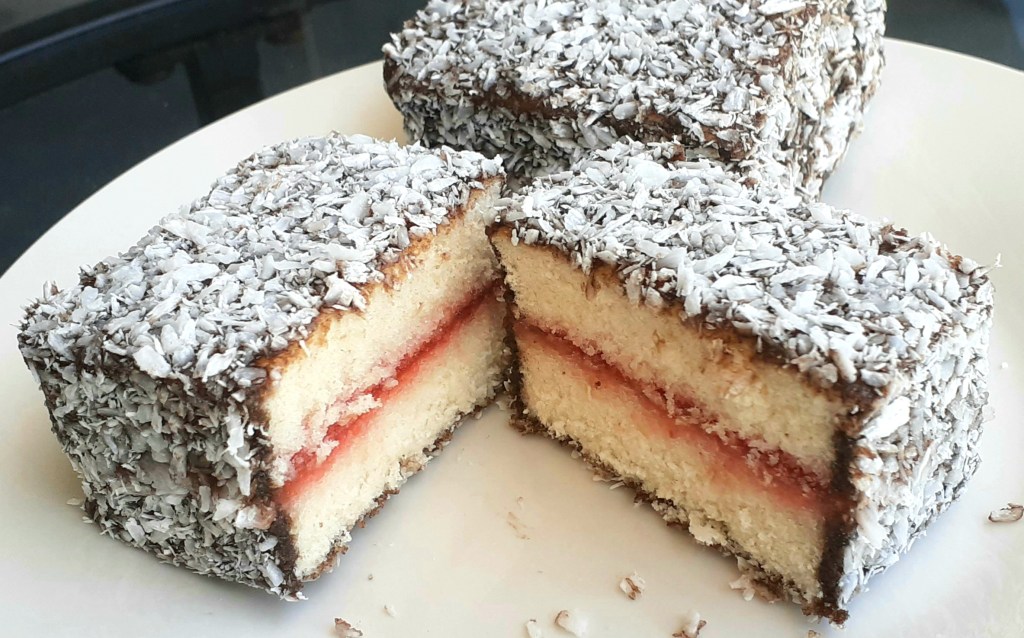
During my travels here in Australia, I have become quite partial to the Lamington. Typically enjoyed with a coffee, it seems to be something of a national treasure, and is on sale in bakeries and cafes everywhere we go.

Essentially it is a square-shaped sponge cake, coated in chocolate icing with a generous sprinkling of desiccated coconut. A simple, and unbeatable combination!

The story goes that it was invented in Queensland, Australia in around 1900 by the chef to the State Governor, Lord Lamington. I understand that New Zealanders have also laid claim to it’s creation, but the Aussies seem to be having none of that!

There are some variations. The ones in my main photo introduce another ingredient – a layer of raspberry jam in the middle – which works really well. There is even a bakery in Sydney that has developed glamingtons, with flavours including strawberry, salted caramel and peanut butter. The original choc and coconut combo remains the most popular, however.

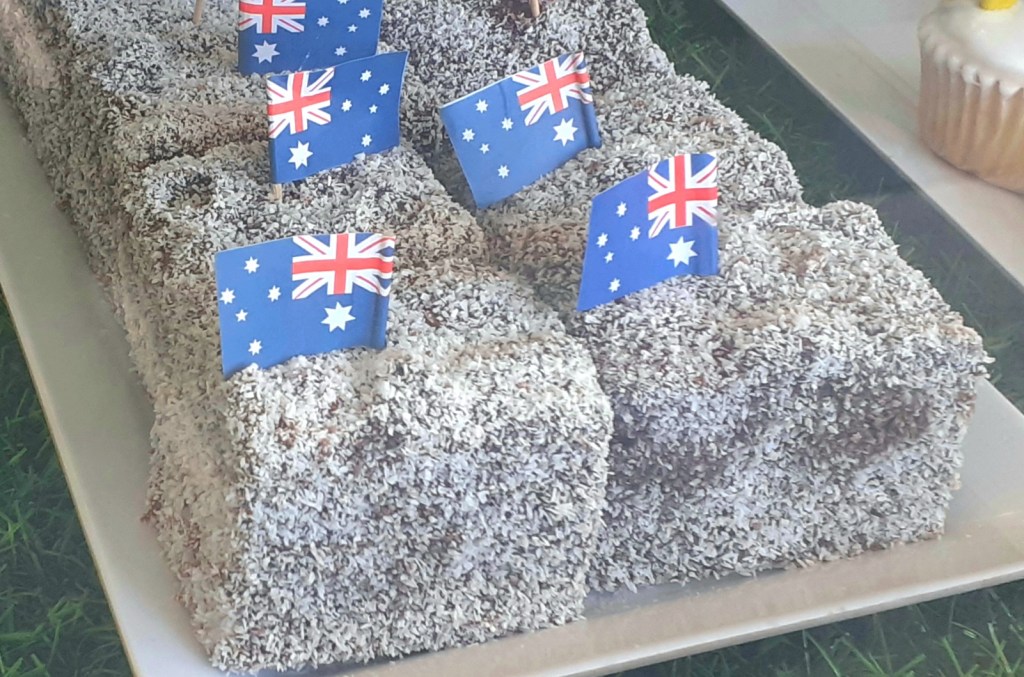
Australia Day (the national holiday) is coming up on 26 January, and one of the ways that people will be celebrating is by baking and eating Lamingtons. These ones, adorned with national flags, I spotted in a bakery today in Brighton, a resort just down the coast from Melbourne.

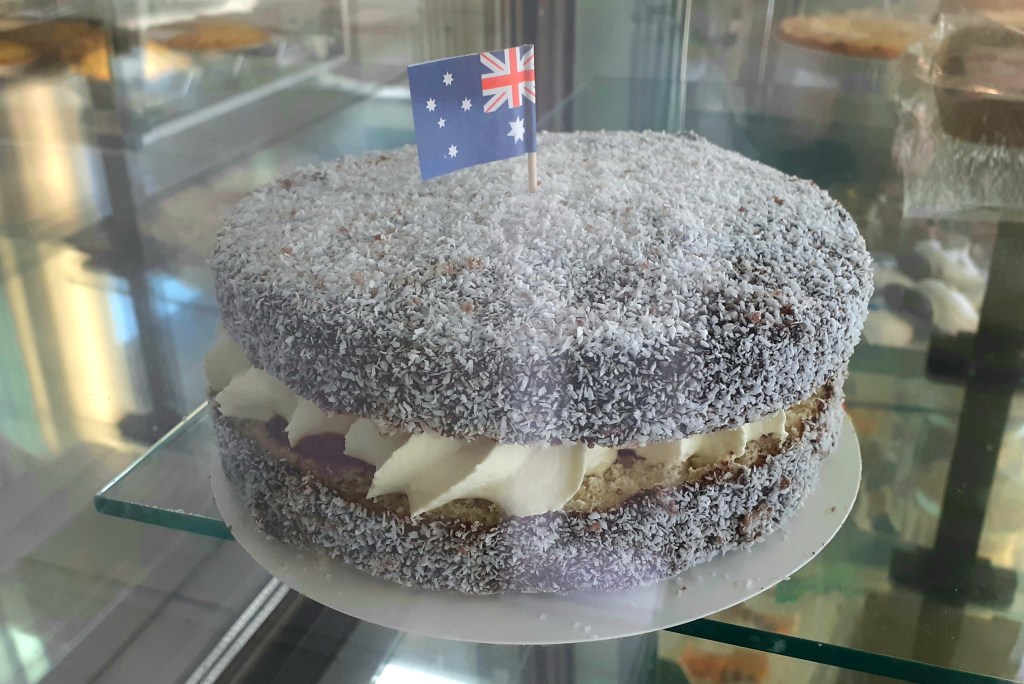
Here is another variation for Australia Day – a Lamington style Victoria sponge filled with fresh cream.

Can’t be bad!

Fancy joining in?

Servings

This will make around 16 cakes.

Timings

20 mins to prep, 20 mins in the oven. Once cooled, 10 mins to coat in the icing.

You Will Need:

  • metal baking tray, 24cm square (or equivalent)
  • 125g sugar
  • 50g butter, softened, plus 1 tbsp for the icing
  • 2 eggs
  • 120g self-raising flour
  • 85g desiccated coconut
  • 2 tbsp cocoa
  • 150g icing sugar
  • 3 tbsp boiling water
  • 1 tbsp butter
  • some smooth raspberry jam (optional)

Method

  1. Heat the oven to 180C.
  2. Grease and line the metal baking tray with baking paper.
  3. Cream the sugar and softened butter together in a mixer. Whisk in the eggs and combine, then add in the self-raising flour.
  4. Pour the batter into the baking tray and spread out evenly with a knife or spatula. Bake for 20 mins.
  5. Cool on a baking tray, then cut into squares.
  6. If you wish to add a layer of jam, do so at this stage – slice each square and spread it in, making a jam sandwich.
  7. For the chocolate coating, mix the cocoa, icing sugar, boiling water and tbsp butter. Give it a good stir so it forms a nice, thick sauce.
  8. Put the desiccated coconut in a separate bowl, alongside.
  9. One at a time, place each sponge square on a fork and dunk it in the choc sauce. Use a spoon to coat the top and sides, then set it in the coconut, gently turning it over so that all sides are coated.
  10. Leave on a wire rack and allow 10 – 15 mins to set, before serving.

Customise it!

As indicated above, bakers across Australia have come up with a number of very creative variations. If, like me, this is the first time you’ve made Lamingtons, I would stick to the basic recipe. With all the dunking in choc sauce and coconut, this has the potential to become quite messy. My advice is to learn to walk before you run!

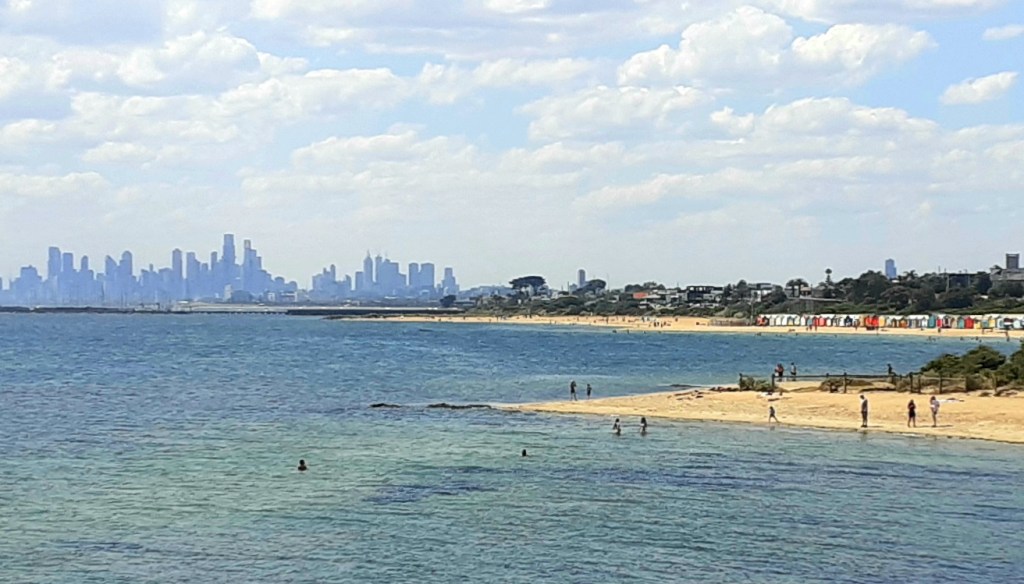
I mentioned earlier that we had visited Brighton today. For my final photo, I will share with you this shot from Brighton Beach, looking back towards the Melbourne city skyline. I liked the contrast between the small town seaside resort, with a line of little coloured beach huts on the right, and the mighty CBD behind. It was another hot one today, reaching 30C, and we joined the many people cooling off in the sea.

Time to add another Australian band to the ADK Playlist. I discovered The Presets, an electronic duo from Sydney, on a visit to Melbourne’s Australian Centre for the Moving Image. This track is called My People.

Categories
Blog Desserts

Peach Melbourne

Peaches are in season in Australia right now, and plentiful in the shops. It’s no surprise therefore that, just as Wimbledon has strawberries and cream, the Australian Open has Peach Melbourne.

The Australian Open, the first tennis major tournament of 2023, is under way at the moment, and is a pretty big deal here in Melbourne. I’ve spent a couple of days at it this week and, aside from watching the tennis, have enjoyed its Peach Melbourne signature treat.

It is of course a play on Peach Melba, the dish created in the Victorian era by a French chef, in honour of the Australian soprano, Nellie Melba. Melba was a stage name that she took from her home town of Melbourne.

The three key ingredients are ice cream, fresh peaches, and raspberries. At the Australian Open, it is served (sorry, couldn’t resist that one) as a tub of whirled vanilla ice cream, covered with a drizzle of pureed fresh peaches, and topped with pieces of dried raspberries (see my main photo).

It is lovely to taste – especially the fresh peach sauce – and a welcome respite from the heat. The temperature hit 37C one day this week, and play on the outdoor courts had to be suspended. I would not be surprised if the tennis players all headed to the Peach Melbourne outlet to cool down.

Regular followers will know that I featured on ADK some ice cream creations made with my own ice cream maker, a few months back during the UK summer. I haven’t made this peach dish before but will definitely be giving it a go when I get home. Watch out for a future post.

As for the tennis, I have really enjoyed seeing the game played up close by world class players. The first day we bought a ground pass, which gives access to all of Melbourne Park, except for the 4 show court arenas. You can wander around and see who is playing, then stand or sit at a match and watch it for as long as you wish, before moving on to another. You can go fetch a coffee (or Peach Melbourne) whenever you choose, or take a deckchair on a central green watching the action on a big screen.

The atmosphere is relaxed and informal off court, if fiercely competitive on. The setting is spectacular, with the skyline of Melbourne’s Central Business District (CBD) rising above the courts.

I liked being able to watch a match from a spectator gallery to the side of the court. The customary view on TV is from a raised camera position at the end of the court, but sitting to the side brings home much more effectively the speed and power with which the game is played at this level.

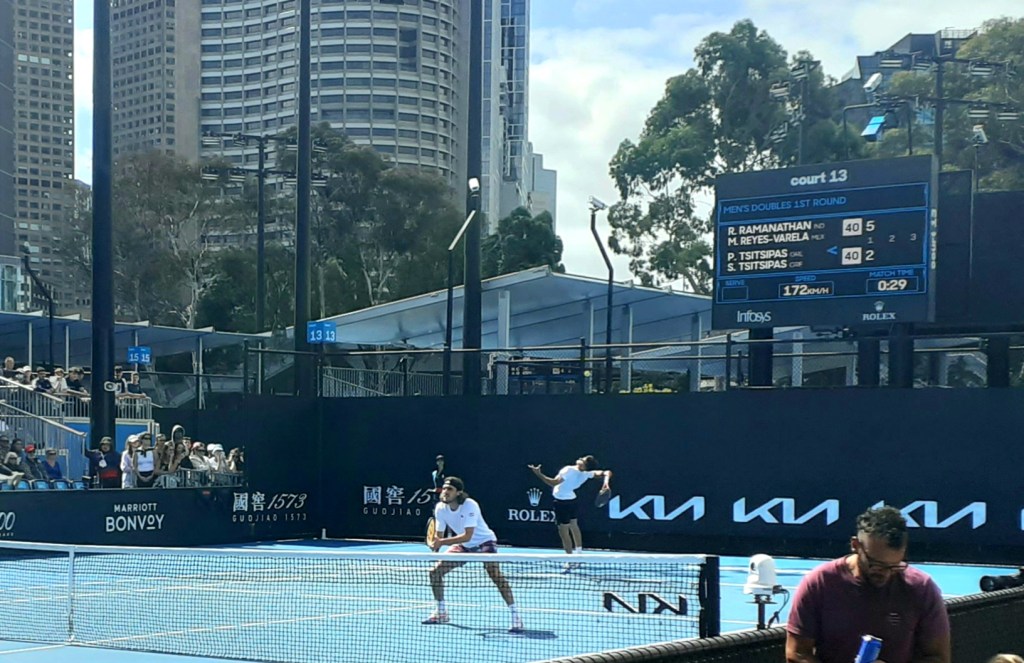
It’s also fun spotting any famous players taking their turn on the outside courts. The biggest name we saw there was the number 3 seed, Stefanos Tsitsipas, see below.

I knew he was a top men’s singles player, but hadn’t realised he also played doubles with his brother. There is a large Greek community in Melbourne, so the boys were receiving enthusiastic support from the fans.

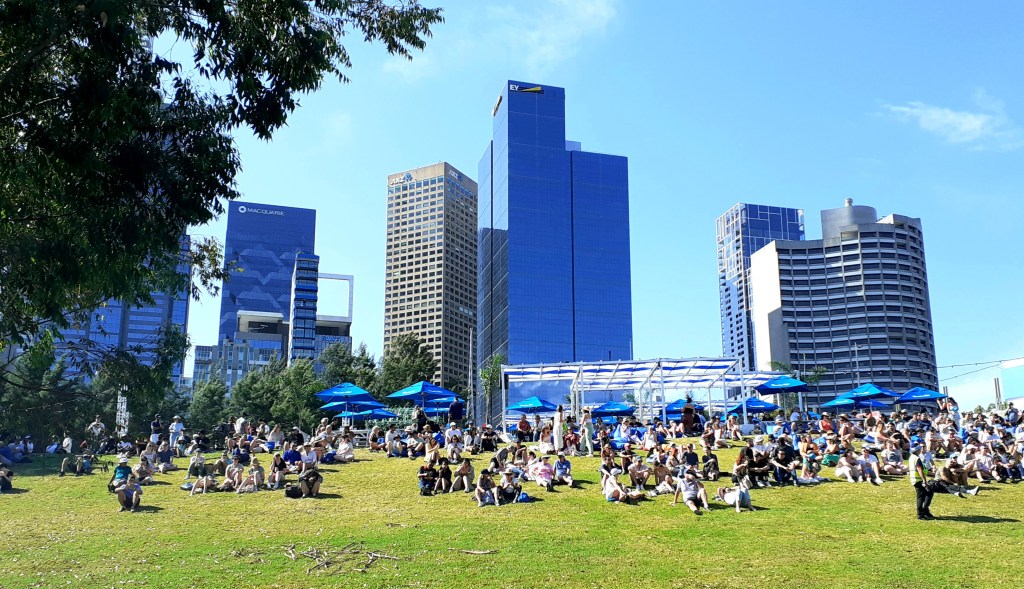
It’s also possible to watch the tennis for free on a big screen, by joining these Melburnians below, at the nearby AO Hilltop – a fan fest site with decent drinks and food.

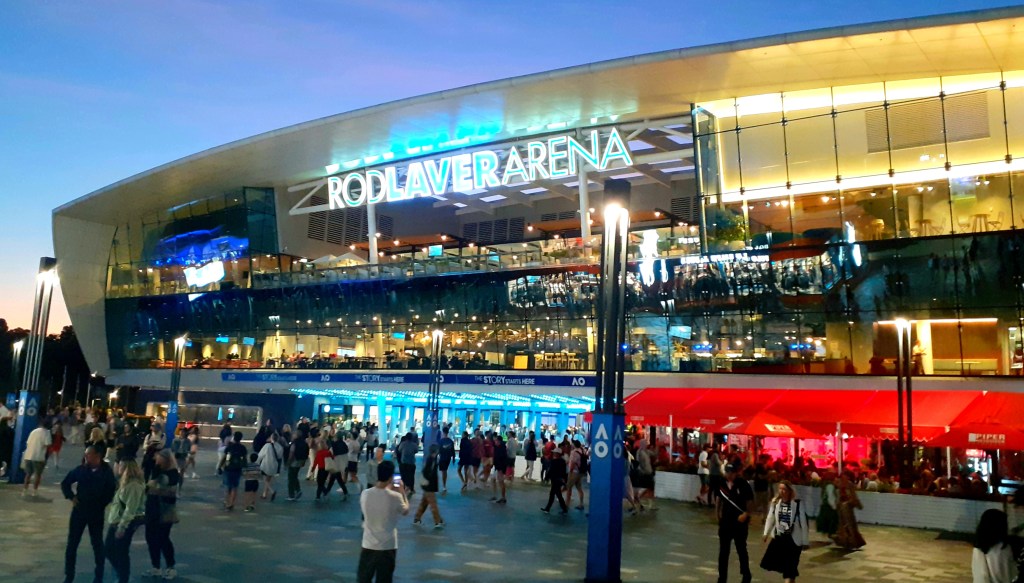
On our second day, we had evening tickets for the biggest of the show courts, the Rod Laver Arena – a lovely birthday present from my son. It was very exciting making our way to the famous 15,000 seat arena, below.

In a tense game, we saw the USA’s Seb Korda inflict a shock defeat on the number 7 seed, Daniil Medvedev.

Our session ended just after midnight – not quite as late as Andy Murray endured this week, finishing at 4am the next morning! With this in mind, our latest addition to the ADK Playlist is in honour of the gallant, battling Scot who overcame the odds to progress to the next round. This is Faron Young with It’s Four in the Morning.