My first full week in Australia has been pretty wild. And I mean that literally.
After a few days in Melbourne to acclimatise and shake off jet lag, we headed south-east of the city to experience life in the remote, southernmost parts of Australia. First stop was Phillip Island, a delightful holiday island popular as a weekend getaway with Melburnians. We then moved on to a wilderness retreat in the State Park of Wilson’s Prom (short for Promontory).
These places are home to some of Australia’s most famous animals. My main photo shows a sleepy little koala resting above me in a gum tree, on Phillip Island.
My photo below shows a wallaby who came along looking interested in the barbecue I was cooking in the outback on Wilson’s Prom.
I also broke off from my barbecue to snap these kookaburras, laughing while perched in a nearby tree, at dusk.
The landscape and climate here shows nature at its wildest. We climbed the 558m high Mount Oberon for this view overlooking Norman Beach and Tidal River, the hub for visitors to Wilson’s Prom.
There seems to be an amazing, and practically deserted golden sands beach on every stretch of coastline. My photo below shows Sunderland Bay, taken at Surfie’s Point.
We have also waited patiently at sunset to watch Phillip Island’s penguin colony return from a day’s swimming and fishing, waddling in unison across the beach to the safety of their burrows. Also, as advised by Park Rangers, I’ve been taking care to protect the food for our barbecues from the visiting wombats.
With all of this wildlife, rugged coastline and amazing surf beach scenery, you may think I have become temporarily distracted from my usual focus on food. Well, there is probably some truth in that to be fair, but expect normal service to be resumed soon. Having said that, let me share with you this heavenly chocolate, peanut butter and almond slice I enjoyed at the Sanny Bakehouse in San Remo.
Choice of music this week has to be Talking Heads, with Wild Wild Life.
Well, I’ve made it. 13 and a half hours in the air with Qatar Airways, crossing 8 time zones, but I’ve made it. All of that on top of 6 and a half hours in the air, crossing 3 time zones, on the initial leg from London to Doha. I suppose I shouldn’t be that surprised that I’m feeling a little groggy with jet lag just now.
First impressions of Melbourne are that it’s a very interesting city, with lots of culture, sport, street art and cafes that take serving good food and coffee very seriously. I took a tram to Fed Square and walked down by the Yarra River to take the photo above, looking across to the Central Business District.
Weather was about 21C – it is just coming into the main summer here. Weirdly, this means that, with the UK summer just gone, I will experience two summers this year. Not that I’m complaining, of course.
I’ve been out for an initial walk around the food shops and cafes of trendy Prahran, where we’re staying, and sampled some of the alternative beach culture at coastal St. Kilda. Lots to like, and I’m looking forward to exploring much more of the city and Victoria state over the next couple of months. Plenty more posts to come!
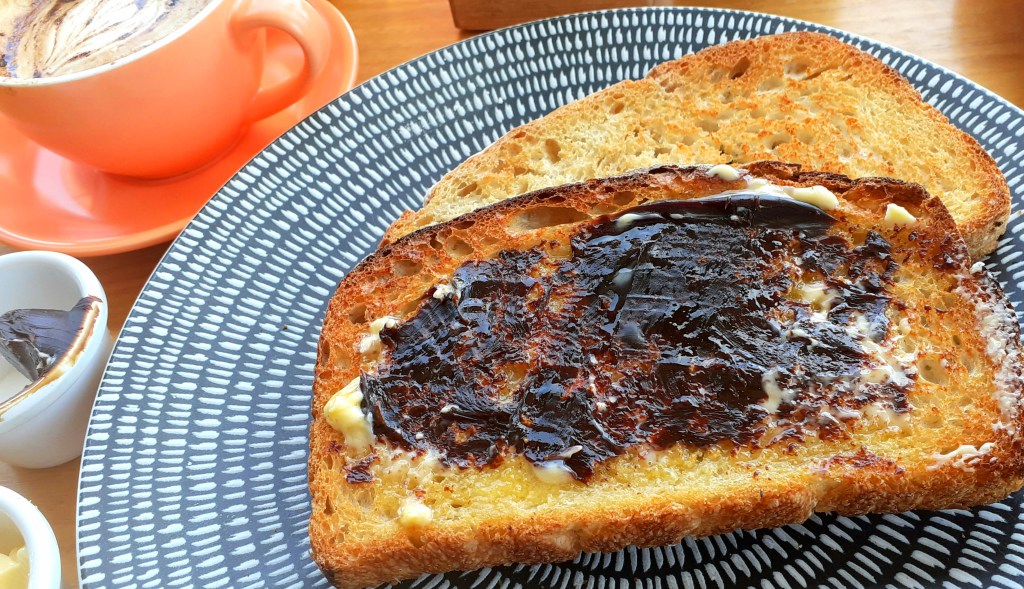
For an initial cafe treat, I couldn’t resist this plate of Australia’s very own delicacy, Vegemite, with butter on thick sourdough toast, served with a cappucino. It tastes like marmite but with the texture of smooth peanut butter. I could be developing a taste for this…
Musical choice is a track from a musician who hails from this city, and who I have admired for many years. This is Jubilee Street by Nick Cave and the Bad Seeds.
Kohlrabi is a great vegetable to cook with. It has a texture that’s been described as a cross between a turnip and a water chestnut, which sounds about right.
Quite often you will see it in recipes that treat it like the poor relation – consigned to the margins of a meal, as a side dish, or have it grated into a salad along with other ingredients.
I felt it deserved its place in the spotlight, so this dish sees it firmly centre stage (or should that be centre plate?) as the star attraction. The crisp, juicy and crunchy texture it retains when cooked makes it suitable as a main, especially for anyone on a vegetarian, vegan or plant-based diet. I hope you will find it lives up to its billing!
It is actually quite simple to make. Cut a large disc-shaped slice of the kohlrabi that is about 1 – 2cm in thickness from the widest point (the equator, if you know what I mean). Trim off the peel, then cut it into about 6 pieces. Go for irregular shapes – you want each steak to be individual and the whole dish not to look uniform. Also, work in a number of angles and corners – these will crisp and caramelise as they roast.
Briefly place the steaks in a shallow pan with a little oil. Fry each steak on both sides for about 2 – 3 mins, then transfer to a roasting dish and place in the oven, heated to 180C. Let them roast for 30 mins, flipping them over half-way through.
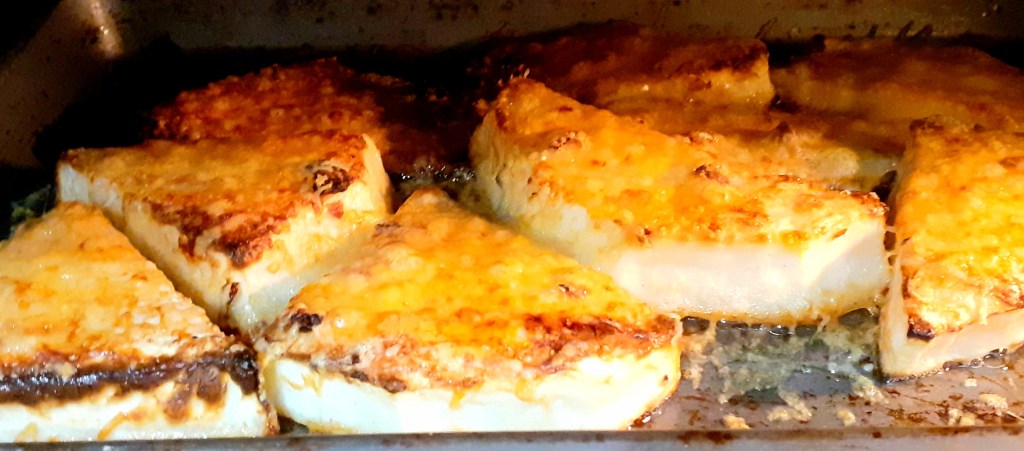
Remove the dish from the oven and grate 40g of parmesan cheese (or vegan alternative if desired) over the steaks. Place back in the oven for a further 10 mins and let the cheese melt. The steaks will be browning up nicely as the photo below shows (I couldn’t resist a sneak peek in the oven to see how they were doing).
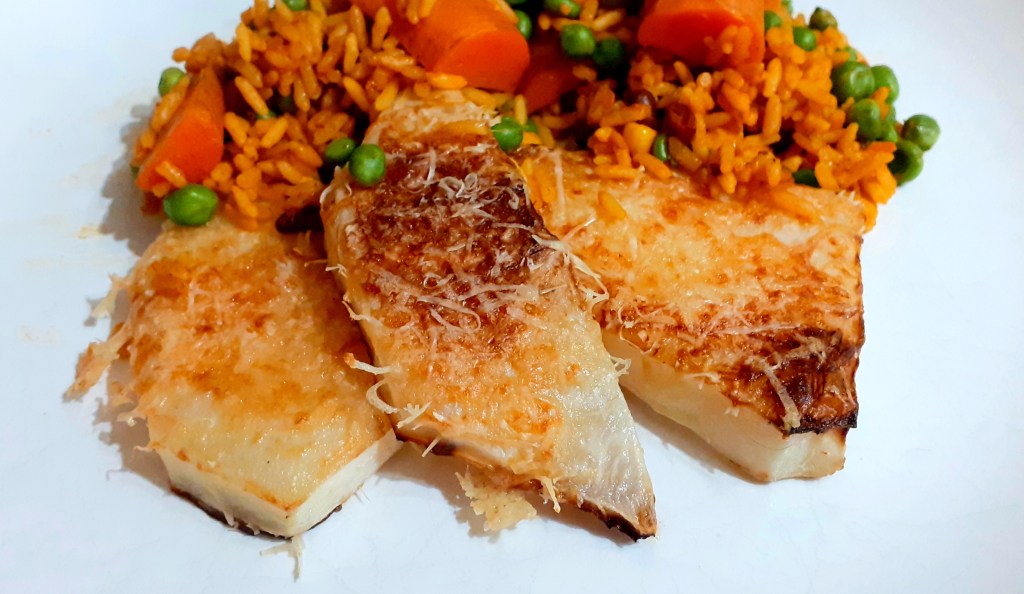
When complete, remove and serve with your choice of accompaniment. In my main photo you can see that I served this with savoury rice and steamed carrots. I served 3 steaks in one serving, making this a meal for 2.
If you like, you can make more servings, or have it again on another occasion, as you will only have used a fraction of that beautiful kohlrabi.
This is an exciting weekend for me, as I am setting off on my travels, spending the next couple of months in Australia, with some time in the Middle-East en route. I’ll be blogging here and tweeting (@differentkitch) along the way, so do please follow me on my journey. I welcome any comments and suggestions on places to visit and eat, food and drink I should try. This lovely track about global travel – Ramblin’ Man from Lemon Jelly – seems particularly appropriate today!
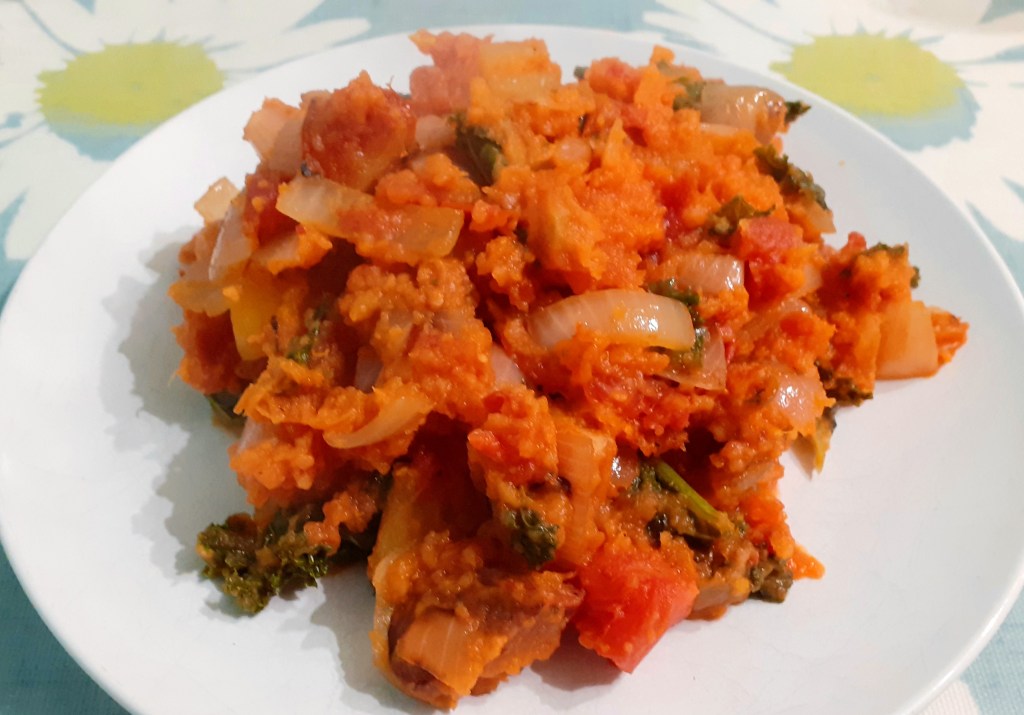
This is a great midweek meal when the nights are closing in, and a dish that I find irresistible! I love the smell and crackle of the chorizo as it sizzles in the pan, and the vivid, contrasting colours. The bright orange of the sweet potato, and freshly picked green kale from the garden, combine to make this autumn on a plate.
Servings
This is a meal for two.
Timings
15 – 20 mins to prepare.
You Will Need
400g sweet potatoes, peeled and chopped into chunks
20g butter
about 80g fresh kale (for me this was 8 or 9 leaves)
1 onion
1 red pepper
100g chorizo
400g can of chopped tomatoes
Method
Put the sweet potato chunks in a saucepan and bring to the boil. Reduce to a simmer for 15 mins.
Chop the kale leaves into strips and place in a steamer over the saucepan. They will soften in the steam from the sweet potatoes as they cook.
Separately, in a frying pan, add the onion and red pepper, chopped, along with slices of the chorizo. There is no need to add any oil or spices, as the chorizo will provide all the oil and flavouring you need.
After 5 mins, add the chopped tomatoes to the frying pan and stir in.
When the sweet potato has cooked, drain it and mash with the butter. Add it to the frying pan, along with the steamed kale.
Give it all a good stir in the frying pan and turn up the heat. Turn the mixture over a few times with a broad spatula – you should try to get some parts of the hash crisped and browned. Serve when it has reached a level of charred-ness that suits your tastes!
Customise It!
Stick to the core of sweet potato, kale and chorizo, but beyond this add in other veg you like. Garden peas or sweetcorn would be fine, for example.
You can use any good chorizo sausage. The one I used is a British-made variety from the Cotswold Curer (see photo). I picked this up at Warwick Food Market when I was in the West Midlands for the Commonwealth Games, back in the summer.
Whatever chorizo you use, remember this is a hash – switch up the heat, get that spatula in there and make sections of it nice and crisp by flipping over and over.
Just like my favourite track from Hot Chip – the latest addition to the ADK Spotify Playlist:
It’s a great pleasure to introduce our latest guest post this week on A Different Kitchen. My good friend, and master baker, Kelvin, shares with us his recipe for Coffee and Walnut Cake. He has treated me to a slice of this and I can confirm it is delicious, with a creamy coffee coating and a walnut crunch.
Hi, this is a cake that I have made a few times now. It has always been very popular with my family, and I have developed it to take account of their feedback. In particular, I have added more coffee cream filling to coat the top and sides of the cake (not just the middle), and more walnuts. This latest version was well-received at my wife’s birthday party recently. My little 3 year-old grand-daughter liked it a lot, having a second slice and asking for me to make her next birthday cake. A satisfied customer indeed!
Timings
15 mins to prepare, and around 40 mins to bake.
Servings
I used a 24cm diameter size baking tin, enough for around 16 generous slices.
You Will Need
For the Cake
225g softened butter
225g caster sugar
4 eggs
275g self-raising flour
1 teaspoon (tsp) baking powder
4 tablespoons (tbs) milk
2 tsp vanilla essence
80g walnuts (chopped)
1 tbs instant coffee granules with 1 tbs boiled water
For the Filling
150g softened butter
400g icing sugar (sifted through a mesh sieve)
4tsp milk
2tsp instant coffee granules with 2tsp boiled water
50g walnuts halved for decorating the top of the cake.
Method
For the Cake
Grease cake tin with a thin layer of butter and pre-heat a fan oven to 160C.
Beat the eggs well in a cake bowl until fluffy. Add butter, sugar, finely chopped walnuts, flour, baking powder, milk and vanilla essence. Dissolve the coffee granules in the boiled water, and add to the bowl once cooled. Mix well.
Spread mixture evenly into the cake tin.
Bake until ready in oven for 30/40 mins. Check to make sure it is no longer moist inside.
For the Filling
Beat softened butter and gently add filtered icing sugar (and when all icing sugar added) add milk. Dissolve the coffee granules in 2tsp water, and add when cooled. Beat together until smooth.
After the cake has cooled, cut it into half. Inside one half thinly spread filling. Place other half on top and cover with the remainder of the filling and around the sides (as shown in the photo).
Finish by decorating halved walnuts over icing on top of cake.
Keep in the fridge to harden the icing.
Take out of the fridge 30 mins before serving.
Slices can be frozen to retain freshness.
My choice of musical track for adding to Kevin’s ADK Playlist is The Sounds of Silence by Simon and Garfunkel. I particularly like this version, recorded live. The wonderful harmonies, the lyrics and the simple accompaniment on acoustic guitar combine to make this a favourite song of mine.
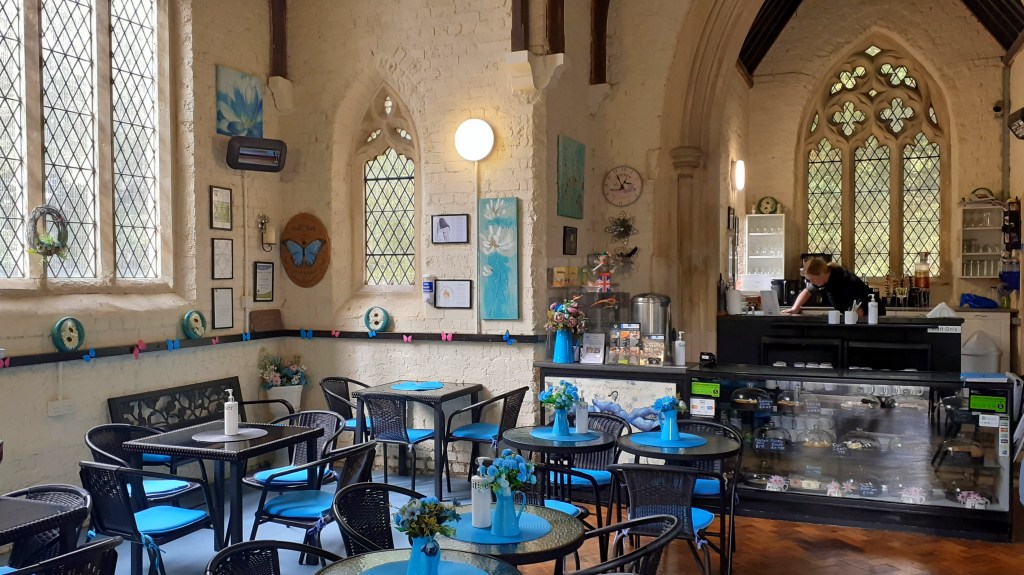
Remembrance Day falls this weekend, when we honour the memory of all those in the armed forces who have given their lives in the line of duty. As I pinned a poppy to my lapel this week, I was reminded of a rare gem of a tea and coffee house I visited a few weeks back. It is a special place for mindful thought and reflection on the loss of friends, family and loved ones. Let me introduce The Starlight Tea Chapel.
‘Stumbled upon’ is no exaggeration. In Essex for a few days, we had planned a walk in Colchester that was set to pause for tea at a National Trust mill. It was only on arrival we found that the mill was closed – cuing up a hasty search of Google Maps for a nearby alternative.
The Tea Chapel is inside the grounds of the cemetery and crematorium, although you will not find it signposted from the road. Built in 1855, it served for many years itself as a venue for funeral services, but was then decommissioned when the nearby crematorium opened. For a few years, it was effectively a store for garden tools, before being leased out as a tea room.
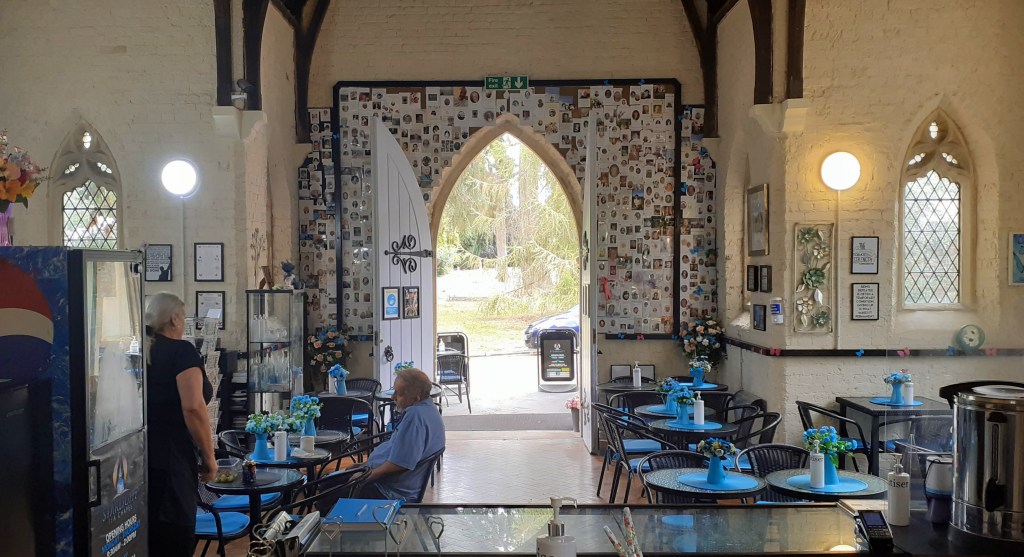
It now serves as a meeting place for a wake, celebration of life or post-funeral reception. In a touching gesture, the wall around the arched entrance door pays tribute to those whose lives have been celebrated here by loved ones, with pasted covers from orders of service (see photo above).
However, it is actually so much more. The history, the green and peaceful surroundings, and the beautiful architecture of the building combine to make this a special place for quiet and mindful reflection generally, over a tea, coffee, lunch or cake.
As we discovered, it is also open to the general public for this purpose – check on opening times before you go. I can recommend the cake!
So what is the corresponding track for adding to the ADK Spotify Playlist? Coincidentally, around the same time as our visit, I managed to obtain tickets to see Muse, a band I really like, on their UK tour next year. The track Starlight seems particularly suitable for this post, not only because of the title, but the lyrics generally and the promise to Never Fade Away.
Continuing the recent theme of cooking with autumn vegetables, this dish brings together a variety of seasonal root veg in a subtle yet spicy curry that is suitable for both vegetarians and vegans. My meal, shown in the photo, used celeriac, mooli (or white radish), kohl rabi, carrot and parsnip, though other veg are available!
Servings
This will make enough to serve four.
Timings
10 mins to peel and chop the root veg, and 30 mins to roast. The rest of the prep can be done while the veg is roasting. Allow 10 mins more to combine and finalise.
You Will Need
a baking tray full of root vegetables, peeled and chopped into chunks. I used celeriac, mooli (white radish), kohl rabi, carrot and parsnip
oil to drizzle
1 medium onion
1 garlic clove, crushed
1 fresh chilli, or 1 tsp chilli powder
1 tsp cumin seeds
1 tsp garam masala
1 tsp nigella seeds
500g passata
bunch of fresh coriander
400ml can of coconut milk
rice to serve
Method
Drizzle oil over the tray of chunked root veg and roast in the oven at 180C for 30 mins.
While the veg is roasting, heat some oil in a saucepan and toss in the garlic and spices until sizzling. Then add in the onion.
After a few minutes, add in the passata, Hold the bunch of coriander over the pan and, with scissors, cut in a generous amount.
Let the passata and coriander cook for a few minutes.
Add in the coconut milk and stir to combine. Cook for a further 5 – 10 mins. It will reduce slightly to give a thick, spicy sauce.
When the root veg is roasted, scrape it into the saucepan and stir in.
Serve with boiled rice.
Customise it!
Lots of scope to vary the veg. Butternut and other squash will work well in the roasting tray, also some chestnut mushrooms or peppers. Adjust the strength of the chilli and spices to suit your taste.
For musical choice, I have gone for a favourite track of mine, which also serves as an homage to the good people at our local community farm who harvest these lovely root vegetables from the soil – Can You Dig It by The Mock Turtles.
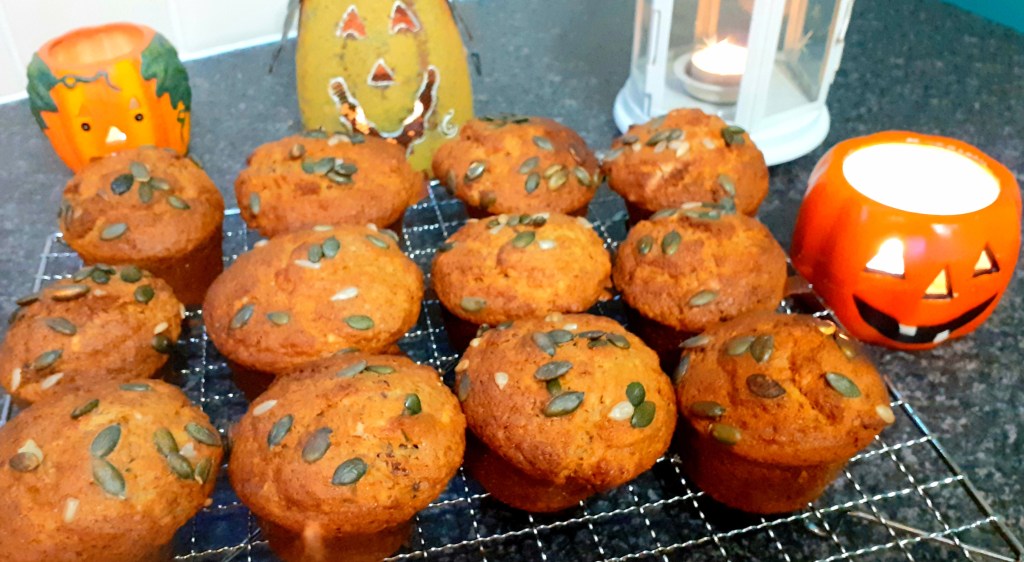
A feature of autumn is having lots of weird coloured and wonderful shaped pumpkins and squashes on our vegetable stalls. This recipe uses one of these to bring sweetness and moist texture to a set of freshly baked muffins. I recently made these on Halloween (as my photo shows!), but they are just as enjoyable for an autumn-themed breakfast, dessert or a snack with tea or coffee.
Servings
This will make 12 muffins.
Timings
10 mins to chop the squash, and 30 mins to roast it. The rest of the prep can be done while the squash is roasting, and the muffins will then take 25 mins to bake at 180C.
You Will Need
Pumpkin, butternut or other squash, peeled with seeds and pith removed, and cut into chunks. You will need 250g of chunks.
255g self-raising flour
1 tsp bicarbonate of soda
half tsp salt
2tsp mixed spice
140g caster sugar
1 egg
150ml milk
2 tablesp runny honey
90 ml vegetable oil
50 g dried fruit
50g chopped mixed nuts
a few handfuls of pumpkin and sunflower seeds to garnish
Method
Spread the chunks of squash out on a baking tray, drizzle with oil, and roast in an oven at 180C for 30 mins.
While the squash is roasting, prepare a muffin tin or mould.
In a bowl, sift together flour, bicarb, salt, spices and sugar. Add the nuts and dried fruit and stir well.
In a separate bowl, mix the egg, milk, oil and honey.
When the squash has finished roasting, remove from the oven. The chunks should be charred and caramelised at the edges. Lift them on to a plate and set aside to cool for 10 mins.
Whirl the squash chunks in a food processor with blade fitted, till you have a puree. This process should also help the squash to cool further.
Scrape the squash puree into the egg mixture and stir. Then add the egg mixture to the dry ingredients and stir well to combine.
Spoon the combined mixture into the muffin tin or mould. Sprinkle a few pumpkin and sunflower seeds on top of each muffin. Bake in the oven, still at 180C, for 25 mins until golden.
Customise it!
Cut down on time to bake the muffins by roasting the squash earlier, perhaps when you already have the oven on cooking something else. Puree it and set aside to cool, then use as stated. Feel free to substitute other types of nuts and seeds as you prefer.
Musical choice for this post comes from Inspiral Carpets. I have just obtained tickets to see the band on tour in London next spring. I’m excited about this – I have grown to really like their music in the last few years but haven’t seen them before. I especially like the 60s sounding farfisa organ played by Clint Boon. They have lots of great tracks but this one seems particularly appropriate to the season – She Comes in the Fall.
The signs of autumn are now all around us. I’ve been enjoying some beautiful wooded walks amidst glorious shades of red and orange leaves. The days are getting cooler, and this coming weekend, in the UK, our clocks will be going back one hour, bringing in earlier, darker evenings.
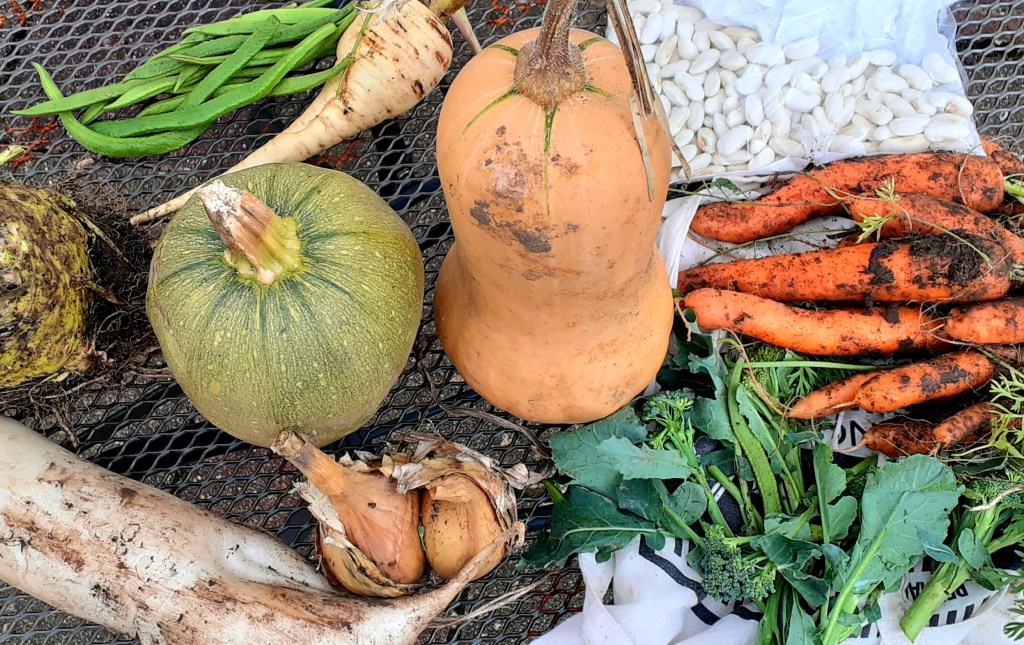
This dish was inspired by the arrival in the ADK Kitchen of a wonderful harvest of autumn vegetables from our local community farm. You can see these spread out in the photo below: butternut squash, another (as yet unidentified!) variety of squash, parsnip, carrots, onions, celeriac and mooli (white radish). Also included in the crop was some broccoli, green beans and fresh butter beans.
There was too much to use in one dish, so I focused on the squashes and root veg, which I think are lovely roasted. I added a tomato and onion sauce, with a maverick ingredient – black olives. It is topped with a crisp crust of wholemeal breadcrumbs, grated cheese and chopped nuts.
The next photo shows the finished article, warm from the oven. Served with a nice glass of red wine, it makes a great comforting meal on an autumn evening, now that the nights are drawing in.
Timings
10 mins to prepare and chop the veg, which then roasts for 30 mins. The rest of the prep you can do while the veg are roasting. Allow a further 20 mins for the assembled dish to roast further.
Servings
This will serve 6 people.
You Will Need
A pyrex dish-ful of chopped seasonal veg: I used butternut squash, celeriac, parsnip and mooli, and added some chestnut mushrooms and red pepper
A sprinkling of herbes de provence
Some olive oil
A 500g carton of tomato passata
1 onion
1 clove of garlic
75 g pitted black olives, whole or chopped
5 or 6 slices of wholemeal bread chopped into crumbs
75g grated cheddar cheese
75g chopped mixed nuts
Method
Chop enough veg to half fill the pyrex dish that you will use. The veg should be in chunks roughly about 2-3cm square. Tip them into a separate metal baking dish and sprinkle with the herbes de provence. Drizzle with olive oil and roast in the oven for 30 mins at 180C. Spread them so that they are in a single layer, and use a second metal dish if necessary.
While the veg is roasting, chop the onion and add it to some hot olive oil in a saucepan, with the garlic clove, crushed. After a few minutes, tip in the passata and black olives, and mix. Let it bubble for around 10 mins so that it is slightly thickened in consistency.
Separately, combine the breadcrumbs, grated cheese and chopped nuts in a bowl. Get your hands in there and give it all a good mix. You want the cheese to be intertwined with the other ingredients so that, when it melts, it will bind it all together into a crisp coating.
When the veg has roasted, combine it with the tomato sauce, and pour into the pyrex dish. Pat it all down with the back of a spatula so there are no gaps.
Sprinkle over the bread, cheese and nut crust, evening it out and patting it down with the backs of your fingers. Give it a final drizzle of olive oil.
Cook in the oven for around 20 mins, or until the top is crisp and golden. With some ovens, it may help to give it a final 5 mins under the grill to crisp it up. Serve.
Customise it!
Lots of scope for customising here, starting with choice of veg. Really, you can use whatever is in season and whatever particular veg you prefer. There are many varieties of squash and root veg around this time of year, most of which benefits from roasting, helping it sweeten and caramelise on the outside and succulent to bite into.
With the crust topping, you can use other bread for the crumbs, and other cheese. Grated blue cheese would give it a lovely taste twist, as would some parmesan. The next time I make this I will include some pumpkin and sunflower seeds in the crusty mix.
You can omit the olives if they’re not your thing. I love them, and had the idea to include them in the sauce and serve the dish with a warmed, sliced black olive ciabatta (see my photo), which all worked really well.
The dish is suitable for vegetarians. To make it vegan, simply omit the grated cheese, though the topping will be a little looser. However, you could always use a vegan cheese. As ever, feel free to experiment!
This time of year also means that Halloween is approaching. I’ll be saying more about this in this coming weekend’s post, and hopefully having a little fun. For now, I’ll choose a track from a Halloween Playlist I have on Spotify, to share as musical accompaniment.
Cue Superstition by Stevie Wonder. Nothing more to say!
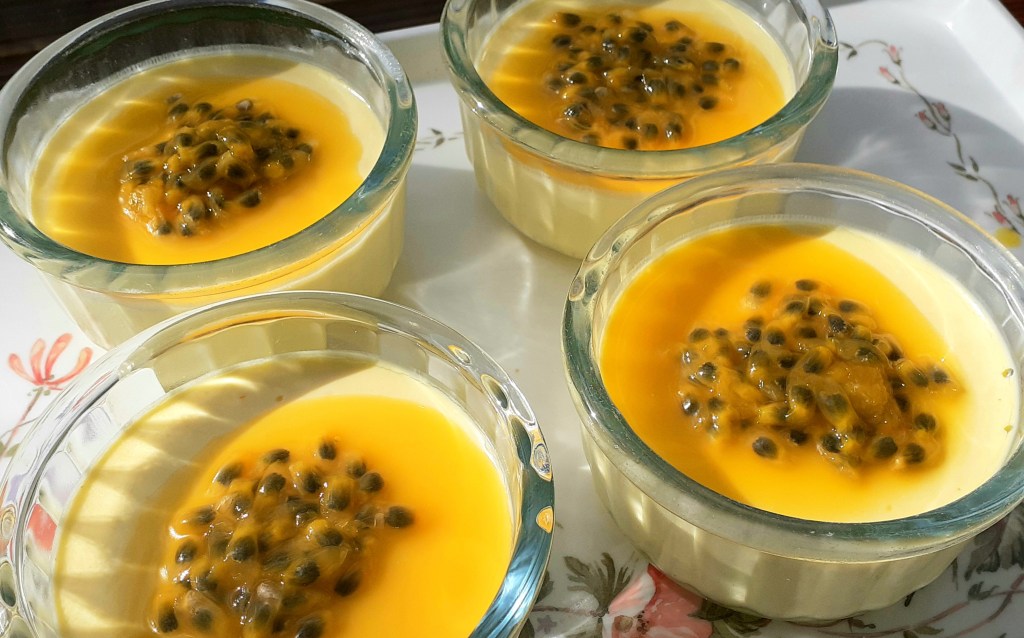
I made these recently to share with friends as a dessert after a dinner party. They look good, taste fresh and tangy with a hint of sweet and sour, are a little different from the norm, and not that difficult to make. They can also be prepared well in advance of mealtime. It is a Mary Berry recipe originally, so thanks to Mary for the inspiration!
My recent photo post on Twitter for this dish received a new record number of likes for A Different Kitchen, so I’m sharing the full recipe here.
Timings
20 mins to prepare, at least two hours to set in the fridge.
Servings
This will make six pots.
You Will Need
6 passion fruits
juice of 1 lime
600ml double cream
100g caster sugar
Method
Tip the cream and sugar into a saucepan. Heat and stir until the sugar has dissolved, then step up the heat and boil for 3 minutes. Remove from the heat.
Halve 5 of the passion fruits and scoop out the juice and seeds. Whirl the juice and seeds in a food processor with blade fitted, until smooth. Push through a sieve so that you have a smooth juice, and discard the seeds.
Add the passion fruit juice to the warm cream and sugar mixture, so that the cream will start to thicken.
Add the lime juice also to the mixture, and stir in so that it thickens further.
Pour the mixture into six ramekins and let cool. Once cooled, place in the fridge to set for at least 3 hours.
When ready to serve, cut the remaining passion fruit in half and scoop out the juice and seeds. Scatter this across the surface of the 6 pots, and serve.
The musical accompaniment to this dish should be smooth, mellow and sophisticated, with just a hint of an edge to reflect the combination of sweet and sour. I’ve opted for a band getting a lot of play recently in the ADK kitchen, and that is Massive Attack, here with the excellent vocals of Tracey Thorn. Enjoy Protection.














 A Different Kitchen