Categories
Blog Food

Satay by the Bay

Satay by the Bay is one of Singapore’s many hawker centres – places where a variety of independent food and drink outlets congregate around a central area with tables and chairs. The idea is that you buy as much or as little as you wish from any of the stalls, then take a seat to eat it.

Access is through Gardens by the Bay, a beautiful and lush green park built on reclaimed land between the Marina Bay area and the waterside. It has two vast domed greenhouses, each of which maintains a bespoke climate to suit plant life that would not thrive here otherwise. It’s a bit like Cornwall’s Eden Project, but set in 30C year round temperatures.

The vast pipe outlets that help maintain the indoor climate of the domes have been dressed up as Supertrees. A 22m high walkway connects them, and gives terrific views over the Gardens with a backdrop of the glass and steel of the CBD.

Some of the many walks allow views of Marina Bay Sands, the vast triple-towered Hotel with a viewing deck across the top. Its design reminded me of my visit to Stonehenge a few months back. It also looks like a huge cricket wicket. Howzat.

In the evening, the Gardens are the venue for an impressive sound and light show, with the Supertrees choreographed to light up to the rhythm of classical music.

All of which makes a pretty good after dinner show for the diners at the hawker centre.

We chose plates of chicken and beef satay, that are cooked to order over hot coals.

The skewers are then served with a spicy peanut dipping sauce, as shown in my photo at the top of the post.

Now, sat here in Singapore’s Changi Airport, our flight is being called, so it’s time to stow my laptop and get to the departure gate.

We have had fun and eaten well in Singapore, but it is time to move on to our next stop. To find out where in the world that will be, check back here this weekend.

Keeping up the current international theme on the ADK Playlist,  here’s Transglobal Underground with the catchy Temple Head.

Categories
Blog Food

Kampong Gelam

Here in Singapore, the district of Kampong Gelam (also spelt Glam) is the traditional heartland of the city state’s Malaysian community. Our visit there, in search of some traditional Malay food, coincided with the start of Ramadan, the period where people of Muslim faith fast during the hours between sunrise and sunset.

We hadn’t been in this part of town during the daytime – that was spent in Chinatown and the Botanic Gardens. Due to the fasting though, I’m guessing that daylight business might have been a little slow for the local catering sector.

However, as Alex Turner of the Arctic Monkeys once (nearly) said, it changes round here when the sun goes down 🙂 .

As we arrived, the wailing sound of the call to prayers was all pervading, booming out across the network of tightly packed streets from the local Mosque.

The religious service inside was being broadcast live on a large screen, and very well-attended it seemed to be. After a day of fasting, it’s no surprise that the hungry worshippers were ready for some great food, as they spilled out on to the streets afterwards.

And how well served they were! There was traditional Malaysian food, like Satay…

…alongside a range of Turkish, Lebanese and Middle-eastern outlets.

The already numerous restaurants and takeaways were supplemented by the Gemilang (meaning Glorious) Festival, bringing even more food options through abundant market stalls.

I was keen to try a Malay dish I had read about called Nasi Lemak. We found it in a small restaurant that has made it their signature dish, and earned themselves a Michelin star, no less, in the process. For the record, the place is called Nasi Lemak Ayam Taliwang, and you can look them up in the Michelin Guide.

The food arrived as shown in my main photo at the top of the post. The undoubted star of the show was the mysterious green parcel to the side of the plate.

The wrapping is a pandan leaf, used in south-east Asian cuisine to add fragrance to food. It is secured at either end by bamboo skewers. These are unpinned, and the parcel unfurled to reveal steamed, soft, fluffy jasmine-scented and coconut-flavoured rice.

The rice is served with tender chicken that falls off the bone and a spicy peanut sauce. There is a side of crispy peanuts and anchovies, and soft roasted aubergine.

An interesting and satisfying meal was rounded off with a glass of fresh, chilled coconut juice, that complemented the food well.

There’ll be another post from Singapore in a few days. In the meantime, let’s have some more suitably themed music for the ADK playlist. Here’s the mighty Asian Dub Foundation with Fortress Europe.

Categories
Blog Food

Hello Singapore

I’m off on my travels again, and hoping to post about some excellent world cuisine over the next little while. First stop is the city state of Singapore, home of the Merlion I snapped in my main photo above.

After a 13 hour flight from London, my wife and I were hungry and ready to explore the local neighbourhood where our hotel is located, in the city’s district known as Little India. It is so-called because, since the 19th century, workers and their families travelling here from India have made this district their home.

Consequently, a walk around the local streets is an experience to behold. They teem with garish gold jewellery shops and the lingering scent of incense. There are spangly market stalls packed with colourful saris and dress shirts, at which industrious tailors sit by their sewing machines, ready to customise a garment to your precise fit.

The lanes are sided by canopies and known as five-foot ways. Originally designed to afford residents fresh air with shade from the hot sun, they now provide alfresco seating for hungry diners at the many restaurants and food stalls selling authentic Indian food.

We settled at a corner establishment and ordered the selection below: chicken and vegetable birianis, which came with a raita and selection of dipping sauces.

The side of vegetable samosas was unlike any I have had before. I am used to a filling wrapped up in a deep fried, triangular parcel of filo pastry, but these were pear-shaped, in a crispy pastry that had the sweet, coconut flavour of peshwari naan bread.

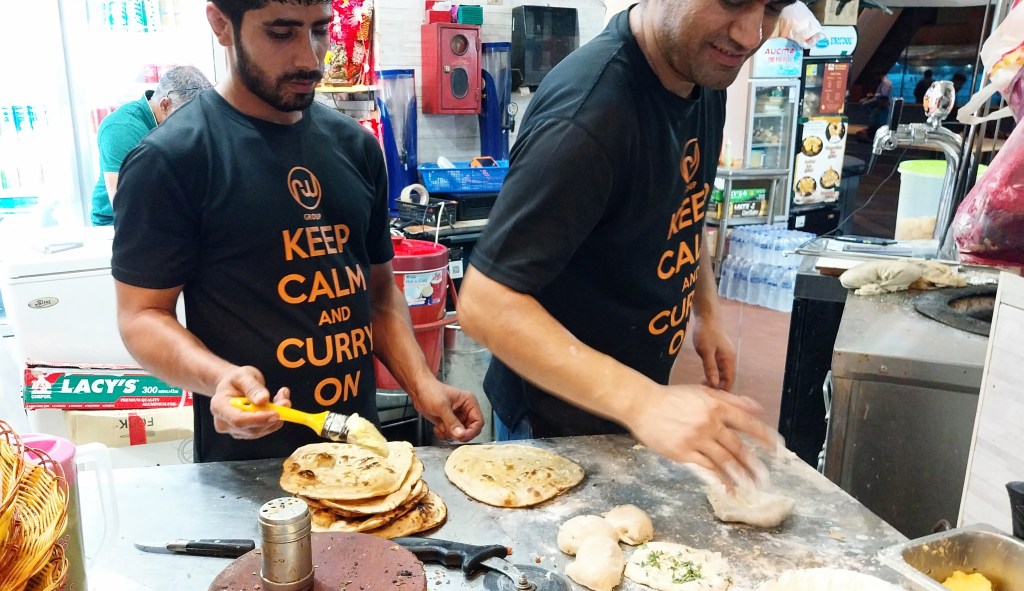
It was authentic, no-nonsense fare, cooked and served with cheer (check out these guys, and their cool t-shirts, below).

I’ve read that this is generally an expensive city, but this food came at reasonable prices (less than S$20 per head, which is about £10/US$20, and that included the Tiger beers).

There’ll be more to come from Singapore, so watch this space. If anyone wishes to send me recommendations on local places to eat, or food to try, please post in the comments below.

I’m keeping the Indian vibe going with this track from Monsoon added to the ADK Playlist: Ever So Lonely.

Categories
Mains Recipes

Carrot & Parsnip Miso Soup

Warm, filling and comforting, this winter vegetable soup is jazzed up a little with the addition of Japanese miso paste.

I hadn’t used miso before, but wanted to try it after reading about it on some of the other foodblogs here on WordPress. It is made from fermented soya beans, which means that it is rich in protein and good for gut health.

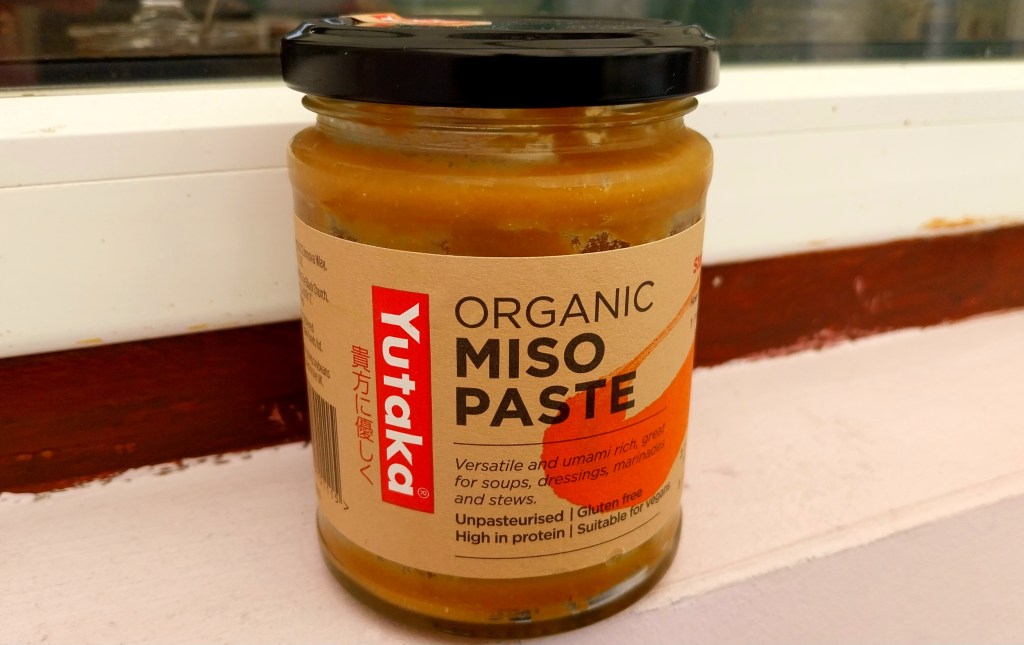
This is the variety that I used, made by Yutaka. I did have a little trouble finding it in Sainsbury’s at first, but eventually came across it in the Far Eastern aisle. Just to clarify, by that I mean the speciality Asian foods section, not that end of the building down by the motorway 🙂

I made a large batch of the soup in a saucepan on the hob, and kept it for a few days. I could then ladle some into a bowl, stir in some miso, and microwave it for around 3 mins for a very quick, tasty and nutritious lunch. It is vegetarian and vegan, so everyone can enjoy what the Japanese call that umami – or rich and savoury – taste.

Servings

About 6 bowlfuls.

Timings

The barley soup mix needs soaking overnight, then boiling for 45 mins. Once that’s ready, the soup takes about 25 mins to make.

You Will Need

  • 100g dried barley/lentils/split peas soup mix
  • oil
  • 1 onion
  • 3 celery sticks
  • 200 – 250g carrots
  • 200 – 250g parsnips
  • 1.5l vegetable stock
  • a few twists of black pepper
  • 1 jar of miso paste

Method

  1. Cover the soup mix with cold water in a bowl and let rest overnight.
  2. The next day, drain the soup mix and rinse in a sieve under cold running water. Place in a large saucepan and cover with boiling water. Let it boil for 10 mins, then reduce to a simmer for another 35 mins. Drain with the sieve, and set aside.
  3. Chop all the veg into chunks and place in the empty saucepan with some oil, over a medium heat. Put on the lid and let it sizzle for around 10 mins, stirring every so often. It should become softened and a little browned at the edges.
  4. Add in the stock and bring to the boil. Then reduce to a simmer for 10 mins.
  5. Remove the pan from the heat for a few moments, and blitz it by plunging in a handheld blender. If you don’t have one, spoon at least half of the soup into a food processor with blade fitted, and blitz it there before returning it to the pan.
  6. Add in the cooked soup mix with 2 tbsp of miso and the black pepper, and stir in. Then simmer for another 5 – 10 mins.
  7. Switch off and let it rest. When it has cooled, transfer to the fridge. It will keep for a few days, during which the texture and flavour will deepen.
  8. To serve, ladle some into a bowl and stir in another tbsp of miso to individual taste. Microwave until hot, and enjoy.

Customise It!

Almost any seasonal winter veg that you have available will go well here. Stick with making the carrot and parsnip prominent, though, as these give it a distinct, sweet flavour. Experiment with the miso, adding as much or as little as necessary to suit your individual taste. The miso already contains salt, which is why I only added black pepper at the seasoning stage.

There probably won’t be a better chance to add Japan to the ADK Playlist, so here they are with the eerie Ghosts.

Categories
Blog Music

The 1975

As a massive music fan (the blog tag line here being Good Food, Great Music), I’m excited to say that this week’s live music experience (see The Lexicon of Love) has continued.

There I was in the ADK Kitchen, working on my next post about a nice vegetarian soup, when a friend called with the offer of a spare ticket to see The 1975 at the Resorts World Arena in Birmingham. I hadn’t heard too much of their music, but am always game to see a new band play live, especially one as globally successful as The 1975. Apologies – that soup recipe will have to wait until this weekend, folks!

With my apron hung on its peg, and the spatula in the dishwasher, we headed off in my friend’s car towards the M40.

We weren’t disappointed – The 1975 were very good.

The stage was set extremely stylishly (see my photo above), all in white and, for the first part of the show, decked out like the cool interior of a chic apartment. Warmly illuminated in changing pastel shades, the coffee tables, lamps, armchairs and TV sets created a relaxed feel, against which the band played great music and their engaging frontman, Matty Healy, acted out his inner angst.

I am still not sure whether Matty really is the chainsmoking, hip flask swigging, tortured romantic soul that comes across on stage, or whether this is just a character portraying the emotional vulnerability that runs through the lyrics of so many of the band’s songs. The answer, I suspect, is somewhere in between.

Track after track of their brand of soulful pop rolled out across an adoring audience – some of their biggest songs, like Oh Caroline and I’m In Love With You, included.

They’re clearly a band that like their performance art, and this is stepped up in the middle part of the show. With the band off for a break, Matty, alone on the stage, sinks to his knees before a bank of TV sets, fizzling with snippets of newscasts reporting global issues of concern. I won’t say any more for fear of spoilers, but what happens next is fascinating.

Some people in white coats swarmed on to the stage. No, not to take Matty away – it was the stage crew, who proceeded to rearrange the set for the second half of the show while the band played on. It reminded me of how the road crew build Talking Heads’ set from the floor up, track by track, during the great concert movie, Stop Making Sense.

The final hour of the set was a joyous celebration of the band’s best music, including Tootime, The Sound, Love It If We Made It, and People. It brings pleasure to the whole of a packed arena. Heck, it even brings a smile to Matty’s face.

All in all, a thoughtful, considered, ever changing, engaging and very entertaining performance. I now consider myself a fan!

Here’s one of my favourite tracks that they performed live. The 1975 with It’s Not Living (If It’s Not With You).

I’ll be back at the weekend with, er, some soup.

Categories
Mains Recipes

Beetroot Falafel

First of all – yes, they really are that colour! No filter required here.

I had the idea that roasted beetroot might make an interesting falafel. Having bought a bag at the market, I began looking around at a few recipes online and in books.

This version is a combo derived from various sources. The inclusion of chickpeas, tahini, cumin and coriander stays true to the falafel’s middle eastern origins, while roasting the beetroot first with garlic, and drizzled with balsamic vinegar, gives it a definite European dimension. The pieces of beetroot give a bite to the texture and stop the falafel becoming too dry.

The falafel are served with a dipping sauce simply made from tahini, fresh lemon juice, honey and black pepper.

And they’re both vegetarian and vegan, so everyone is happy 🙂

Servings

This made 10 falafel.

Timings

25 mins to roast the beetroot, then 10 mins to make up the falafel. They then roast in the oven at 180C for 20 mins.

You Will Need:

  • 300g raw beetroot, peeled and cut into chunks
  • 1 garlic clove
  • oil
  • balsamic vinegar to drizzle
  • 250g chickpeas
  • 2 tbsp tahini
  • 1 tbsp ground coriander
  • 1 tbsp ground cumin
  • a twist of sea salt

For the tahini dip:

  • 3 tbsp tahini
  • juice of 1 lemon
  • 2 tbsp honey
  • a twist of black pepper
  • toasted sesame seeds to sprinkle

Method

  1. Scatter the chunks of beetroot on a roasting tray. Crush the garlic clove over the chunks and drizzle with oil. Place in the oven at 180C for 25 mins. Half way through, take the tray out and drizzle the balsamic over.
  2. Let the roasted beetroot cool for 5 mins while you prepare the rest of the mixture.
  3. Put the chickpeas, tahini, coriander and cumin in a food processor with blade fitted. Add in the beetroot and any oil/garlic scrapings from the roasting tray. Blitz to a smooth consistency.
  4. Shape into patties with the palms of both hands. Place on a clean roasting tray and brush with oil. Place in the oven for 20 mins, turning them over with a spatula half way through.
  5. While the falafel are in the oven, combine the ingredients for the dipping sauce with a spoon. Sprinkle over some toasted sesame seeds just before serving.
  6. Serve the cooked falafel with the dipping sauce alongside, as shown in my main photo above.

Customise It!

Good as they are, there are two things I will do differently next time I make these. Firstly, I’ll include some chopped fresh coriander, which I think will enhance further both the taste and the look. Secondly, I would like to try cooking them in an air fryer, which I reckon will give them a crispier shell.

I wouldn’t change the colour though which, as you can see from my photo, is a deep shade of purple. Now that’s what I call a cue for adding the next track to the ADK playlist! Air guitar at the ready everyone, this is Deep Purple with Smoke on the Water.

Categories
Mains Recipes

Soup-erbowl

This weekend’s incoming batch of seasonal veg from our local community farm had winter soup written all over it. I’m talking hearty and wholesome here, with pearl barley and lentils, giving a good portion of protein and fibre. Included in the box was even a handful of fresh herbs – parsley, sage, rosemary and thyme, would you believe. Well, hey – I feel a song coming on!

For the benefit of any millennials, that’s a reference to a line in a Simon & Garfunkel song, Scarborough Fair – check it out.

Which brings me to another great American institution that’s been around for over half a century. Yes, it’s Superbowl weekend – Superbowl LVIII to be precise (that’s 58 to you and me – why does the NFL insist on using roman numerals?).

The pinnacle of the American Football season is a match-up between the Kansas City Chiefs and the San Francisco 49ers. It’s a repeat of the 2020 game, when the Chiefs emerged victorious. My prediction is that the Chiefs will be taking home the trophy once again – Patrick Mahomes and co just seem to have the experience and the ability to do what it takes when it comes to the postseason play-offs.

Food is always a key part of enjoying the Superbowl, and each year I aim to come up with a healthy(ish) snack to have with the game. There will definitely be some Smoked Paprika Popcorn on the table, when the game kicks off at around 11.30pm UK time.

It’s always fun seeing what extravaganza they have lined up for the Half Time Show. This year the game is taking place in Las Vegas, which is where U2 have been performing their residency at the Sphere. Seeing as Bono and the lads are in town, I did hope they might be popping down to the stadium to treat the audience to a few numbers. Usher is this year’s headliner, however. I understand he’s trailed that he may bring along a special guest, so….you never know?

Anyway, where was I? Back to the homemade soup, which I shall be enjoying this Soup-erbowl weekend.

Servings

4 adult servings.

Timings

The pearl barley/lentil mix needs soaking overnight, then boiling/simmering for 45 mins. Making the soup is then about another 30 mins.

You Will Need

  • 100g pearl barley/lentil/split pea mix
  • 500ml water
  • 1 onion
  • 2 celery sticks
  • 2-3 carrots
  • 1 parsnip
  • 500ml veg stock
  • handful of parsley, sage, rosemary and thyme (or whatever fresh herbs you have!)

Method

  1. Soak the pearl barley mix overnight in the cold water.
  2. The next morning, pour the water away and rinse the pearl barley mix under cold running water. Place in a saucepan and cover with water, Bring to the boil for around 10 mins, then reduce to a simmer for another 35 mins. Switch off and drain.
  3. Using the same, empty saucepan, heat a little oil and throw in the chopped onion, celery, carrots and parsnip. Stir and let the veg soften in the heat.
  4. Pour in the veg stock and bring to the boil. Reduce to a simmer, and tear in the herbs. Season with salt and pepper.
  5. After 10 mins, blitz about half of the soup with a handheld blender. Alternatively, transfer half to a food processor with blade fitted, blitz and return it to the pan. This will give the soup a nice consistency, while still having chunks of veg in there.
  6. Add in the cooked pearl barley mix and simmer for another 10 mins. Switch off, and the soup is ready to serve.

Customise It!

Any other winter root veg will go well – swede, celeriac, potatoes for example. Add in a leek or two. Just make sure you don’t mess with the parsley, sage, rosemary and thyme (only kidding, use whatever fresh herbs are to hand).

Just imagine what a brilliant Half Time Show Simon & Garfunkel could have put on. As far as I know, they never did one, however, and it’s unlikely to happen now. Unless they do an Abba, and have avatars, perhaps? All that classic Americana would go down a storm with the Superbowl audience. We can but dream. Here they are with one of their best: Mrs Robinson.

Enjoy Usher; enjoy the Superbowl, everyone.

Categories
Blog Drinks Mains

Lo/Hi

We’re nearing the end of 2023. I’ve been fortunate to travel to many interesting places this year, and have enjoyed sharing my experiences of the local food, drink, culture and the music it inspires, in my posts here on A Different Kitchen. As the year draws to a close, there is one more fun place to tell you about.

In December I spent a few motorhoming days in the picturesque town of Bridgnorth in Shropshire. The place is actually made up of two distinct towns: my main photo above is taken in Low Town, by the banks of the River Severn, looking up towards High Town.

My photo below is then taken having climbed up to High Town, where there are great views looking out over, er, Low Town.

From the Middle Ages, traders’ boats travelled up the River Severn to unload their cargo at the Quay in Low Town. The goods were then wheeled up by hand cart to the market hall in High Town via The Cartway – a twisting, cobbled path. You can still walk this route today, see my photo below.

It is as steep and winding as ever, though many of the cottages along the way are now cosy, bijou holiday residences, judging by the number of lockboxes on the frontages.

The goods imported were mainly rum, spices and exotic foods from distant lands, and they were exchanged for local ceramics, metalwork and coal. The market hall still stands in the centre of High Town and hosts a market, though these days it features regional meats and speciality cheeses.

Trade continued until the mid 19th Century when, according to the Town Guide, it was overtaken by the arrival of the railways. My own alternative theory is that, after years of hauling their beautiful rum, spices and exotic foods up to High Town, to exchange them for a few of our pots, pans, and pieces of coal, the tired and hungry importers eventually realised they were getting rather the bum end of the deal.

Among the many curious features of High Town is the Castle Keep. It is all that remains standing of the Castle, which was largely destroyed in the English Civil War of the mid 17th Century. I say standing, but leaning is a more apt description – see below.

To borrow a word styling from American Football commentators, it is amongst the most leaningest structures in the world. In fact, it is 4 times more leaningest than the Tower of Pisa in Italy. How it hasn’t fallen over, I don’t know. Even though it moves a few degrees each year, it is reportedly safe – there are no cones or hazard warning tape to keep pedestrians at a distance. I can only assume the Town Council’s Health and Safety Department has a commendably relaxed attitude to risk. Still, I wouldn’t dawdle while going past/under it, if I were you.

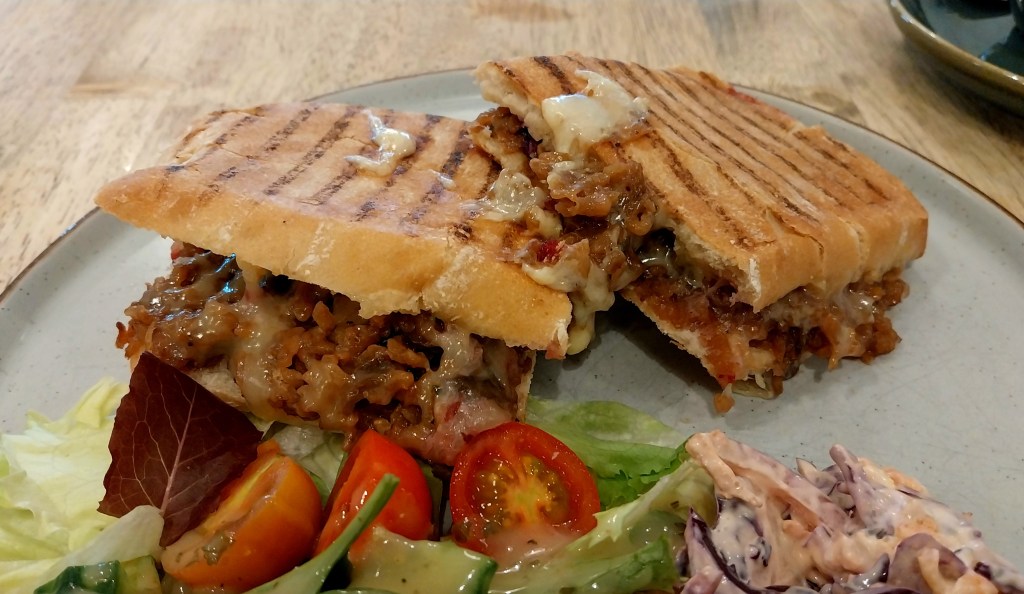
Food options are many, varied and good quality. I stopped for lunch in High Town’s Coffee at d’Arcy’s, tempted by the seasonal vegan toasty – a hot panini filled with slices of nut roast and cranberry sauce. Delish!

I accompanied this with a Pumpkin Spice Latte. I have to confess to being somewhat late to the party with this concoction. For some time I have held the puritan view that, if the coffee beans are good quality, roasted with expertise and ground by a skilled barista, the drink should not then be ruined with a shot of sweet syrup. That was before I had the benefit of trying one, however, when I realised how great it tastes. I am now a convert who believes that, used correctly, a shot of syrup can complement and enhance a good quality coffee, rather than overpower it.

The unique geography of Bridgnorth kept reminding me of this track, which played a few times on my headphones as I walked around exploring. I am quite sure The Black Keys – those heavily blues-influenced rockers from Ohio – didn’t write this about a picturesque market town in Shropshire, but it’s a great song and the title fits well. Here they are with Lo/Hi.

Happy New Year everyone! Onwards to more travel, sounds, food and frivolity in 2024.

Categories
Blog Breakfast

Solstice at Stonehenge

Fancy an online breakfast watching the sun rise over Stonehenge on the Winter Solstice this Friday? Read on.

We’re approaching that time of the year when those of us here in the northern hemisphere experience the shortest day. The Winter Solstice is a special time at Stonehenge, which I visited during my recent motorhome trip to England’s west country.

Now a World Heritage Site, Stonehenge is a very mysterious place. Historians still do not fully know how or why our Neolithic ancestors built this grand arena of standing stones some 5,000 years ago, when tools were primitive and scientific knowledge rare. However, the stone circle manages to correctly align with the movement of the sun at two key points in the year, every year – sunrise on the Summer Solstice, 21 June, and sunset on the Winter Solstice, 22 December.

The mystery has imbued the place with a magical significance. Coachloads of people from all over the world visit the stones every day of the year, to stand and gaze up in awe and wonder as to their original purpose (see my photo at the top of the post). And on the Solstice, many people make a pilgrimage here to witness the event for themselves.

To give a sense of the mystery, I took some photos of the scene under a turbulent, evolving sky. All of the shots in this post were taken within a span of around 15 mins, while I walked around the stones. A cold wind was whipping across the exposed landscape, the quality of light was changing, and the clouds gathered and churned. My final photo below shows how the scene can suddenly turn very dark and brooding. Quite an atmosphere.

This Friday, I’ll be settling down with a breakfast bowl of Brainfood to watch English Heritage’s free, live streaming of the sunrise from Stonehenge, here. Expect things to kick off after 7.00am, with the actual sunrise forecast for 8.09am. All times are GMT, so check the corresponding time for wherever you are in the world. North America, you may need to set an alarm!

Comments below will be open if anyone wishes to chat, while I’ll also be on my Twitter/X channel @differentkitch.

There aren’t many hippie artists on the ADK Playlist, but I think the nature of this post, and the time of year, justifies the addition of this track: Jethro Tull with Ring Out, Solstice Bells.

Categories
Bakes Recipes

Cranberry, Oat & Yoghurt Muffins

It’s that one time in the year when the UK’s lovely friends and allies over there in the US and Canada share with us your precious treasure of fresh cranberries. Thank you!

The rest of the year, we have to make do with jars of Ocean Spray Sauce. Not that I am complaining about that, though – they are a reliable addition to the winter dinner table. We also have dried cranberries, of the sort I used to make Cranberry & Pistachio Cookies, for example. However, none of these ever tastes quite the same as the fresh article.

So how excited was I this week, when I saw packs of fresh cranberries imported from America, sitting there in Sainsbury’s fruit and veg section, nestling up alongside the blueberries. I quickly threw a couple of packs in the trolley and began making plans.

Here I am sharing with you my fresh cranberry, oat and yoghurt muffins – just follow the recipe below. I like these because they bring out the natural sourness in the berries, which we can’t usually taste as the processed varieties have been sweetened before they reach us. That sourness is enhanced by the bitterness of the yoghurt, while there is also a chewy, nutty bite in the rolled oats.

The light brown sugar provides a complementary sweetness in the cake mixture, making for an overall, pleasing blend of flavours on the tongue. What’s more, as the fresh cranberries burst with the baking, they infuse the muffin with juice that will keep the cake moist. Irresistible!

See my main photo above for the muffins, including one I cut in half to show the richness of the filling. A highly satisfying, healthy muffin to be enjoyed at breakfast, as a snack or a dessert.

So, to all our North American friends – as you can see, we are taking care of your special gift to us, and turning them into healthy, tasty treats. Please keep these little fellas coming!

Servings

This will make 12 muffins.

Timings

10 mins to prepare, 20 mins to bake at 180C.

You Will Need

  • 200g plain flour
  • 1 tsp baking powder
  • half tsp salt
  • 85g rolled oats
  • 140g natural yoghurt
  • 1 tsp bicarbonate of soda
  • 1 egg
  • 120g light brown sugar
  • 140g fresh cranberries
  • 90ml milk
  • 90ml veg oil

Method

  1. Switch on the oven to 180C. Prepare a muffin tray or mould.
  2. Sieve the flour, baking powder and salt into a bowl.
  3. Pulse the cranberries in a food processor with blade fitted, for a few seconds, 2 or 3 times. Light chopping will help them fully bake and soften in the muffins. Tip into the bowl of flour and stir so the fruit is coated.
  4. In a separate bowl, combine the oats with the yoghurt and bicarb. Leave for a couple of minutes, then stir in the egg and the sugar. Finally, stir in the milk and veg oil.
  5. When the oven is up to temp, combine the wet ingredients with the dry, and stir until no dry ingredients are visible. Spoon in to the muffin tray/mould, and place in the oven for 20 mins.
  6. When they are looking browned, as in my main photo above, remove to a wire rack to cool. Enjoy!

Customise It!

If I was making one change to this, I would swap in broken pieces of white chocolate for some of the cranberries, at a ratio of up to half and half. That also helps bring out the sweet and sour contrast.

There really can be only one band to accompany this post, so I’m adding this track to the ADK Playlist. Limerick’s own The Cranberries with Dreams.