The time has come to leave the Dordogne after a lovely holiday, and head back to the UK.
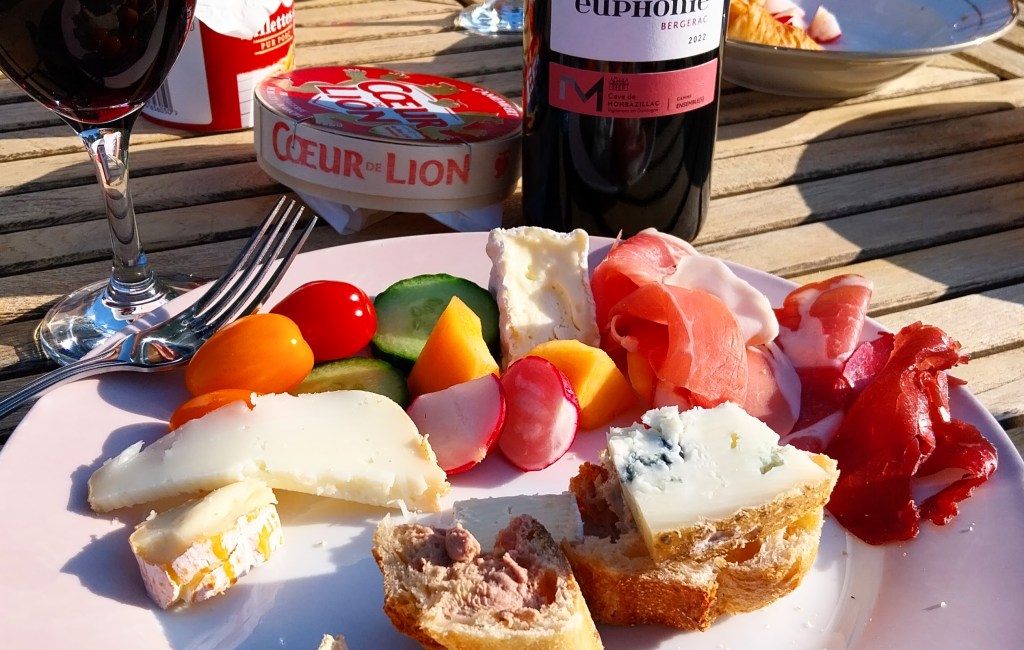
We have certainly dined well during our stay, as should be clear from my last few posts. My favourite meal in France remains a very simple one, however – a summer spread of cheese, paté, hams and salad that we have enjoyed outside in the sun most evenings, as shown in my photos above and below.
We’ve enjoyed baguettes from the local boulangerie, baked fresh and collected every morning, and best eaten the same day. They have a crisp exterior, and soft, buttery textured inner that carries a real taste.
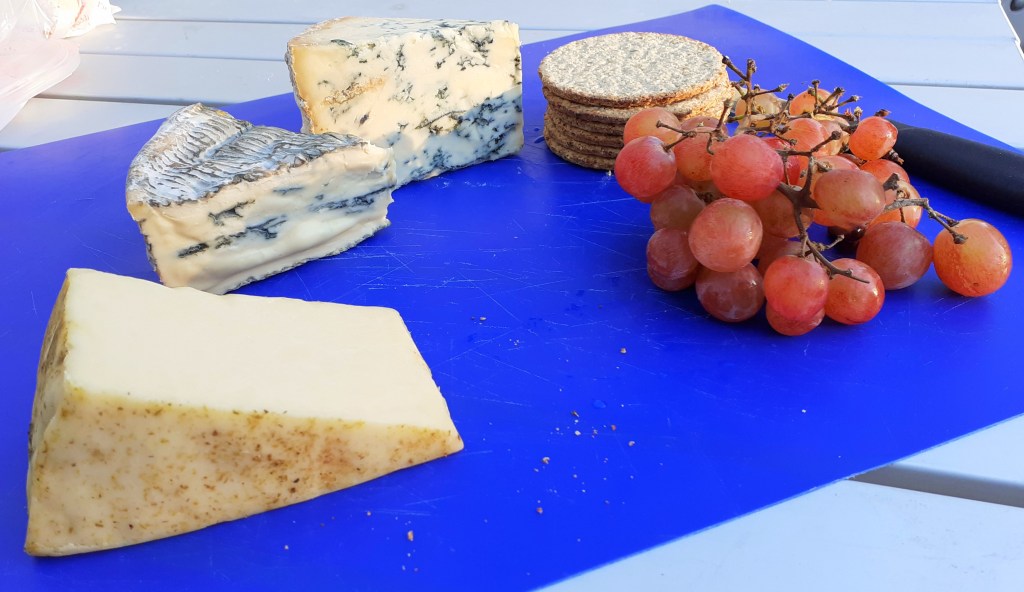
A visit to the fromagerie is always fun, as there are so many French cheeses to try. We’ve usually opted for a cheeseboard comprising a soft, a hard and a blue: in the one below the soft is a Vieux Pané, the hard cheese a Tomme de Montagne, and the blue a Basque Bleue.
Paté de fois gras goes well spread on a hunk of baguette, and local cured hams from the charcuterie have been tastily paired with chunks of ripe, golden melon from that marché in Bergerac.
Enjoyed with a glass of Bergerac Rouge, of course. While watching the sun set.
Time to say au revoir.
I’ve downloaded my listening for the journey back from Bergerac Airport. I’ve chosen a 2023 digital remaster of New Order’s Substance album, which is sounding even greater than ever. Here’s a track to show what I mean: Confusion ’87.
Today’s bake has the look and texture of a muffin with the taste of a savoury scone. If, like me, you adore the heavenly flavour of cheese and onion, you’ll love these savoury muffins made with grated mature cheddar cheese and fresh chopped scallions (spring onions). They contain much less sugar than sweet muffins, and are suitable for vegetarians.
What’s not to like?
Servings
Makes 12 savoury muffins.
Timings
10 mins to prepare, 25 mins to bake at 160C.
You Will Need
255g plain flour
3 tsp baking powder
1/2 tsp salt
3 tbsp caster sugar
60g mature cheddar cheese, grated, plus extra for topping
3 scallions, finely chopped.
1 egg
240ml milk
90ml vegetable oil
Method
Turn the oven on to 160C. Prepare a muffin tin or mould.
Sieve the flour, baking powder, salt and sugar into one bowl, and stir to mix. Add in the cheddar and scallions, stirring again to ensure the scallions are coated in the flour.
In a second bowl, combine the egg, milk and veg oil.
When the oven is up to temp, pour the contents of the second bowl into the first. Stir until fully combined, then spoon the mixture evenly into the tray or mould.
Place in the heated oven. After about 15 mins, take from the oven and sprinkle the grated cheese topping over each muffin. Place back in the oven for a further 10 mins, until risen and the cheese topping is lightly browned.
Place on a wire rack to cool, then enjoy!
Customise it!
Mature cheddar works well as it is strong tasting, but you can experiment with other cheeses if you wish. You could also include some nuts or seeds in the sprinkled topping.
I’ve been quietly pleased with how good these taste, and the fact they can be easily transported for picnics and as snacks on the go. This means I will probably be trying further variations on savoury muffins – I reckon on giving chilli a go, and possibly a vegemite option in honour of my recent Australian travels. Watch this space!
Music this week comes from the recent match-up between Manchester legends Liam Gallagher (Oasis) and John Squire (Stone Roses). I had downloaded their album and listened to it on my travels back from Australia. This is probably my favourite track, with the kind of 60’s British pop-influenced chorus you might expect from these two: Mars to Liverpool.
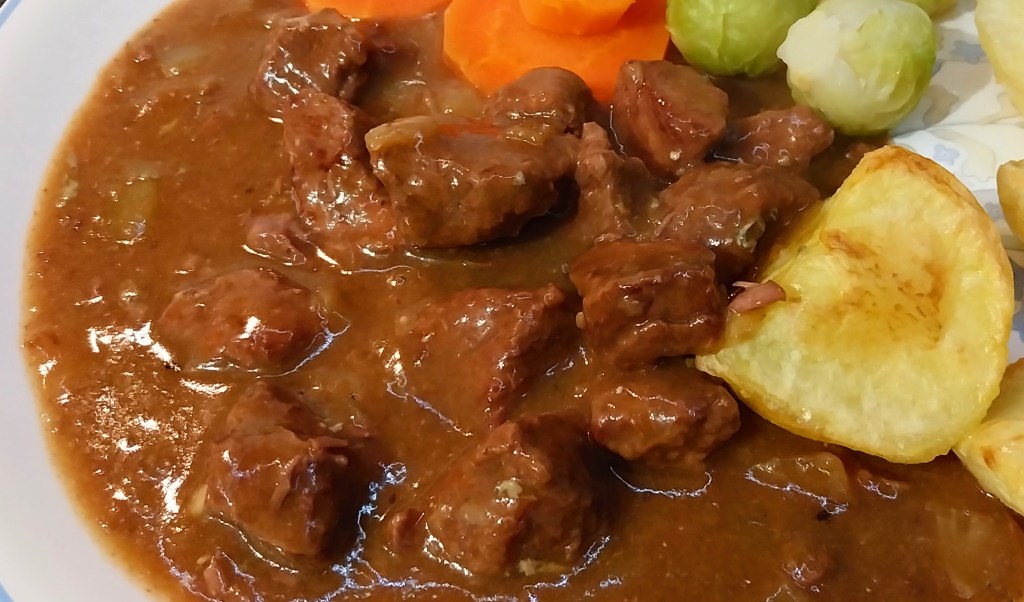
I first tasted the combination of beef and stilton cheese some years ago, as a hot filling in a Cornish Pasty. I thought the taste was divine and have been a fan ever since, enjoying it in casseroles as well as pies. Stilton adds a salty sharpness to the beef juices, making a rich and creamy gravy to coat and complement the tender and succulent beef.
What better dish to make, therefore, as the next in my slow cooker season.
Servings
6 adult servings, alongside your choice of veg.
Timings
20 mins to prepare, and 4 – 5 hours bubbling away in an electric slow cooker.
You Will Need
700g braising beef, cut into chunks
a few spoonfuls of plain flour
salt and pepper
oil
1 large onion
1 clove garlic
1 litre of beef stock
1 large glass of red wine
200g stilton cheese
some cornflour and tap water
Method
Turn on the electric slow cooker to the high setting.
Sprinkle the flour, salt and pepper on a dish, then roll the pieces of beef in it till they are coated all over.
Warm some oil in a frying pan and fry the beef until the pieces are seared all over. Transfer to the slow cooker bowl.
Crush the garlic clove and add to the remaining hot oil in the pan. Chop the onion and add also. Stir until softened, then add to the slow cooker bowl.
Pour the stock and wine into the hot pan, and heat until it is bubbling. Pour over the beef and onions in the slow cooker bowl.
Leave the slow cooker on high for around 30 mins, then reduce to the medium setting. Let it bubble away for 4 – 5 hours.
Using a fork, pull out a piece of beef to check that it is cooked. It should be tender and flake apart when pressed with the fork.
Cut the stilton into pieces and then crumble with your fingers into the slow cooker. Stir gently so that the pieces begin to melt into the gravy, thickening it as they go.
If you wish to make the gravy thicker, mix up a couple of teaspoons of cornflour with the same amount of tap water, and stir to dissolve. Add into the gravy. You can repeat this again if necessary, to reach the thickness you desire.
Serve with your choice of roasted, boiled or steamed veg. Mine in the photo is served with roast potatoes, boiled brussels sprouts and carrots.
Customise It!
If you wish, you can add veg directly into the slow cooker, and they will take on the flavours of the beef gravy as they cook. Root veg, such as carrots, swede, parsnips and celeriac will work well. You could also serve the dish with rice instead of roast potatoes, to soak up all that rich, stilton sauce.
Don’t worry if you do not have an electric slow cooker. You can use a casserole dish instead, and cook it in the oven. Start off with the oven at 180C, then reduce it to 160C at step 6 above.
It’s getting to that time when I receive my playlist from Spotify with all my most-played tracks of the year. This is one that will almost certainly feature, as I’ve listened to it many times. It’s by New York band Yeah Yeah Yeahs: Heads Will Roll.
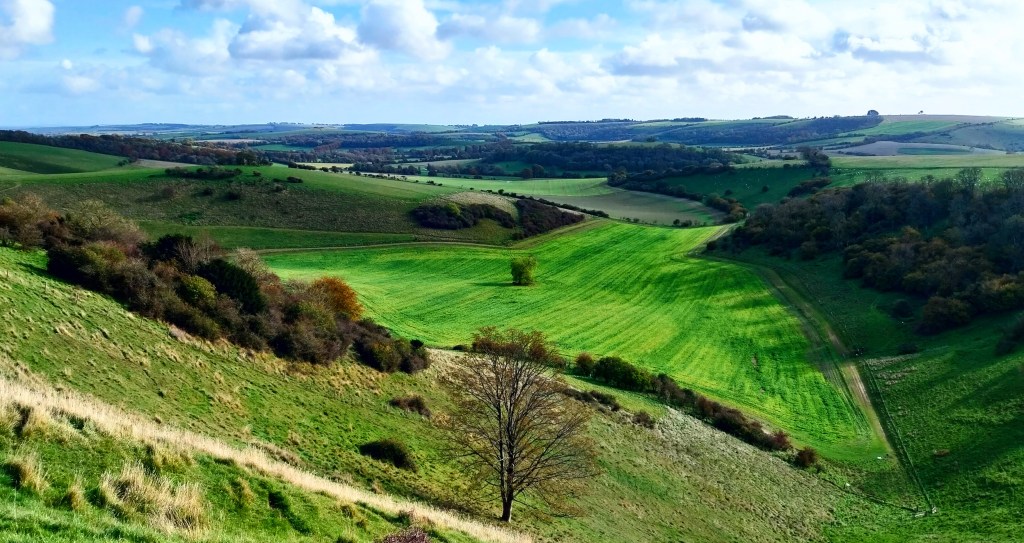
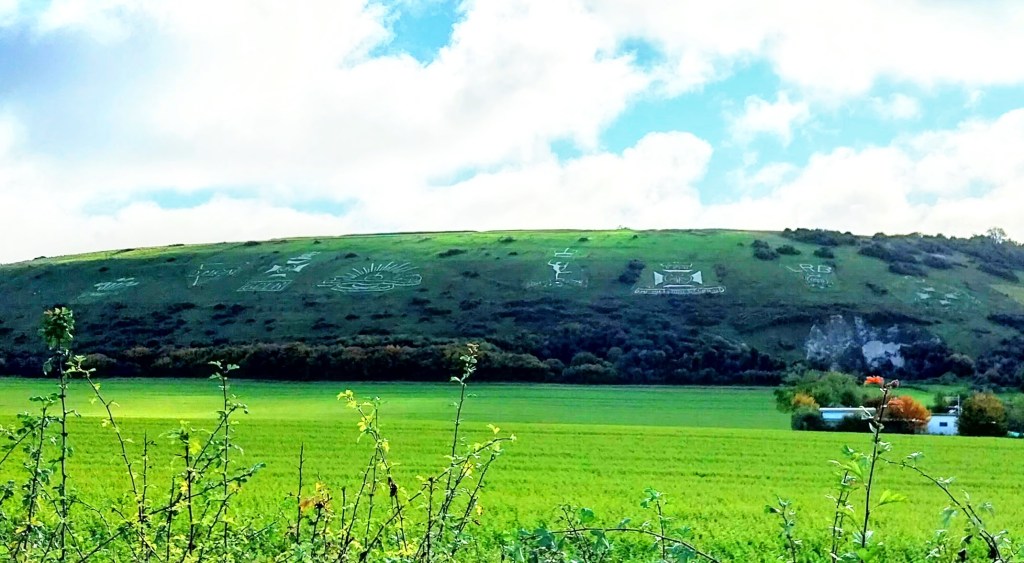
This week we have been away again in the motorhome, enjoying walks and views like this one in my photo above, at Cranborne Chase.
On the edge of England’s west country, it is officially designated an AONB – Area of Outstanding Natural Beauty – and it isn’t difficult to see why. Rolling countryside provides a backdrop for long autumn walks and close-up interaction with wildlife.
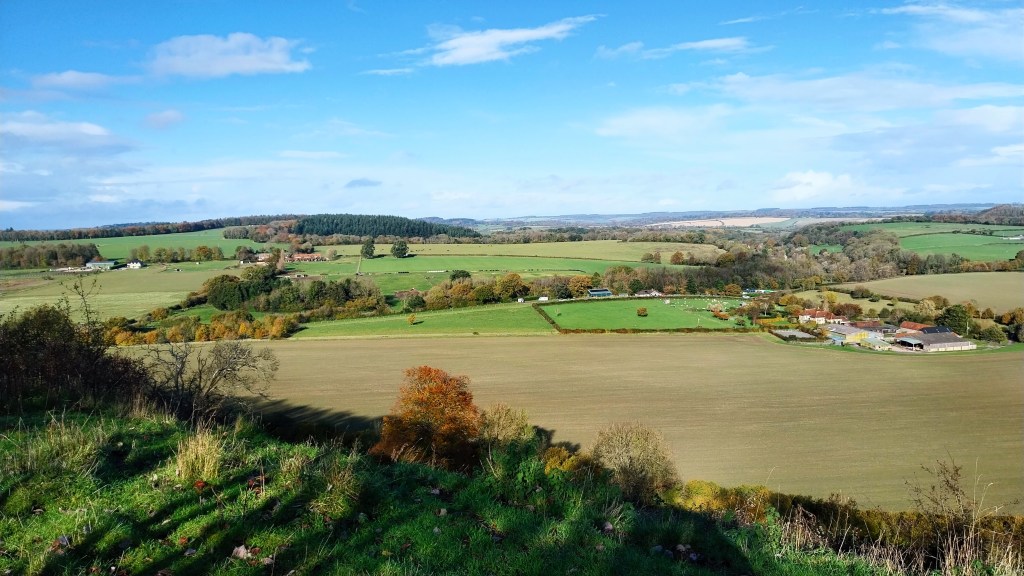
You may think my photo below shows a random wide ranging picture of the English countryside. Well, that’s true – but if you zoom in on the white speck, slap bang in the middle of the shot, you will have located our motorhome. We were on a small campsite that is part of a sheep farm.
I took this shot after hiking high up on the ridge that hosts a long distance footpath from Shaftesbury to Salisbury. It demonstrates how remote we were: just us, our caravanning next door neighbour, and a flock of sheep to the east.
Incidentally, I did try counting the number of sheep, but fell asleep before I could finish 🙂
Cranborne Chase is also an International Dark Sky Reserve, which means that, when night falls, it is bloomin’ dark. There is, literally, no artificial light from anywhere around on this vast landscape, and so the star gazing is first class. There was also the twit-twoo of the local owl to keep us company.
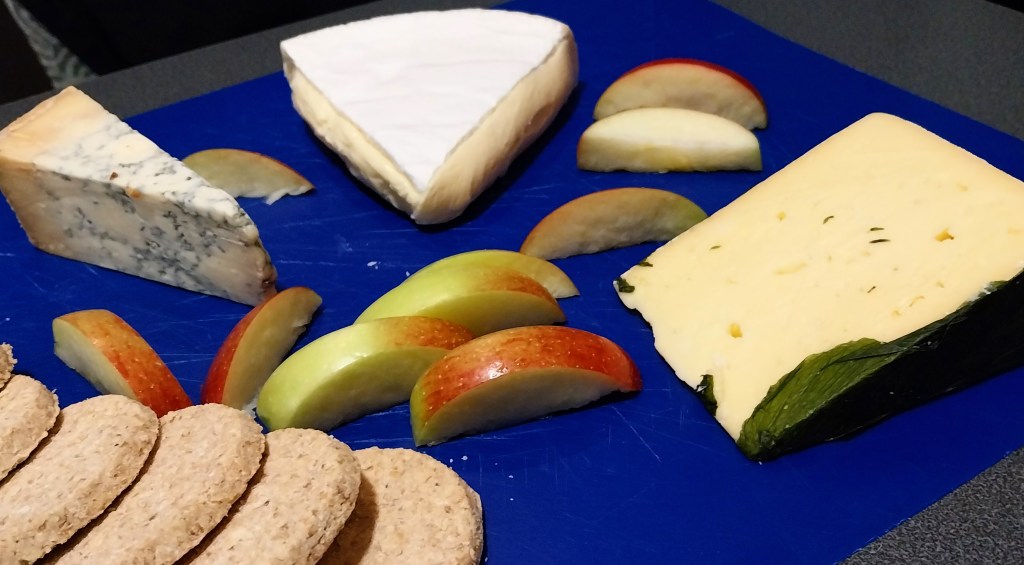
Way out here, the only local shop is a farm shop, doing a great line in west country cheese. Regular followers will know that I require little persuasion to put together a regional cheese board, such as this one below. The best of England’s west country is represented here with (from left to right) Dorset Blue Vinny, Somerset Brie and Garlic Yarg, from Cornwall.
A few years ago I visited the farm in Cornwall where they make Yarg. The garlic variety is hard to come by outside of the west country. They wrap the cheese in leaves from local wild garlic plants, and these infuse it with the flavour and scent of garlic as it ripens.
The oatcakes are from Bath and the apples local.
An interesting feature in the landscape is the Fovant Badges. At the time of the First World War, the British Army were stationed here, for final training before travelling over the Channel to the trenches in France. The young soldiers amused themselves (or kept their nerves at bay) by carving large scale versions of their regimental badges into the chalk grassland on the side of local hills. Through careful maintenance and restoration, they are still visible today.
The lady (and sheep farmer) who owned our campsite told me that her father-in-law was one of those young men stationed here, while waiting for the call to fight in what became the Battle of the Somme, where thousands of young soldiers tragically died. On the morning when he was due to travel to France, he required emergency dental treatment, and was excused from going. He went on to live and have a son, that she had been married to for 60 years, and with whom she’d had a family. Ain’t it strange, sometimes, how life works out.
You can find out more, here, about the Fovant Badges.
This weekend is, of course, Armistice Day and Remembrance Sunday, when we honour all those who weren’t quite so fortunate to escape with their lives. I have been wearing my poppy with pride this week, and will leave you with some fittingly inspirational music from Stevie Wonder: Higher Ground.
It wouldn’t be Christmas without a decent cheeseboard. Travelling down under this year, I made a point that our choices would all be Australian-made.
Cheese here is heavily influenced by Europe. You will find versions of the most popular cheese from France, Italy and England that have been home-made in Australia. Alongside these are many small and independent producers experimenting with new styles and presentation.
You can see my selection for our Christmas Day meal in the photo above. Here are the ones that made my final cut, including further information and links to the producers, should you wish to find out more:
Endeavour Blue is from King Island Dairy, which is based on a small island in the Bass Strait between Tasmania and the Australian mainland. The island’s microclimate produces lush pasture, hence rich creamy milk and cheese. This blue is reminiscent of a good gorgonzola.
Gumleaf Smoked Cheddar from Bodalla Farm on the New South Wales coast, south of Sydney. Smoked in leaves of a gum tree, it is part of their Bush Tucker Cheese range. Thankfully, it doesn’t taste too strongly of eucalyptus, just good smoked cheddar!
Fresh Chevre Goat’s Cheese, dusted with ash, from Meredith Dairy in western Victoria. Ash helps balance acidity and develop a rind, while adding visual interest to your platter.
Brie from Udder Delights, an independent producer from Lobethal in the Adelaide Hills, South Australia.
Camembert, also from Udder Delights.
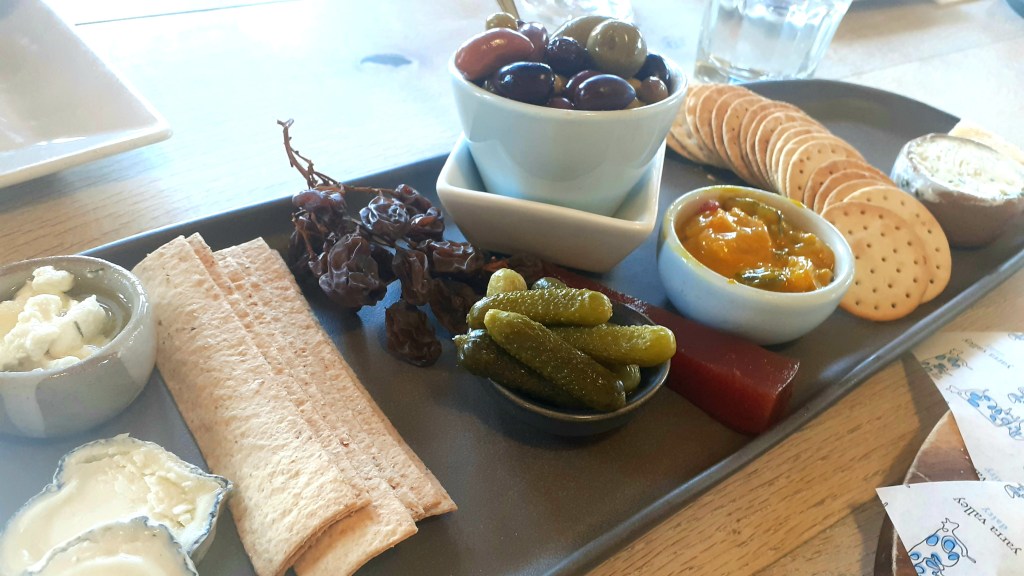
I also enjoyed a trip with family and friends to the Yarra Valley Dairy. Their range of goats cheeses are served as part of a sharing platter along with other delights like olives, cured meats, cornichons, home-made relishes and terrine, see my photo below.
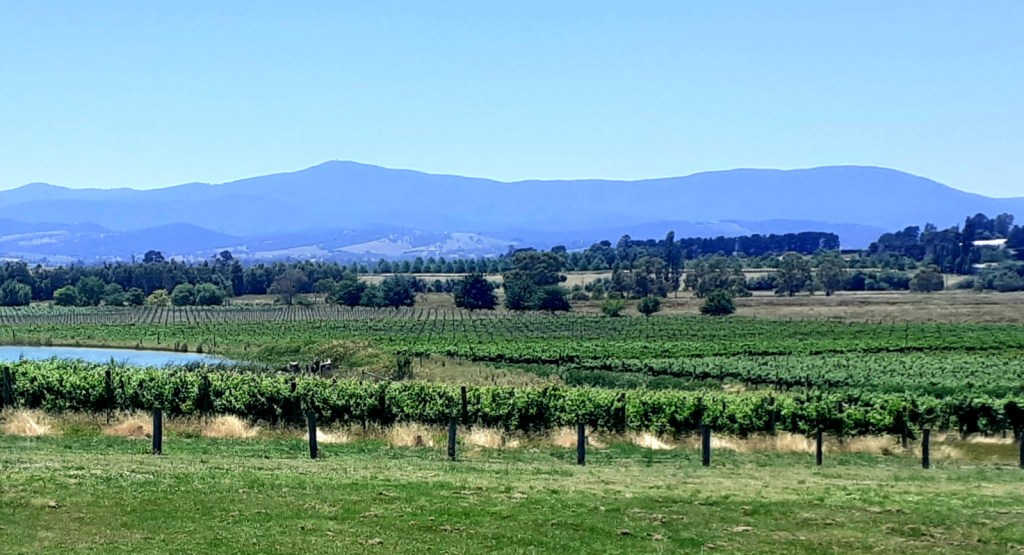
The Yarra Valley is a major wine and cheese producing region of Victoria, in the hills north-east of Melbourne. Here is a photo I took of the vineyard and hills beyond, while stopped for some Cellar Door wine tasting at Yering Farm Wines.
A gourmet experience of rich and creamy cheese, fine wines, in a beautiful rural setting with sunny weather (it reached 37C!). All in all, a Beautiful Day. Time to add U2 to the ADK Spotify Playlist.
While sampling the foodie delights of the West Midlands, during my stay here for the Birmingham 2022 Commonwealth Games, I’ve had the great fortune to come across the Merry Mouse. Who, you say?
The Merry Mouse is a Deli Van that visits the markets around the region. It’s particular speciality is local cheeses – often produced by small farms. You can’t fail to notice the distinctive livery.
Aided by helpful descriptions of the cheeses, and the knowledgable seller, I decided to put together my own Merry Mouse Cheeseboard.
First up was Cheddar Hop – a wedge of tasty, mature cheddar that had been rolled in toasted hops. This gives it a spiced and smoky flavour, with best bitter notes.
Accompanying this was a piece of Colston Bassett Stilton. The description given by the MM was that this was simply the best Stilton you can get. I’m not inclined to disagree with that assessment.
Finally, we had a slice of Cote Hill Blue, a soft and unpasteurised creamy blue brie-style cheese, made on a small farm in Osgodby, Lincolnshire.
Served up with some oatcakes and red grapes, and with the closing ceremony of the Games on TV, it made quite the occasion.
It’s been a thoroughly enjoyable 11 days at Birmingham 2022. The elite sports have been great to watch, and the Festival Sites, other cultural activities and local food and drinks, a joy to experience. All in all, it’s demonstrated the rich diversity of the West Midlands. The Games have shown once again the power of sport to bring people together and overcome barriers – something we were all in need of after the last couple of years of enforced separation and restrictions.
During the Ceremony, the Commonwealth Games baton was handed on to Regional Victoria, in Australia, who will host the next event in 2026. I will be visiting Victoria this winter and am looking forward to discovering more of the local food and culture there (including the local cheeses). However, more of this in a few months’ time
For now, it seems apt to close an amazing 11 days with this track from one of Birmingham’s own – The Beat.
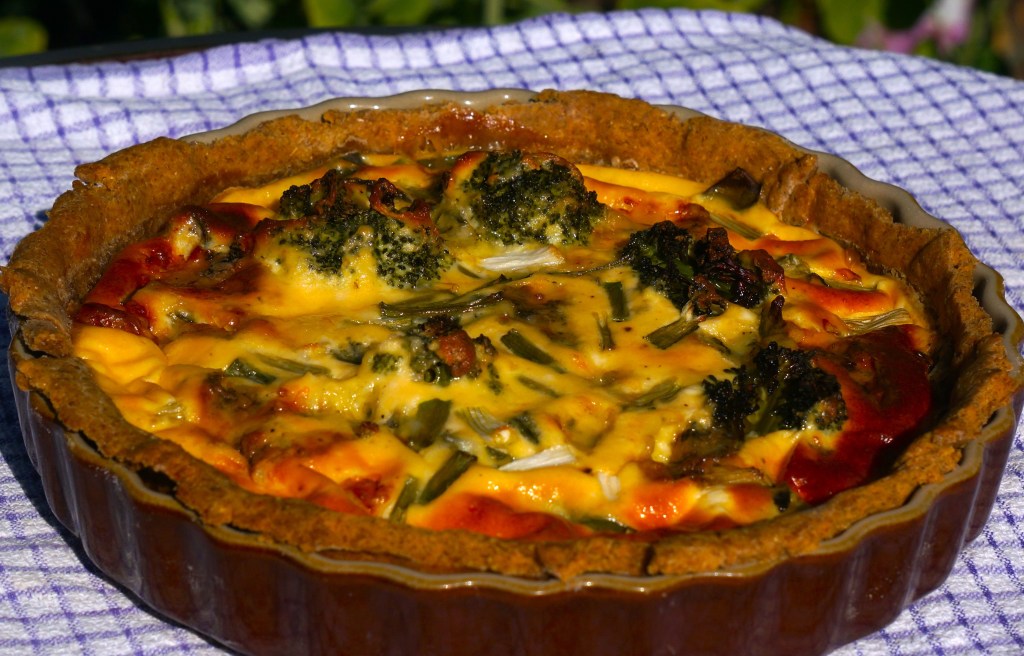
Summer green vegetables are reaching their peak just now, and this quiche brings out the best in them. Fetch a crop from the garden or market stall, and mix with creamy ricotta and salty blue cheese in this fresh and vibrant quiche.
Servings
Makes 4 generous slices, or 6-8 average ones!
Timings
About 15 mins initially to prepare the pastry, and another 15 mins to prepare the filling including steaming the veg. Baking time is an initial 10 minutes for the case alone, then 45-50 mins for the filled quiche.
You Will Need
For the pastry
115g plain flour
115g wholemeal flour
100g soft margarine
a pinch of seasalt
a pinch of paprika
a few drops of cold water
For the filling
Approx 180g fresh green veg (I used broccoli, french beans, runner beans and mange tout)
about 3 spring onions
3 large eggs
130g ricotta cheese
50g stilton cheese
twist of black pepper
Method
Grease a 20cm flan dish with some margarine or spread. I like to line the base with a circle of greaseproof paper in addition, as I find it helps to remove the quiche once baked.
Make the pastry by sieving the two flours into a food processor fixed with blade, along with the margarine cut into cubes. Pulse until it resembles fine breadcrumbs. Add a few drops of water and pulse again until you have a ball of pastry whirling around the blade. Take it out, pat into a ball and wrap in clingfilm, placing it in the fridge to stay cool.
Prepare the veg. Trim the ends off the beans and cut into 2-3cm lengths. Trim the ends of the mange tout, and cut any leaves and tough stalks off the broccoli.
Put the veg into a steamer over boiling water for about 10 mins.
While the veg is steaming, turn on the oven and set to 180C. Take the pastry from the fridge and roll out with a rolling pin to a size that will fit the flan dish. Carefully place it into the dish. Leave any pieces overhanging at the edges for the moment. Prick the base with a fork in 5 or 6 places. Place it back in the fridge while the oven is getting up to temperature.
Remove the veg from the steamer and drain in a colander. Set on one side.
With the oven up to temperature, remove the pastry dish from the fridge. Crumple a square of greaseproof paper with your hands and place it in the dish. Fill the paper with baking beans, spreading them out with your fingers so they cover the whole of the base and are gently pressed up to the sides. Place in the oven for 10 mins.
While the pastry base is baking, top and tail the spring onions and cut into 2-3cm lengths. Chop the stilton roughly into cubes. It will crumble a bit as you do.
Mix the eggs and ricotta in a jug, and give it a few twists of black pepper.
Remove the pastry dish from the oven and carefully lift the paper and baking beans into a separate bowl to cool. Don’t worry too much about any pastry overhanging the edges – it will drop off as it bakes, either at this stage or the next one.
Spread the steamed veg across the pastry base, and crumble the stilton over it. Carefully pour the egg and ricotta mix into the pastry base, making sure it gets into all the little cavities between the veg. Dot over the chopped spring onions, making sure they are lightly pushed into the mixture so they don’t burn.
Bake in the oven, still at 180C, for about 45 – 50 minutes. The mixture should have risen and the top should be slightly browned. Remove and leave to cool in the dish.
When cool, chop into slices and serve!
Customise it!
Main opportunity for going freestyle here is in the choice of veg. Sticking broadly to the theme of seasonal green/garden veg, you can use whatever you have to hand – perhaps introduce some greens, spinach, kale or chard. Herbs will also go well. Any combination should work, but keep it to a total of around 180g so as not to overfill.
You can also use any other crumbly blue cheese in place of stilton e.g. Dorset Blue Vinney. If you’re short of time, or don’t want to bother making the pastry, then you can use some ready made shortcrust pastry.



 A Different Kitchen