Categories
Mains Recipes

Beautiful Borlotti

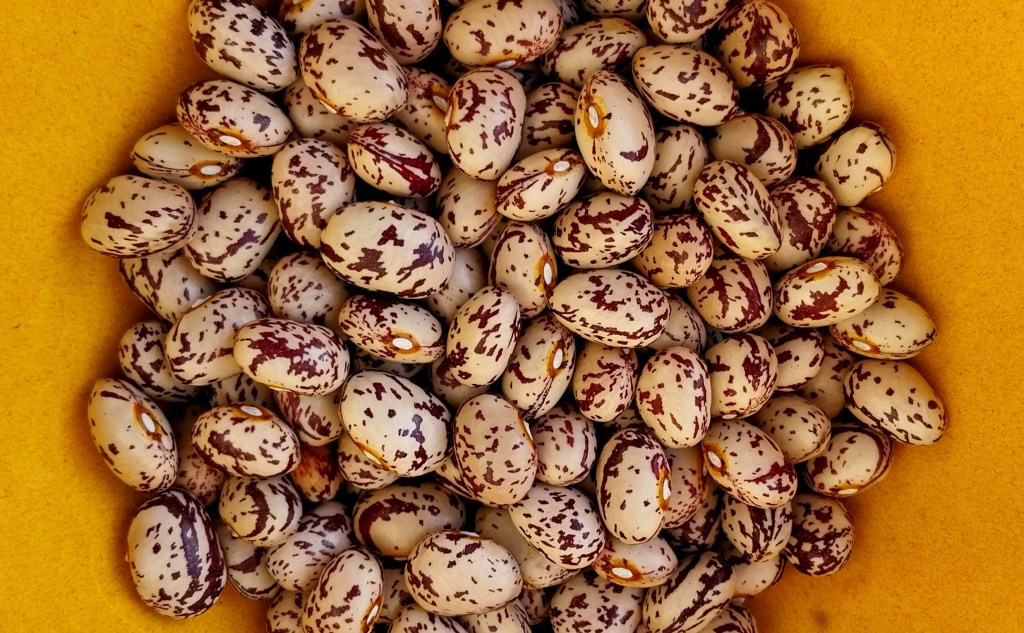
This harvest of borlotti beans, fresh from the pod (shown in my photo above) has been a very welcome arrival recently in the ADK Kitchen. I always think they are one of the most beautiful foods in their natural uncooked form.

They’re not bad cooked, either. The beans do tend to lose that magical, mottled sheen, but more than make up for it in their creamy, smoky taste. They also provide generous amounts of protein and fibre.

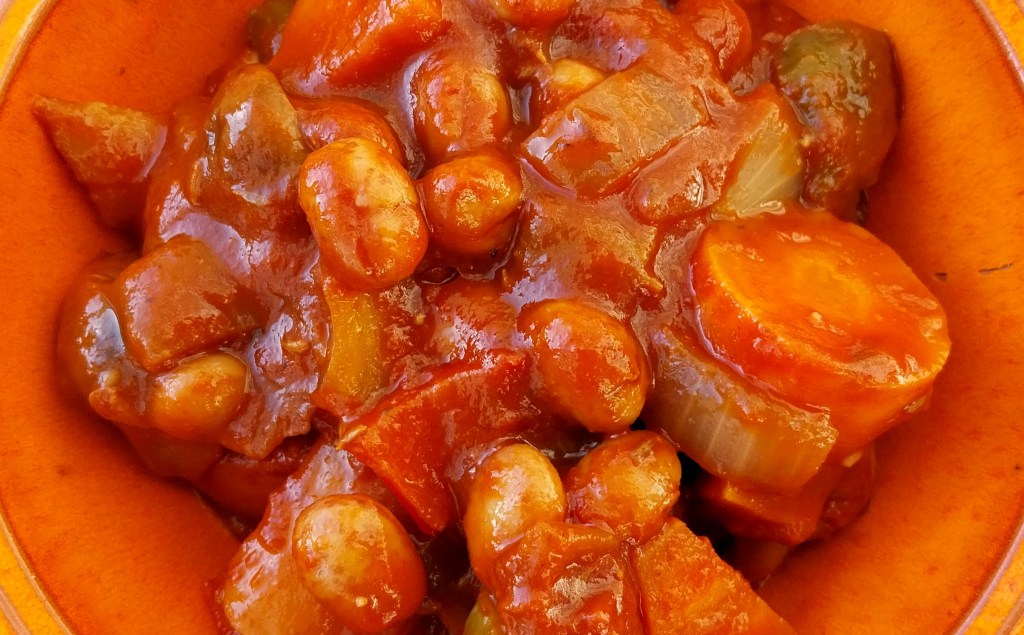
For this dish (shown in my photo below), I have given them a starring role in a chilli suitable for vegetarians, vegans and, indeed, anyone who enjoys a bowl of rich, warm and creamy comfort food this time of year.
Servings

4 adult portions.

Timings

The beans soak overnight, and are then boiled/simmered for at least an hour. Once these stages are complete, the rest will take about 30 mins to cook.

You Will Need:

  • 120g uncooked borlotti beans
  • cold water
  • 1 onion
  • 1 garlic clove
  • 1 tsp chilli powder
  • 1 tsp cumin seeds
  • oil
  • 1/2 a red pepper
  • 1/2 a green pepper
  • 2 celery sticks
  • 1 carrot
  • 6 -7 chestnut mushrooms
  • 1 400g carton of tomato passata

Method

  1. Wash the beans, then place in a bowl with enough cold water to cover them. Leave for 24 – 36 hours.
  2. Drain and rinse the beans under cold running water. You should find that they have doubled their weight through the water they have absorbed. Place the beans in a saucepan with enough fresh water to cover them, and bring to the boil. Reduce and simmer for 50 mins.
  3. Drain the cooked beans and wash again under cold running water. Set aside.
  4. Heat some oil in a wok, and add in the garlic, chilli and cumin. When it sizzles, add in the onion, peppers and celery, chopped into chunks.
  5. About 5 mins later, add in the mushrooms and carrot, also chopped into bitesize chunks.
  6. Stir with a spatula until all the veg is nicely softened, then add in the passata and the cooked borlottis. Top up with about half an empty carton’s worth of fresh water, and turn it up to boil.
  7. Bring to a simmer for about 15 mins, by which time the sauce will have reduced to provide a thick, creamy coating for the beans.
  8. Serve up with a portion of brown rice.

Customise It!

Replace the onion with chopped leeks, and add in some roasted squash if you wish. Shred in some spinach, cavalo nero or chard leaves.

Skip the rice and wrap a few spoonfuls up in a warmed tortilla. Perhaps with some soured cream on the side. This is making me hungry again…

It’s getting to that time of year when I receive messages from Spotify that my Unwrapped Playlist – containing my most played tracks of 2024 – is imminent. Here’s one track that will almost certainly be on it, and which seems to go well with the subject of this post: Leftfield with Pulse.
Categories
Blog Snacks

Waterfront

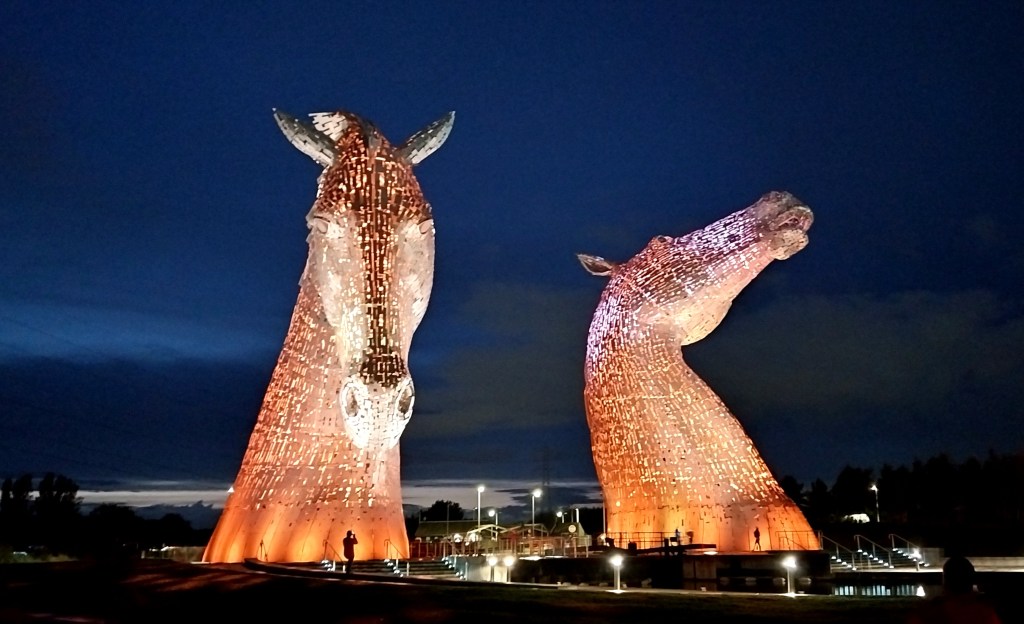
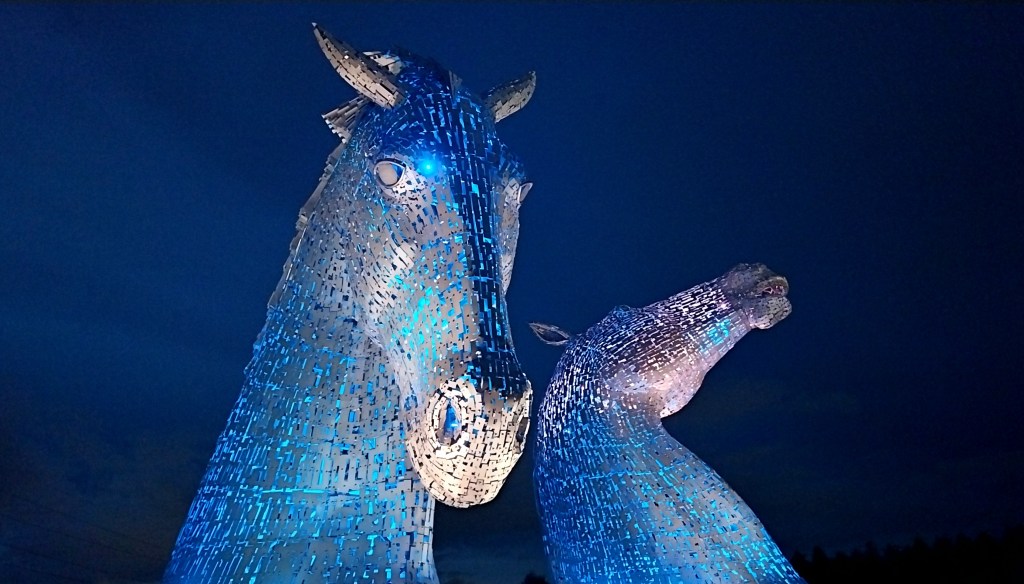
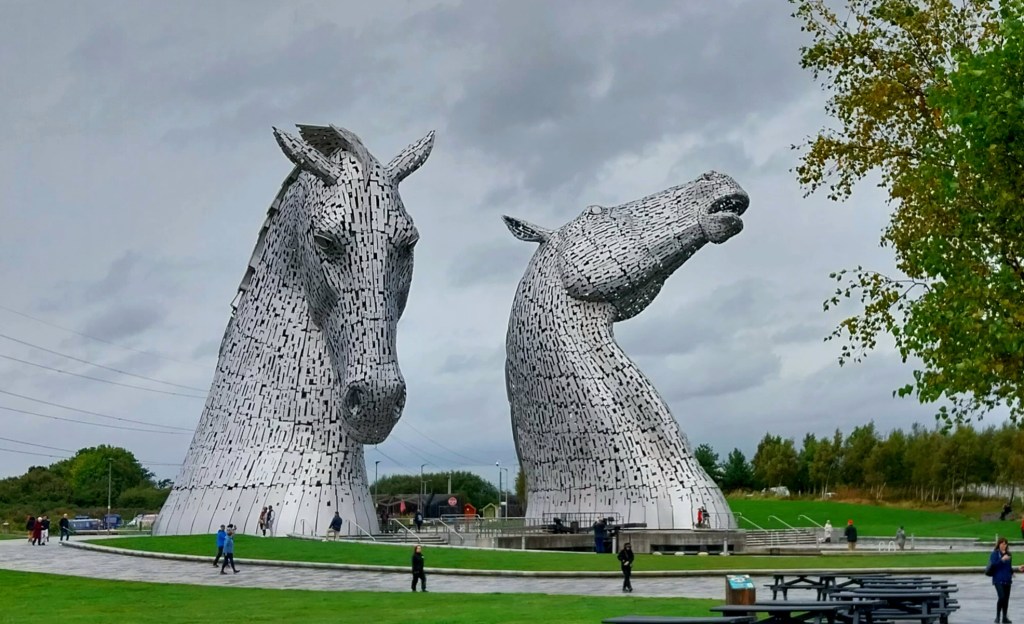
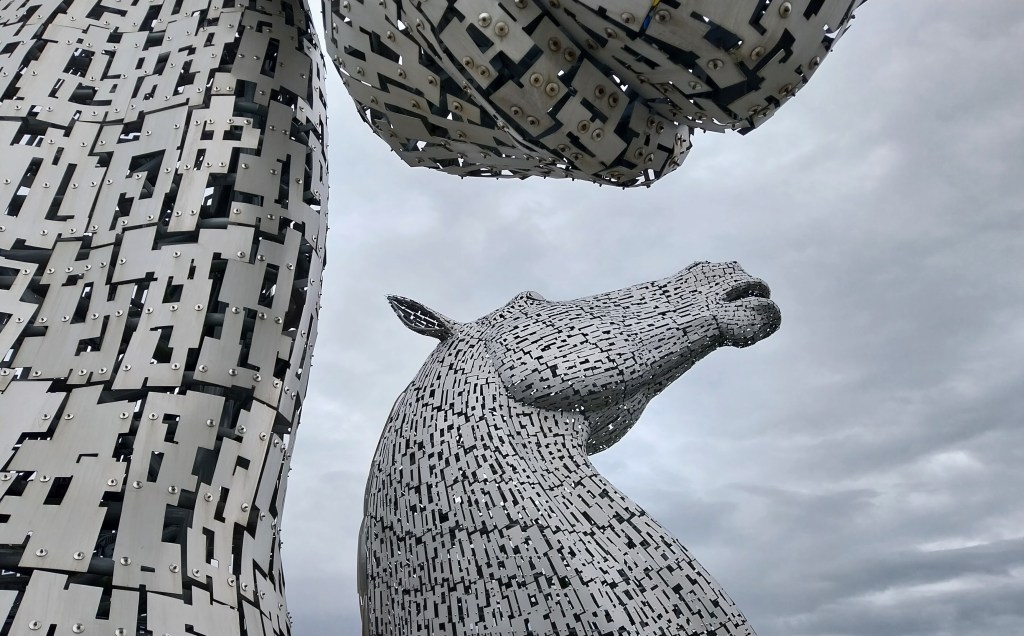
Next stop on our motorhome tour of Scotland is Falkirk, to see the giant horse statues known as the Kelpies. And what a beautiful and impressive sight they are! Standing 30m tall, they tower over the many visitors from far and wide who rock up every day to see them.

The Kelpies can be found alongside the Forth and Clyde Canal, which for many years was key to Scotland’s industrial revolution. Joining the River Clyde with the Firth of Forth, it was in its day the main route by which goods could be transported from Glasgow on the west coast to Grangemouth on the east coast, and from there on to new markets in the Baltic and Russia. Strong, heavy set horses, known as kelpies were central to the operation. Led along the canal towpath by hand, they would haul the goods-laden boats behind them, making their way towards the coastal ports.

The Canal fell into disuse in the 1930s and was shut in the 1960s, rendered obsolete by the newer forms of transport of road and rail. However, in 2001 it was reopened, and is now mainly for leisure and recreational use, with new businesses and hospitality outlets popping up in its vicinity. The creation of artist Andy Scott, the Kelpies followed in 2013.

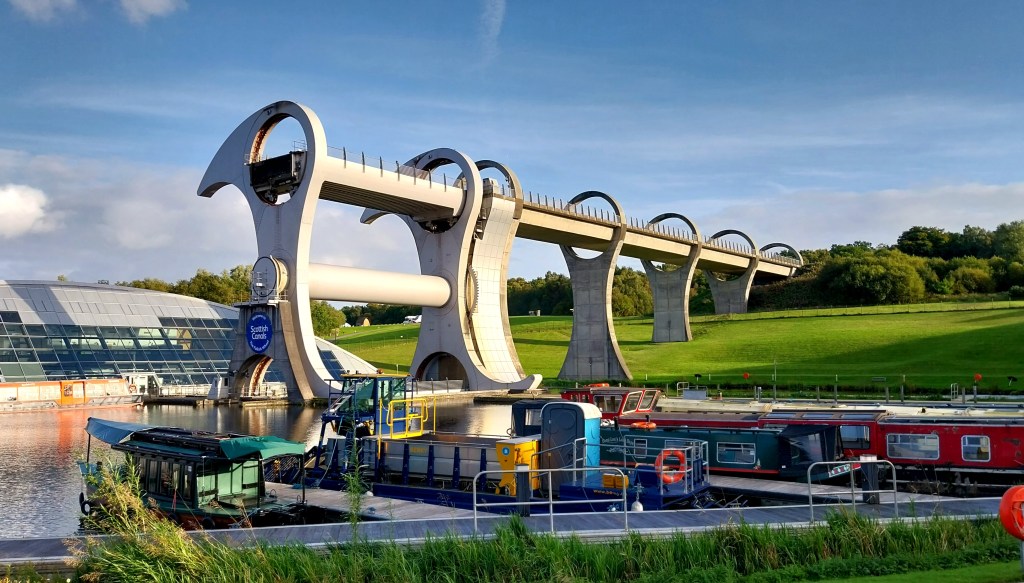
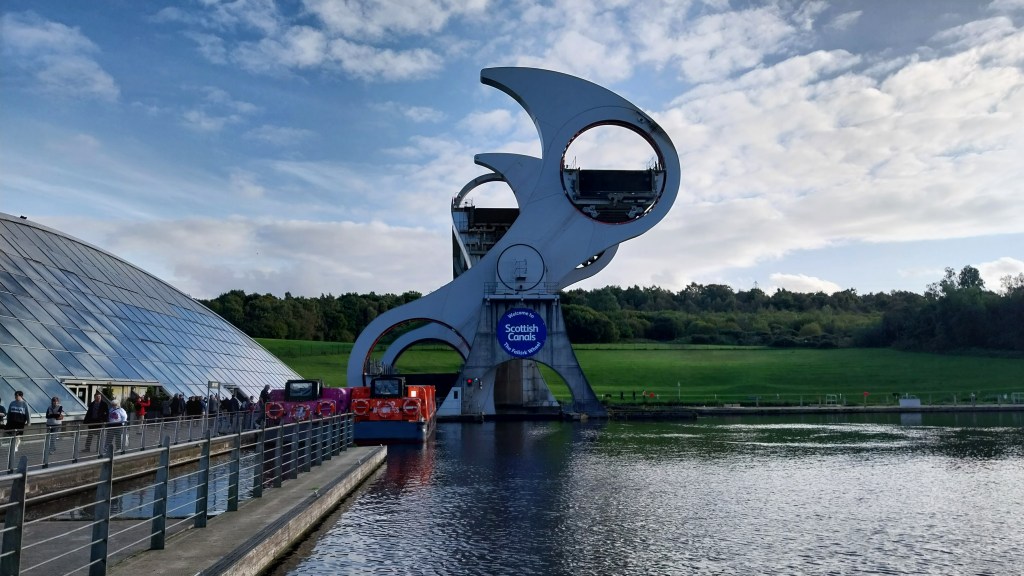
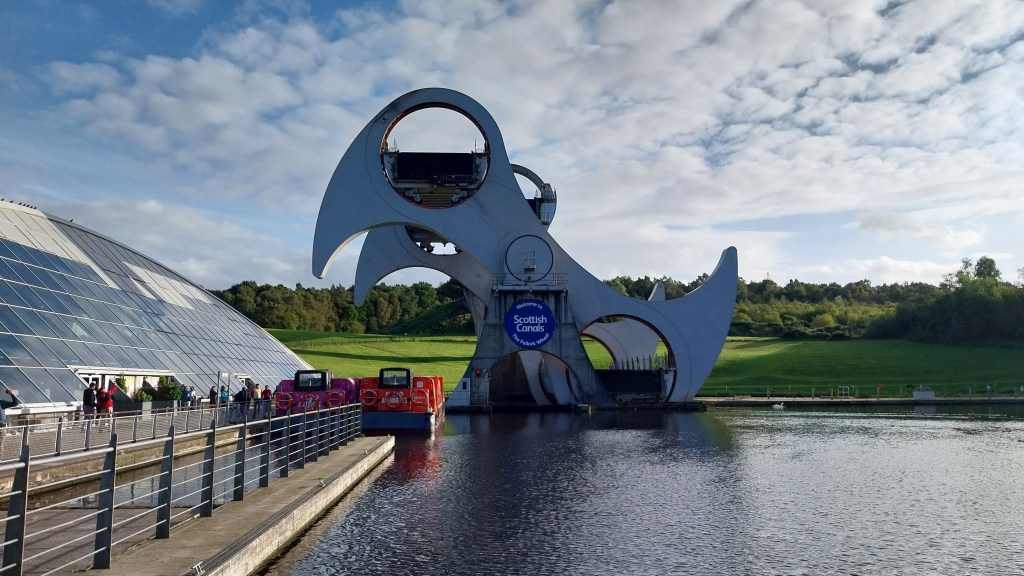
Another impressive sight is the Falkirk Wheel, an engineering wonder that opened in 2001, connecting the Forth and Clyde Canal with the Union Canal, even though the canals are on completely different levels.

It does this by picking up a boat from the lower canal (the Forth and Clyde) and rotating 180 degrees to release it on to the upper canal (the Union). In this way, it enables uninterrupted travel by water from Glasgow to Edinburgh.

The Wheel is also now a major tourist attraction for the area. Together, it’s all a great example of technology, art and culture driving economic regeneration in a post-industrial landscape.

We returned after dark to see the Kelpies illuminated. We weren’t disappointed.

The coloured lights are constantly changing, and the horses are visible from miles around.

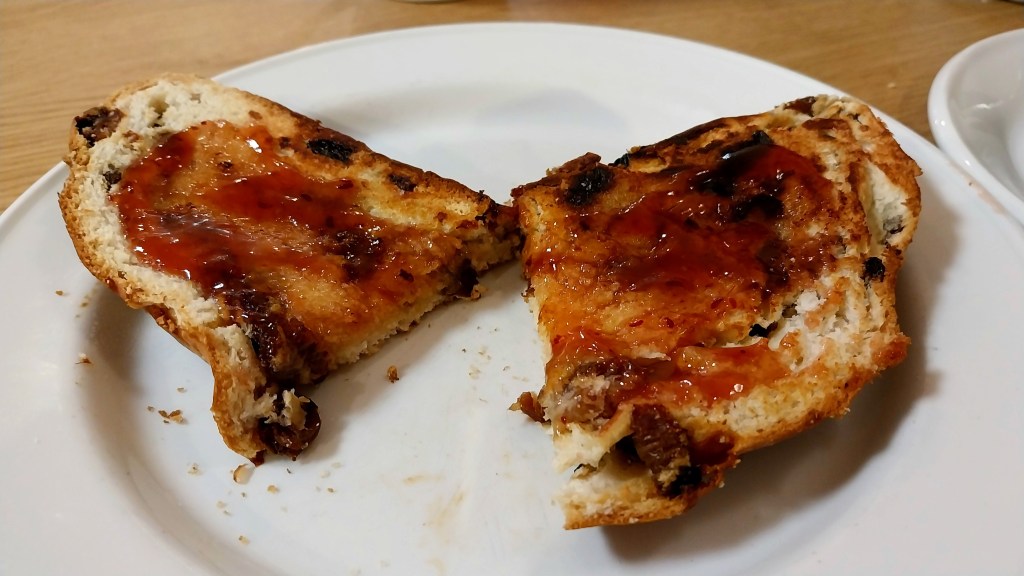
Foody highlight on this part of our trip was the Selkirk Bannock. I have featured this before on A Different Kitchen, when it was given to us as a gift from a friend who had visited the Scottish Borders area, from whence it comes (read much more about this traditional Scottish delicacy on my original post here). I have been looking out for it as I was keen to taste some while away on this trip – on its home turf, so to speak.

A rich tea loaf, packed with fruit, I had it served here toasted with melting butter and jam, alongside a pot of tea. Perfect for elevenses or a refined afternoon tea. Delicious!

Continuing the recent chain of Scottish bands featured on the ADK Playlist, here is a great track by Glasgow’s Simple Minds, that might just also have been inspired by the historic local setting of the Forth and Clyde Canal. This is Waterfront.

Categories
Blog

Don’t Look Back Into the Sun

I recently spent a few days in Margate on England’s Kent coast. I had heard a lot about how it was regenerating itself from a classic, but decaying, traditional seaside resort into a modern centre for music and the arts, with independent cafes and eateries.

Beach, food, music and the arts – it sounded like my kind of place.

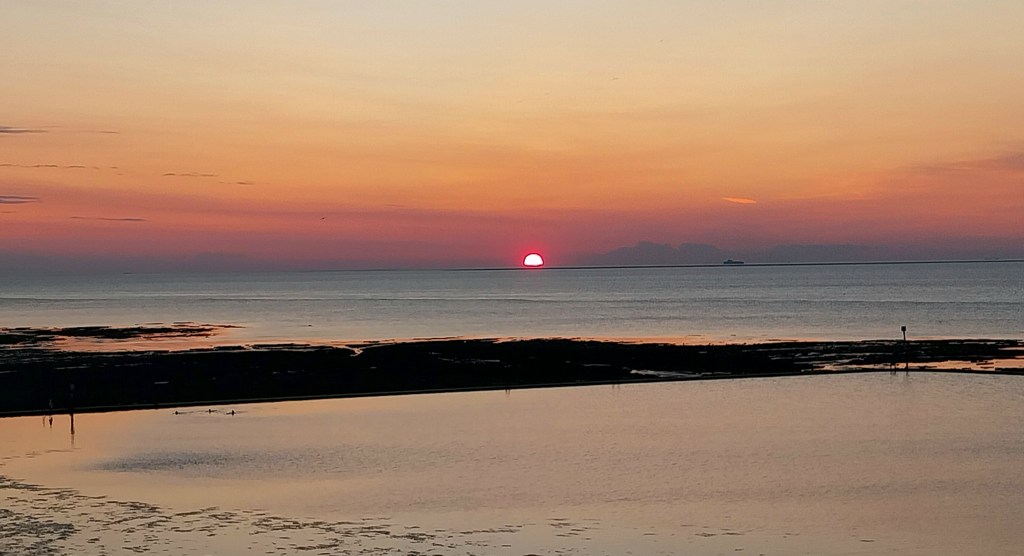
The town’s provenance as a centre for the arts is well founded. The long sea front has unbroken views facing west, and the quality of the natural light is what reputedly attracted classical artist JMW Turner to reside and paint here. The description of the light is accurate – there are cracking sunsets every evening, especially this time of year when the days are long (see my main photo above for one example).

This is the home of Tracey Emin, and the town’s heritage trail is full of references to other legendary Brits who have also made this their place of abode. Here is the vista that inspired TS Eliot to write his epic poem The Wasteland. Hawley Square, with imposing terrace houses looking out over a beautiful old public garden, has been home to John Keats, Lord Nelson and, erm, Hawkwind.

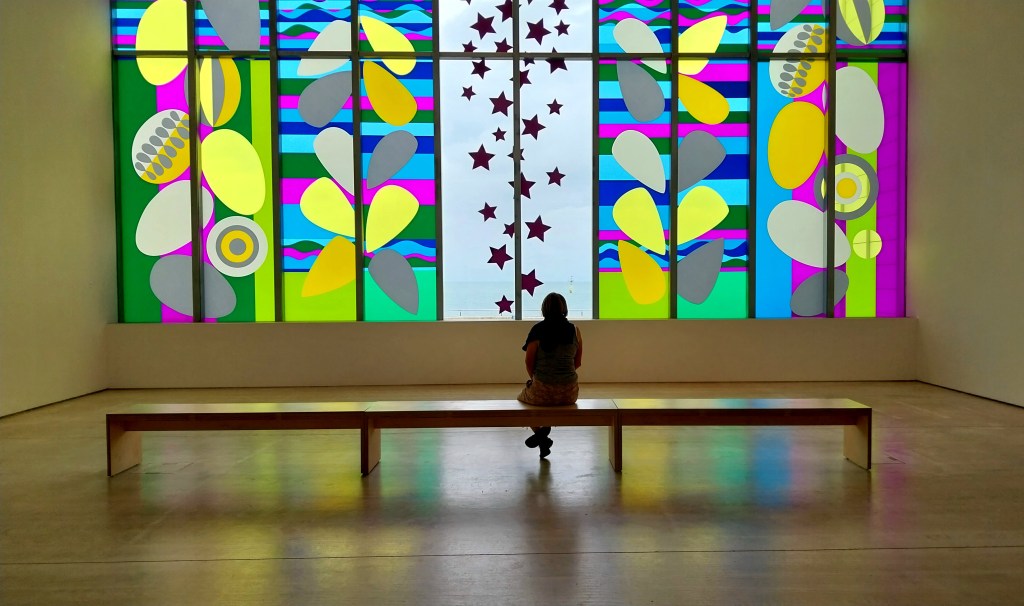
The artistic regeneration has been kickstarted by the arrival of the Turner Contemporary Art Gallery, built on the site of the guesthouse that Turner stayed in while visiting here. It has a huge window looking out to sea, dressed for our visit by Brazilian abstract artist Beatriz Milhazes. It reminded me of a stain glassed window, see below.

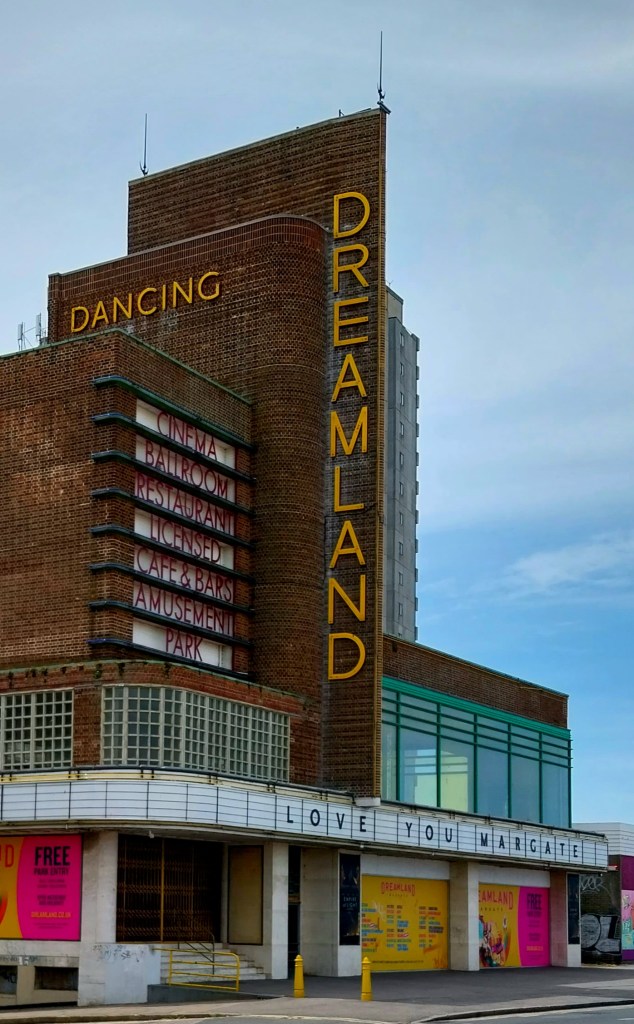
Dreamland, shown below, is a 1930s amusement park, restored to all its retro glory and serving also now as a venue for visiting bands. The summer programme includes Placebo and Queens of the Stone Age, so they are clearly having success in attracting top quality music.

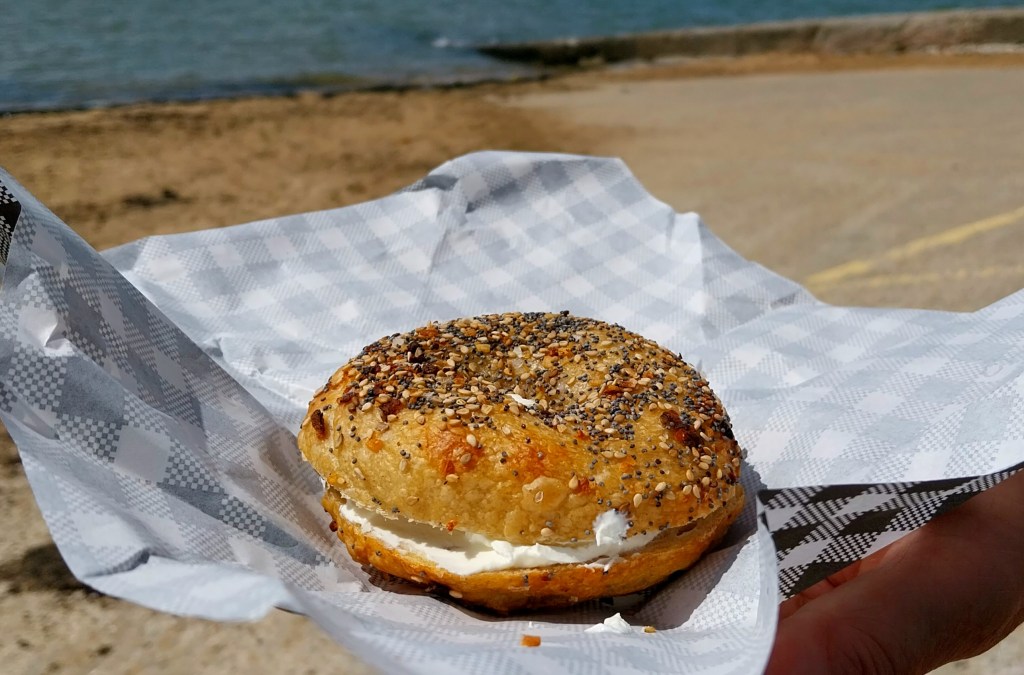
Near the Turner, and just across from the main beach, is the Old Town. Programmed for clearance in the 1960s, it was, thankfully, saved and is now a thriving centre for independent shops and cafes. We enjoyed grabbing a takeaway coffee or sandwich and taking it over to eat on the beach. Takeaway of choice was Sub Rosa, which specialises in fresh bagels. Below is my soft, chewy and delicious ‘everything’ bagel with cream cheese.

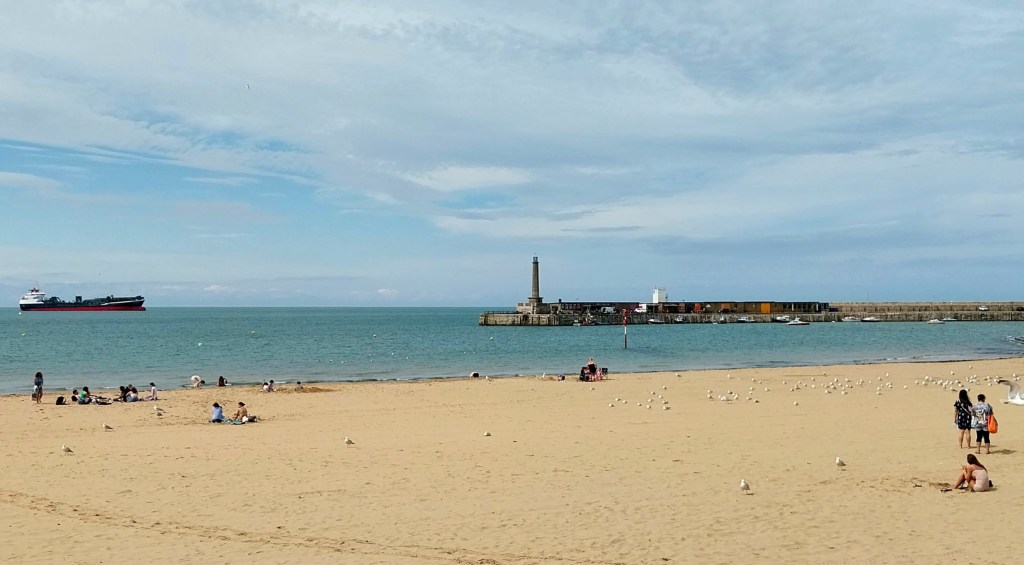
It is impossible to tire of the views across the sands, see one example below.

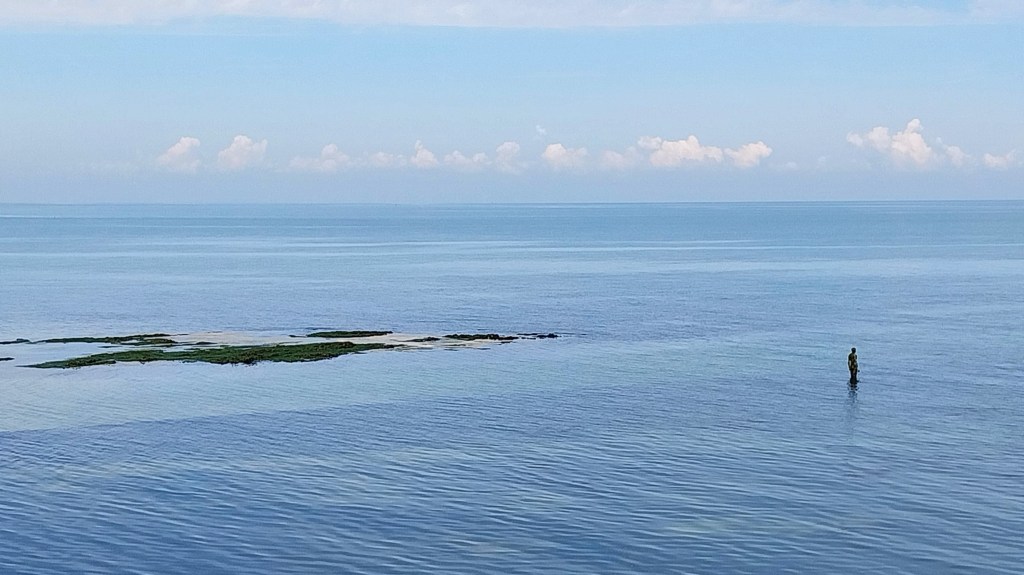
In another direction, you may just spot one of Antony Gormley’s iron men figures gazing out to the horizon. Be warned, however – he does get completely submerged at high tide (the statue that is, not Antony Gormley, obvs).

While there is lots to enjoy and get excited about at Margate, I do need to add some note of caution and balance, before everyone signs up to a short break there. The regeneration is still, very much, a work in progress! The arty points of interest, vintage clothes shops, adventurous foodie cafes and cappuccino bars rub shoulders with a serious amount of shabby and decaying buildings, graffiti and neglected public spaces. If that sort of thing disturbs you, then it may be best to leave your visit till the rebirth of the town is a little further down the road.

With its juxtaposition of crumbling facades of a once great English seaside resort, artistic heritage and modern day grunge, you may be excused for thinking Margate would be the perfect place for those bohemian songsters, The Libertines, to open a boutique hotel. Well, guess what? Pete, Carl and co have invested in the Albion Rooms, a stylishly kitted out 8 room hotel with bars and music venue (see below). It also has a recording studio, which is used both by The Libertines and local indie bands.

So I will finish by adding The Libertines to the ADK Playlist. Here’s a track that could easily have been written about the glorious view from Margate’s beach, just across from the Albion Rooms. This is Don’t Look Back Into the Sun.

Categories
Blog Drinks

Paint Me Down (Under)

I want to share with you some of the great art in public places I’ve come across in Australia.

For reasons I can’t quite explain, my experiencing of art is inextricably connected with the consumption of coffee and pastries. Visit to a gallery? Sooner or later my wristwatch will be telling me it’s time to visit the coffee shop. Walking on a public art trail? I guarantee at some point there will be a minor detour to take in that nice, funky looking cafe over there. More about Australia’s cafe culture in a moment – let’s first take a look at some of the art.

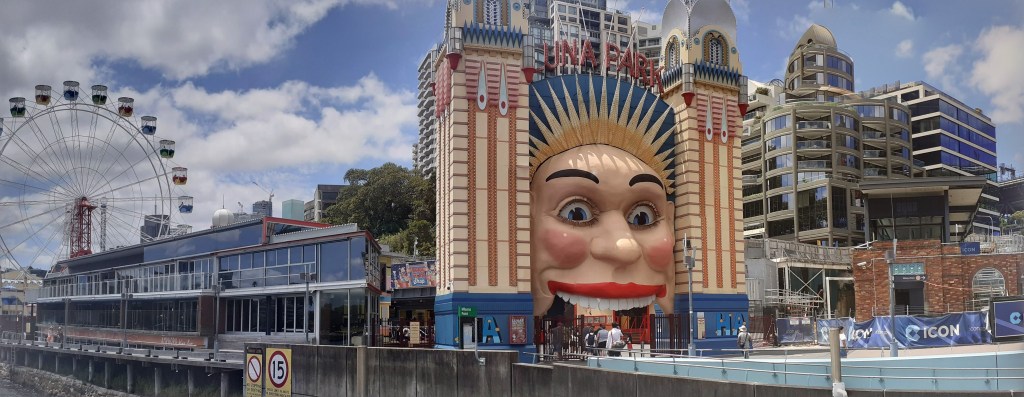
I’ll start with the art deco entrance to Luna Park, Sydney’s retro amusement park that dates back to 1935, shown in my main photo above. It is a joy to behold – the huge grinning face is visible all the way from the other side of Sydney Harbour, getting progressively larger as you approach it on the ferry. If you look closely you will see visitors walking through the mouth to enter the amusement park, giving a sense of its vast scale.

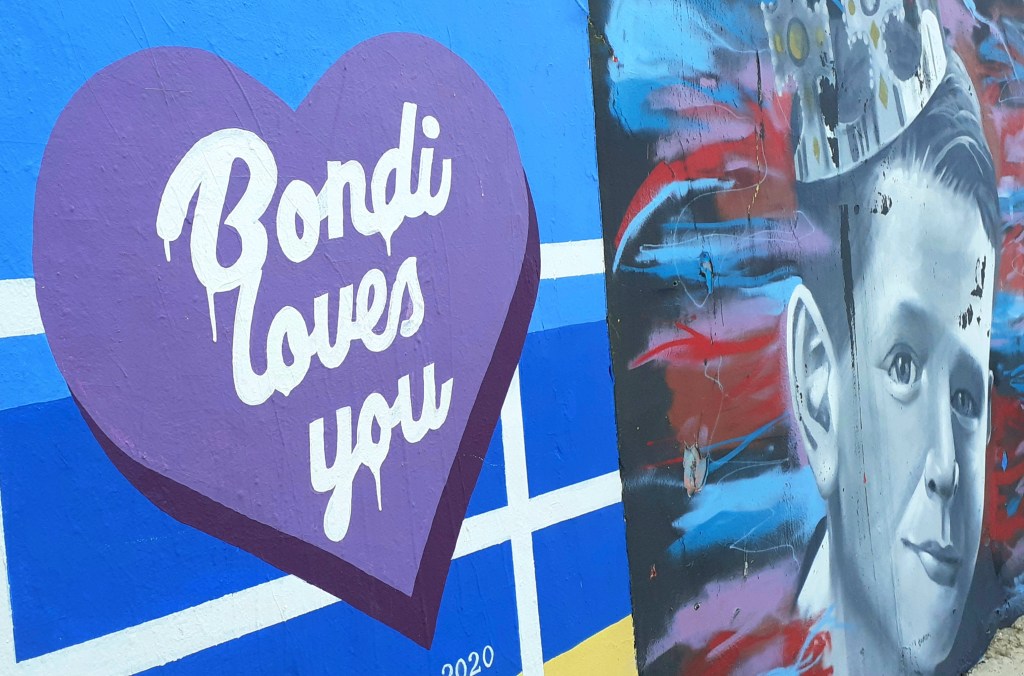
My next photo below was taken at the graffiti wall which lines the promenade at Sydney’s famous Bondi Beach – a place where chic boutiques and upmarket cafes co-exist with the bohemian grunge of the local surfing community. Our visit here soon led to a visit to one such cafe (see, what did I tell you), from which we enjoyed the free entertainment provided by the surfers. This was easily the best surfing I have ever seen – well-poised riders catching a wave for a good 10 – 15 seconds before diving neatly into the water, then doing it all again.

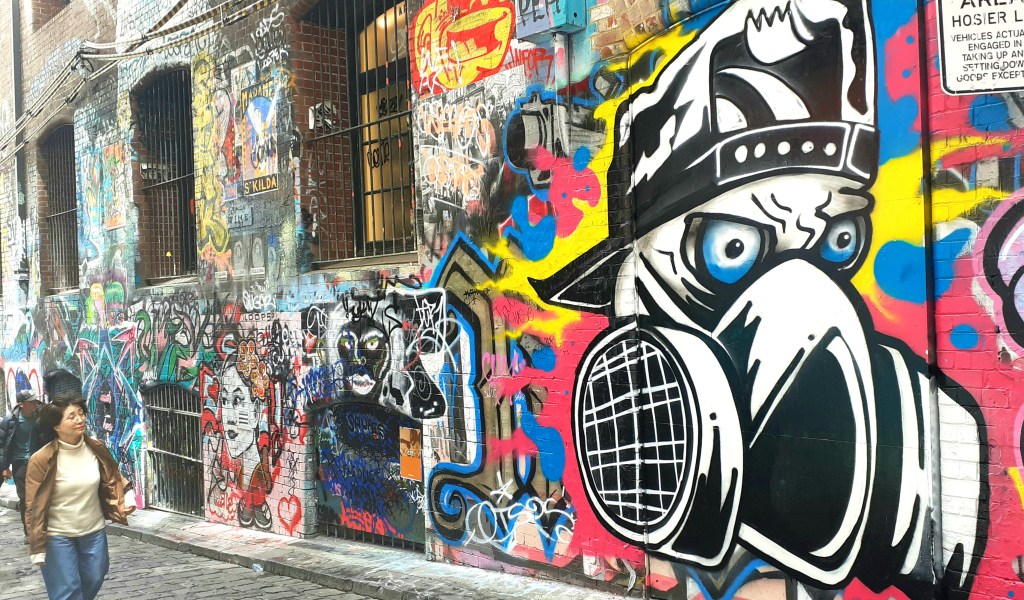
Back in Melbourne, Hosier Lane is known as Spraycan Alley, making it a popular tourist attraction – see below. It is positioned in the Lanes and Arcades quarter chock full of fiercely independent cafes. A visit to at least one of these is inevitable (for me, that is) when in this part of town.

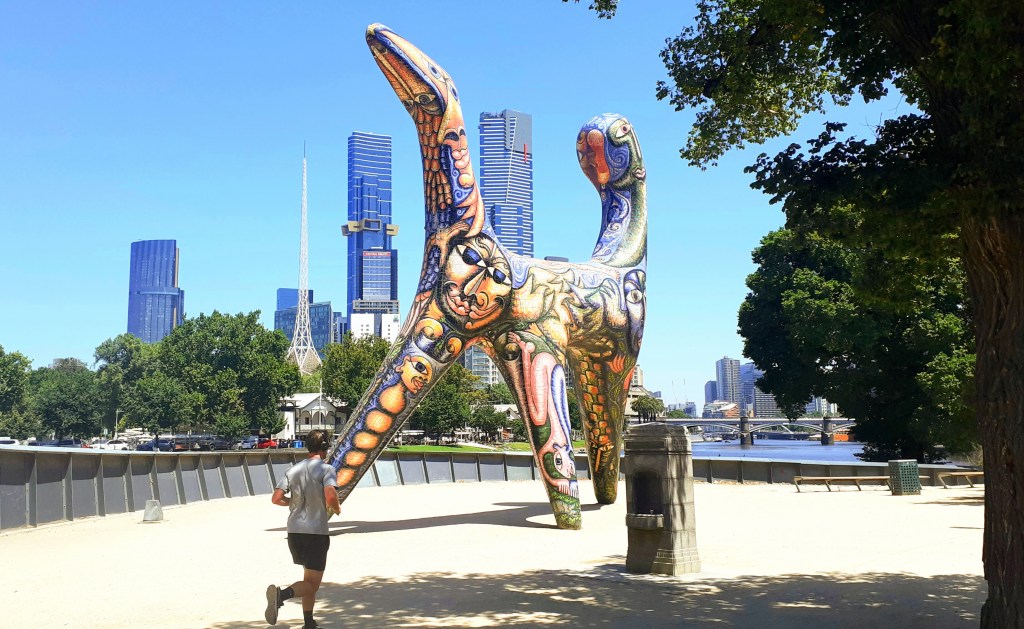
Indigenous art influences are strong wherever we go. The tall three-legged, two headed Angel (by artist Deborah Halpern) is situated in Birrarung Marr, the public park that stretches out along the River Yarra from Federation Square to the home of the Tennis Open.

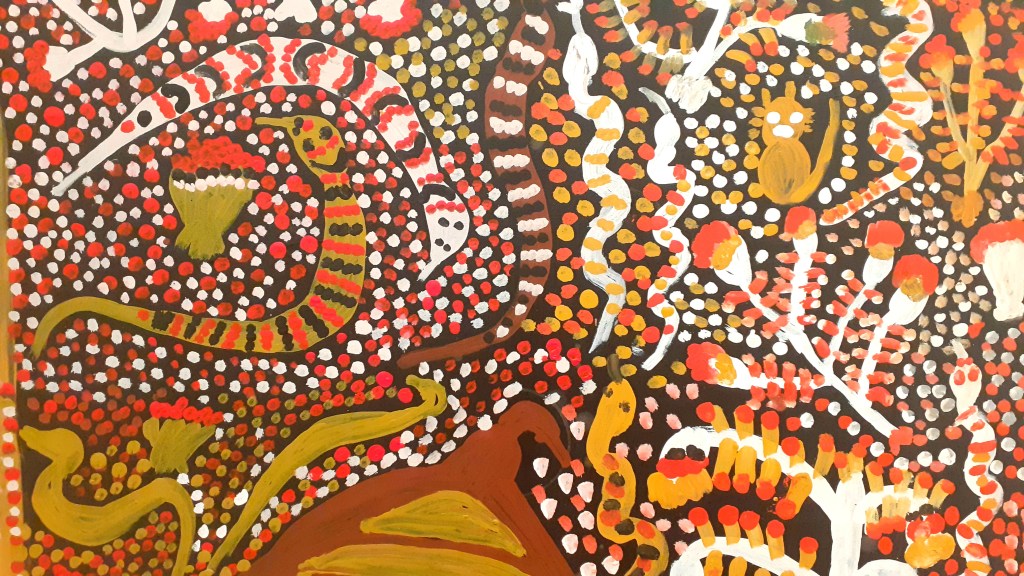
Again in Melbourne, the whole of the ground floor of the Ian Potter Centre (free to enter) is given over to indigenous people’s art. The paint used is generally derived from rocks, minerals and clay, giving it an earthy feel, and a colour palette based around an ochre spectrum. The abstract designs and patterns evoke the meditational nature of the aboriginal philosophy known as the Dreaming. My photo below is an example, by artist Willie Gudabi.

And so to the world of coffee and pastry that I associate with these images. Cafe culture is big in Australia. They are nearly all independents – you will only very occasionally see a Starbucks or other chain. Baristas take their work very seriously, and the making of a hot drink has itself been elevated to something of an art form. I can honestly say I have never had a bad cup of coffee since arriving in Australia.

At first the coffee menus were like a different language, but I now understand my way around them. There is no such thing as an americano – it is a long black and, if you want it white, you ask for a small jug of milk (specifying whether it should be hot or cold, and dairy, oat or other) on the side. A batch brew is a filter coffee, and a cold drip is an iced version – usually a latte served over ice cubes and, in some places, a scoop of ice cream.

Cappucino and flat whites are as you would find in the UK but, surprisingly, decaff is nowhere to be found on the menus. Seemingly this is because the serious coffee aficionados do not consider it to be a credible option. While there is no doubt that Australia makes great coffee, I do think this is one area where the approach is a little out of step with modern times.

So boil the kettle, or fire up your espresso machine, and fetch a nice coffee while enjoying these images. Which one is your favourite and why? Please feel free to leave a message in the comments section below, if you like.

The title of this post has probably given away the latest track I’ve chosen for the ADK Playlist. Paint Me Down is not one of Spandau Ballet’s biggest hits, but I have always really liked Martin Kemp’s bass line, which kicks in right at the start and stays prominent thoughout. Take it away, lads..

Categories
Blog

The Thrill of It All

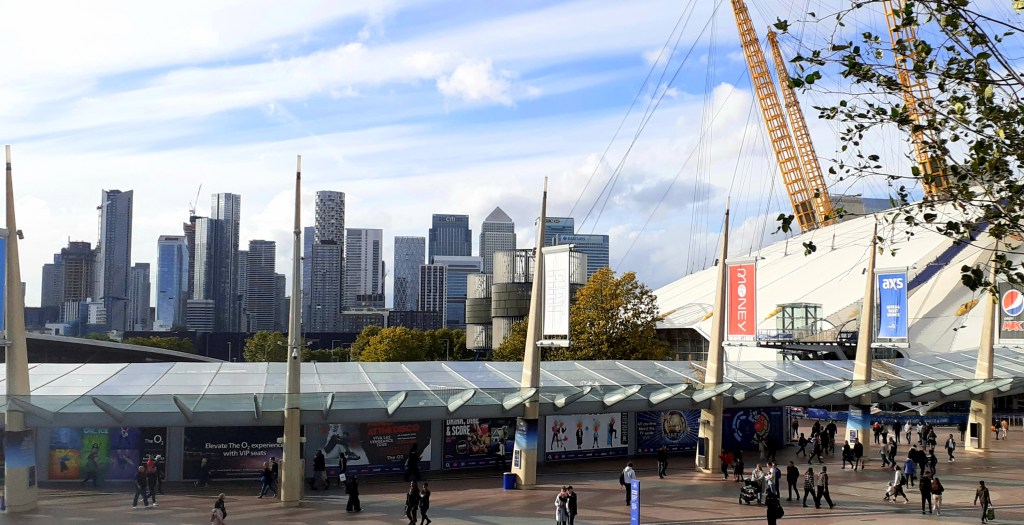
This weekend just gone is one I had been looking forward to for some time. Tickets to see Roxy Music at the O2 Arena in London were a lovely surprise birthday present, and the day had finally arrived!

Roxy have directly influenced so many trends in music, from glam rock, punk and new wave to the new romantics and so much indie and electronic music since. It is difficult to convey how markedly different they were when they first arrived on the scene – an eclectic blend of suave crooning over buzzing guitar, blasting rock sax and experimental keyboards. Unique and original, they really were unlike anything we had seen before.

I have always been a fan of Roxy, and this show did not disappoint. The band performed lots of tracks that I have been listening to for years on vinyl and cd, and still nowadays on Spotify – Virginia Plain, Do the Strand, In Every Dreamhome a Heartache, Love is the Drug – to name a few.

Of course, with the passage of time, Ferry, Mackay, Manzanera and Thompson are all a little older and mellower. However, it still feels a privilege to be in the presence of the original band members when performing these era-defining songs.

My favourite track was Editions of You, played out at the O2 before an Andy Warhol-inspired backdrop, featuring garishly coloured lino prints of that famous Campbells Soup tin, and stars such as Marilyn Monroe and Jackie O. To these had been added vintage portraits of the band members from their heyday, in the same pop art style, acknowledging their own place in the pantheon of modern cultural icons.

I don’t know if we will see a tour like this again from Roxy, but if not, this is a fine way to remember the band and celebrate their wonderful legacy.