Categories
Mains Recipes

Brazil Nut Roast

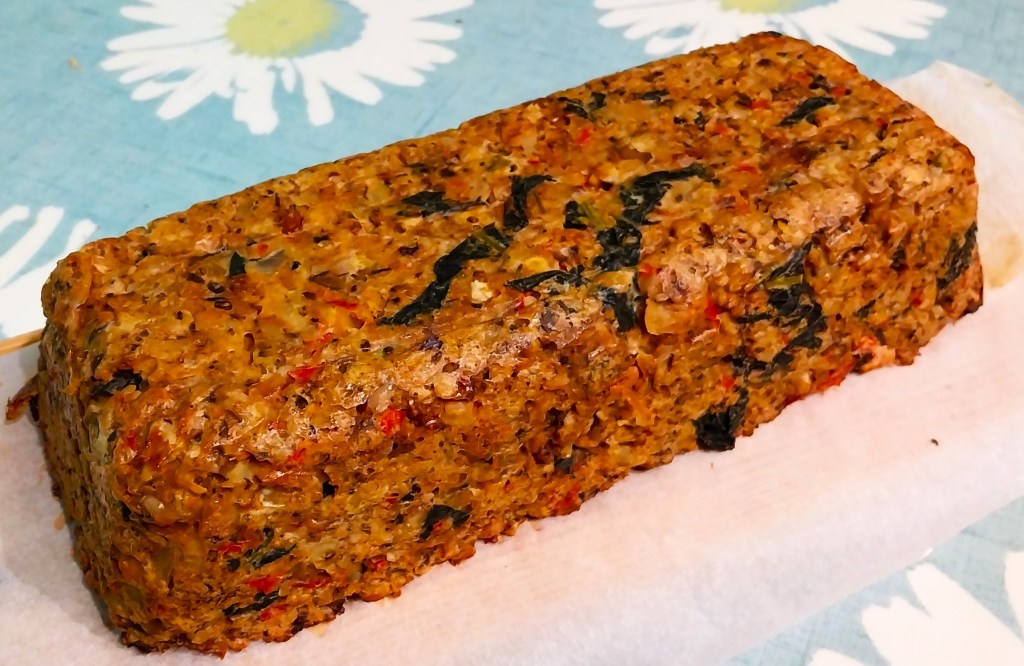
Nut roast is one of my favourite dishes this time of year. I love the taste and the texture, with the contrast between the crunch of the nuts, the crispy toasted shell, and the soft, richness of the roast veg incorporated in the mix.

I didn’t make one over the recent holiday period though – traditional roast turkey and ham took centre stage on the ADK Christmas dinner table. I’ve been keen to make one, therefore, to start the New Year.

I was reading an article about the various health benefits of brazil nuts, and then discovered a special offer in Lidl for packs of them at a very reasonable price. Gradually, the idea for this dish began to form. I found a BBC Good Food recipe as a starting point and developed it from there. Don’t you just love it when a plan comes together?

It’s important to think about the blend of colours you want in the mix, to make it visually interesting and get the tastebuds tingling. You can see from my photos that I’ve included shreds of cavalo nero, fresh herbs and grated carrot – all seasonal and locally grown, by the way. Their green and orange stands out amongst the creamy chopped brazils, and the golden wholemeal breadcrumbs. In some places you will also spot a rich brown which comes from a secret ingredient – the Vegemite I brought back from my trip to Australia this time last year!

In a moment I’ll deal with some options to mix up the ingredients and customise it to your liking. Firstly though, here’s how I made it.
Servings

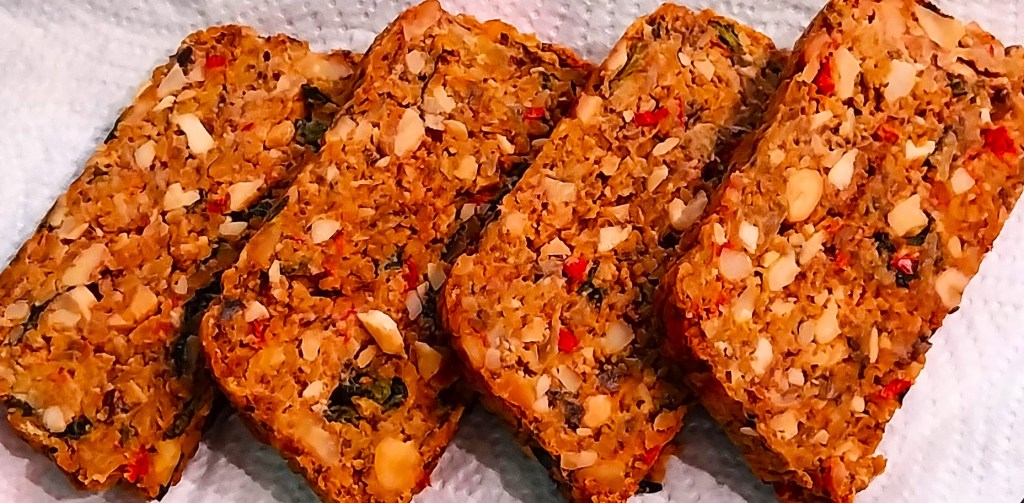
This will make about 12 generous slices, like the ones in my photo above i.e. 6 adult portions of 2 slices each.

Timings

30 mins to prepare, 30 mins to roast at 180C.

You Will Need

  • a 1.5l loaf dish
  • 1 onion
  • 1 red pepper
  • 200g chestnut mushrooms
  • 1 tbsp olive or rapeseed oil
  • 1 carrot
  • a handful of fresh herbs e.g. thyme, sage, rosemary
  • 100g red lentils
  • 300ml vegetable stock
  • 1 tbsp vegemite (or other yeast extract)
  • 5 – 6 leaves of cavalo nero
  • 100g wholemeal breadcrumbs
  • 150g brazil nuts
  • 2 eggs
  • sea salt and black pepper
  • 400g tin chopped tomatoes
  • a handful of basil leaves

Method

  1. Grease and line the loaf dish. I find that using baking paper for this really helps with removing the cooked nut roast from the dish, at the end.
  2. Finely chop the onion, red pepper and mushrooms. I find that doing this in a food processor, with blade fitted, gets the veg to the right size pieces to meld together in a nut roast.
  3. Put the oil in a wok on the hob. When the oil is hot, crush in the garlic clove, followed by the finely chopped onions, pepper and mushrooms. Let it sweat for a few minutes, stirring from time to time (leave the food processor bowl and blade to one side, with no need to wash it out – you will be using it again in a moment).
  4. Grate in the carrot and tear in the herbs.
  5. Pour in the stock and tip in the lentils. Bring to the boil, then reduce to a simmer for 15 mins so that the lentils soften and the mix thickens. Dip in the spoon of vegemite, so that it slips off the spoon into the hot liquid and dissolves into the mix.
  6. For the last few mins of simmering, add in the cavalo nero, cut into fine shreds.
  7. After 15 mins, switch off and transfer the mix to a plate. Set aside to cool for 10 mins.
  8. Switch the oven on at 180C. Spread the brazil nuts on a tray and place them in the oven to toast while it’s heating up.
  9. Put the slices of wholemeal bread into the food processor, still with blade fitted, and blitz to breadcrumbs. Transfer to a large mixing bowl.
  10. After 5 mins, remove the nuts from the oven and blitz to small pieces in the food processor. Don’t obliterate them to a powder, however – you want to retain an element of crunch!
  11. Add the nuts to the breadcrumbs. Then add in the slightly cooled veg and lentil mix. Finally, crack in the eggs. Give it all a really good stir so that it is fully combined. Give it a good seasoning with a grinding of sea salt and black pepper.
  12. Spoon the mix into the loaf dish and level the top by pressing down with the back of a spoon. Place in the oven for 30 mins.
  13. Remove and leave to cool for 5 mins, then invert it on to a chopping board to cool completely. It should look like my photo at the top of the post. When cool, it can be sliced with a bread knife, as shown in my other photo.
  14. Serve with a very simple tomato sauce, made by heating the chopped tomatoes in a saucepan, with the basil leaves torn in, until the tomatoes reduce and thicken. Grind in a few twists of black pepper.

Customise It!

Feel free to swap in other veg that is in season and/or that you have to hand. A couple of celery sticks chopped will go well, for example. You can add a combination of mixed nuts, instead of the brazils, if you wish. I’m a big fan of Vegemite, and think it adds a lot to the taste of a nut roast. I recognise, however, it’s not everyone’s cup of tea, so leave it out if you wish. A few shakes of Worcester Sauce would not go amiss in its place.

According to my Spotify Unwrapped for 2023, one of my most played bands in the last year has been Leftfield. I was not terribly surprised about that, as their This Is What We Do album, that came out in late 2022, has been played a lot in the ADK Kitchen. I’ve already featured a couple of tracks from it in other posts, and here is another. This is Leftfield with Pulse.

Categories
Mains Recipes Sides

Spicy Bean Burger and Salsa

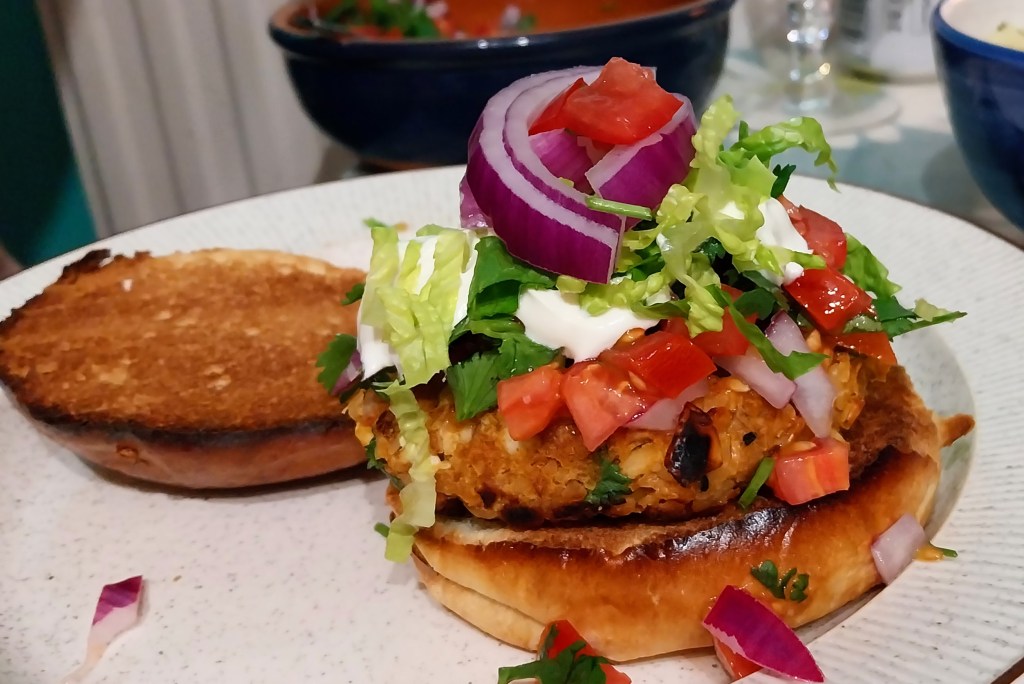
Whenever I look at the above photograph, I just want to place the fingers of both hands on the top of the roll, my thumbs underneath, scrunch it all together and take a large bite.

Which is a pretty good clue to what happened next, the moment I’d set my camera phone to one side.

I love the taste of a good veggie burger, and many times will choose one over a meat version. So when a bag of freshly harvested pulse beans arrived from our local farm, I had little doubt what to make them into.

I soaked the beans overnight and then boiled them for around 45 mins, before draining, cooling and mashing. However, you can just as easily use a can of beans that are ready to use.

Mixing the mashed beans with breadcrumbs and an egg gives a good texture that ensures the burgers, once shaped into patties by hand, stay together during the cooking process.

A fun part of the exercise is deciding what spices to add, and you can really go to town on tailoring it to your tastes. I opted for chopped red chilli, ground cumin, freshly chopped coriander and nigella seeds. Hey, you want garlic? Crush it in!

Here’s another shot just before the lid was positioned, showing the toppings including raw red onion, chopped lettuce, sour cream and my home made tomato salsa. Don’t worry if some pieces topple over the side while building it – this is real food. The scrunching down of the brioche roll between your hands will hold everything in, as you go to take that first bite….

Getting hungry, yet?

Servings

This mixture made 6 burgers, each the size of a brioche bun.

Timings

If cooking the beans from raw, they need to soak overnight, then be boiled for around 45 mins before draining and cooling. You can save time on this by opening a can of beans instead. Otherwise, prepping the burger mixture and salsa takes about 20 mins, with another 20 mins to fry/keep warm.

You Will Need

For the bean burgers:

  • 400g cooked beans e.g. kidney beans, butterbeans
  • 100g wholemeal breadcrumbs
  • 1 egg
  • 2 red chillis, finely chopped
  • 1 tsp ground cumin
  • small bunch of coriander leaves, chopped
  • 1 tbsp nigella seeds

For the tomato salsa:

  • 4 – 5 ripe tomatoes, finely chopped
  • half a red onion, finely chopped
  • small bunch of coriander, chopped
  • 1 garlic clove, crushed
  • juice of half a lime
  • a splash of white wine vinegar

To serve:

  • 6 brioche buns
  • chopped lettuce
  • soured cream
  • chopped raw red onion

Method

  1. Mash the beans on a plate with a potato masher, and scrape into a bowl. Add in the breadcrumbs, egg and all the spices.
  2. Roll up your sleeves and get your hands in there, squidging the mixture between your fingers till it is all well combined.
  3. Pull out just enough of the mixture to make one burger, and flatten it down between the palms of your hands. Set aside on a tray. Repeat to make 6 burgers in all. Place the tray in the fridge to chill while you make the salsa.
  4. In a separate bowl, combine all the salsa ingredients and give them a stir. Set the bowl in the fridge.
  5. Switch on the oven to 140C. Fry each burger on the hob for 4 – 5 mins on each side, then transfer to a tray and place in the oven. This will keep the burgers warm until serving time, and also round off the cooking process, making them browned and crisped all over.
  6. Serve each burger in a toasted brioche roll, on a bed of chopped lettuce, and topped with a dollop of the salsa. Add raw chopped red onion and sour cream.

Customise It!

The sky really is the limit here. Add slices of avocado to the bed of chopped lettuce if you want. Top it off with your favourite cheese, grated, and slam it back in the warm oven for a few mins to melt, before adding the salsa. Engage imagination!

The next band to feature on the ADK Playlist has been around for over 20 years, and is finally enjoying some well-deserved public attention, following a collaboration with Taylor Swift. Two critically acclaimed albums released in 2023 have also helped their cause. Their sound reminds me of Nick Cave and the Bad Seeds, and Arcade Fire, so they are definitely worth a listen if you haven’t heard their stuff. Here’s a good one to start with, included on 2023’s Laugh Track. From Cincinnati, Ohio, this is The National (featuring Bon Iver), with Weird Goodbyes.

Categories
Blog Drinks Mains

Lo/Hi

We’re nearing the end of 2023. I’ve been fortunate to travel to many interesting places this year, and have enjoyed sharing my experiences of the local food, drink, culture and the music it inspires, in my posts here on A Different Kitchen. As the year draws to a close, there is one more fun place to tell you about.

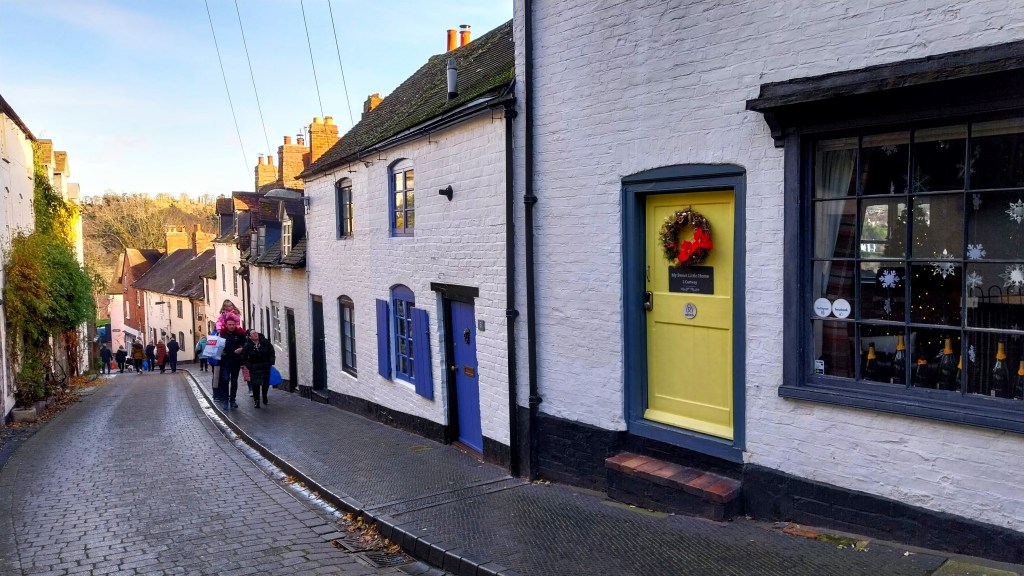
In December I spent a few motorhoming days in the picturesque town of Bridgnorth in Shropshire. The place is actually made up of two distinct towns: my main photo above is taken in Low Town, by the banks of the River Severn, looking up towards High Town.

My photo below is then taken having climbed up to High Town, where there are great views looking out over, er, Low Town.

From the Middle Ages, traders’ boats travelled up the River Severn to unload their cargo at the Quay in Low Town. The goods were then wheeled up by hand cart to the market hall in High Town via The Cartway – a twisting, cobbled path. You can still walk this route today, see my photo below.

It is as steep and winding as ever, though many of the cottages along the way are now cosy, bijou holiday residences, judging by the number of lockboxes on the frontages.

The goods imported were mainly rum, spices and exotic foods from distant lands, and they were exchanged for local ceramics, metalwork and coal. The market hall still stands in the centre of High Town and hosts a market, though these days it features regional meats and speciality cheeses.

Trade continued until the mid 19th Century when, according to the Town Guide, it was overtaken by the arrival of the railways. My own alternative theory is that, after years of hauling their beautiful rum, spices and exotic foods up to High Town, to exchange them for a few of our pots, pans, and pieces of coal, the tired and hungry importers eventually realised they were getting rather the bum end of the deal.

Among the many curious features of High Town is the Castle Keep. It is all that remains standing of the Castle, which was largely destroyed in the English Civil War of the mid 17th Century. I say standing, but leaning is a more apt description – see below.

To borrow a word styling from American Football commentators, it is amongst the most leaningest structures in the world. In fact, it is 4 times more leaningest than the Tower of Pisa in Italy. How it hasn’t fallen over, I don’t know. Even though it moves a few degrees each year, it is reportedly safe – there are no cones or hazard warning tape to keep pedestrians at a distance. I can only assume the Town Council’s Health and Safety Department has a commendably relaxed attitude to risk. Still, I wouldn’t dawdle while going past/under it, if I were you.

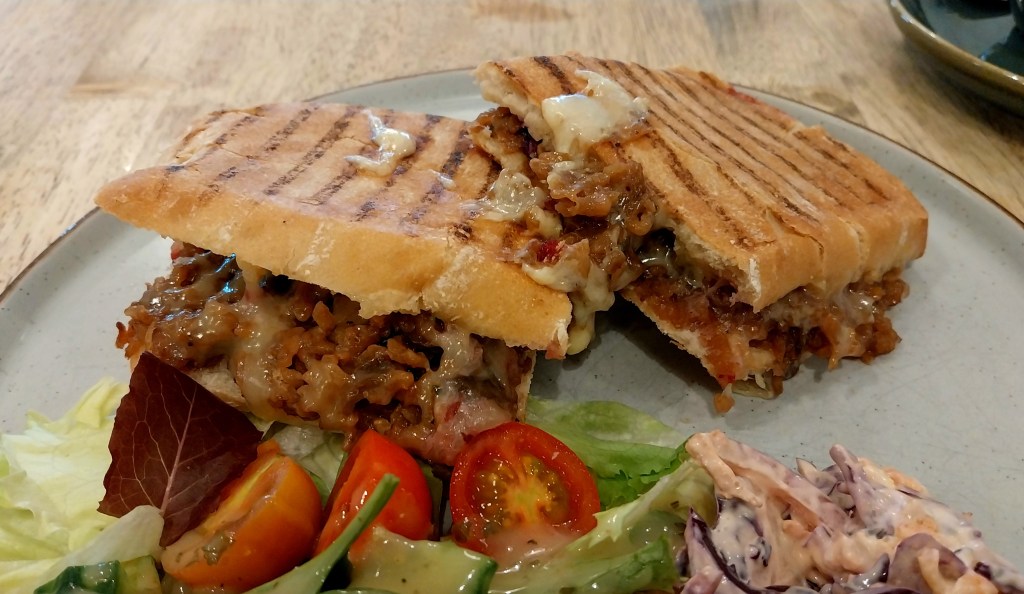
Food options are many, varied and good quality. I stopped for lunch in High Town’s Coffee at d’Arcy’s, tempted by the seasonal vegan toasty – a hot panini filled with slices of nut roast and cranberry sauce. Delish!

I accompanied this with a Pumpkin Spice Latte. I have to confess to being somewhat late to the party with this concoction. For some time I have held the puritan view that, if the coffee beans are good quality, roasted with expertise and ground by a skilled barista, the drink should not then be ruined with a shot of sweet syrup. That was before I had the benefit of trying one, however, when I realised how great it tastes. I am now a convert who believes that, used correctly, a shot of syrup can complement and enhance a good quality coffee, rather than overpower it.

The unique geography of Bridgnorth kept reminding me of this track, which played a few times on my headphones as I walked around exploring. I am quite sure The Black Keys – those heavily blues-influenced rockers from Ohio – didn’t write this about a picturesque market town in Shropshire, but it’s a great song and the title fits well. Here they are with Lo/Hi.

Happy New Year everyone! Onwards to more travel, sounds, food and frivolity in 2024.

Categories
Blog Mains

Gösser und Gulasche!

While here in Graz, we have moved indoors from the freezing, yet festive Christmas Markets (see Walk Out To Winter) for our next tasting of traditional Austrian food and drink. We are now at the Gösser Bräu, a long established beer hall and restaurant over towards the River Mur in the west of the city centre.

Originally the site of the Gösser brewery, it has been serving traditional Austrian fare since 1902, along with some terrific beers. The place has a warm, modern and stylish interior, but still carries the look and feel of a classic European, high-ceilinged beer hall, with the chink and clatter of glasses and echo of lively chatter from the bench tables, mainly occupied by large groups of friends.

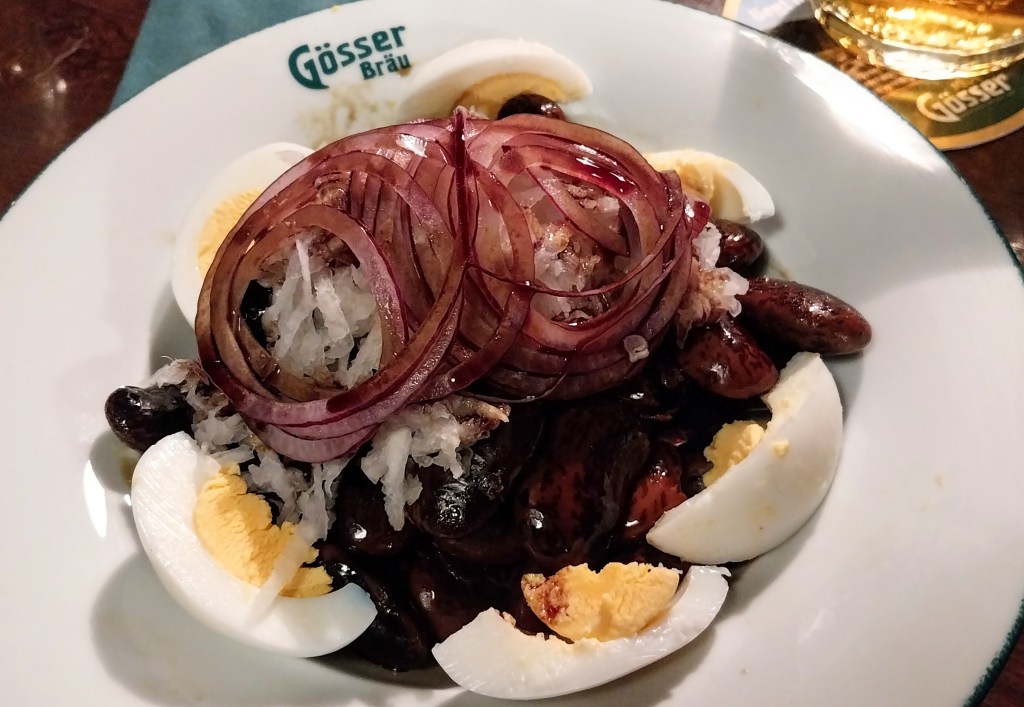
There were 6 hungry people in our party, all in search of some warming, filling and tasty rustic fare. My starter was a dish I have had before in Austria and really wanted to have again on this trip. It is Styrian Bean Salad, a regional speciality from this part of Austria. It consists of dark pulses the size of butter beans, tossed in green, nutty-tasting pumpkin seed oil. The salad is topped off with grated white radish, raw red onion rings and segments of hard boiled egg.

It was as delicious as I remembered it.

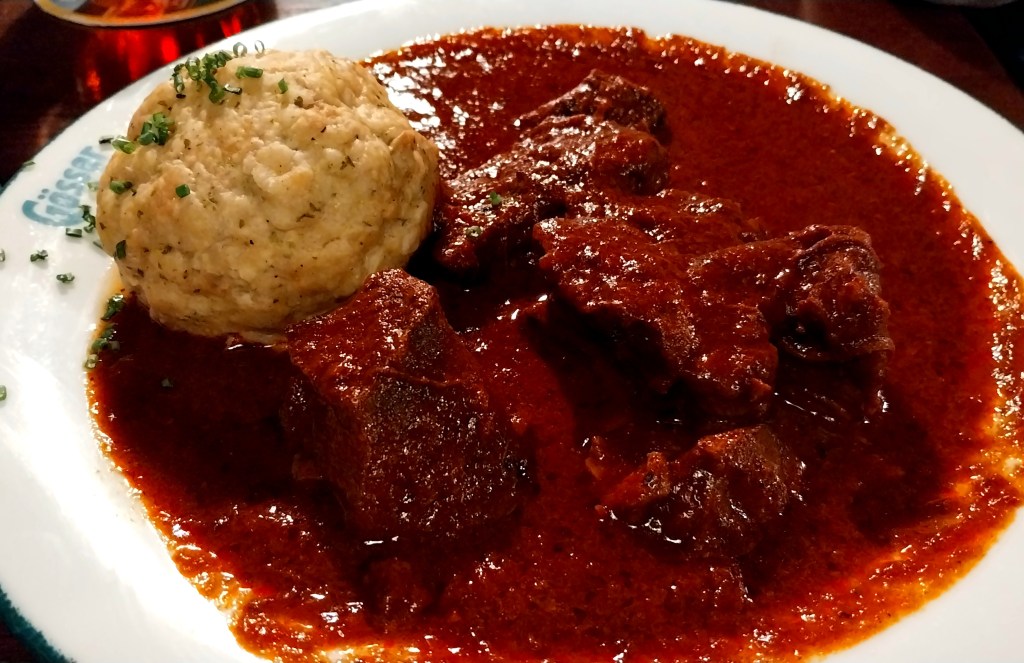
For mains, the Gulasche (or Goulash), was a popular choice with our group. It is shown in my main photo at the top of the post – a hearty dish comprising chunks of tender, slow cooked beef in a rich gravy, served with a Semmelknödel, a bread dumpling. I have only ever eaten dumpling on a very few occasions, and here it was skilfully prepared and cooked, with a mild herb flavouring. It held its shape when sliced and did a grand job soaking up the tasty gravy.

The beers are excellent. I chose the Bock beer that is brewed specially for Christmas and holiday occasions, having had a reliable recommendation on this (thank you, Kelvin!). It is a little stronger than their usual beer and packs a memorable, caramelish taste. I was enjoying it so much that, er, most of it had gone by the time I remembered to take a photo for the blog (whoops).

I noticed they were also serving a darker beer, so tried some of that. I liked the colour, which was somewhere between brown and ruby, and the thick foamy head. Predictably, the taste was maltier than the Bock.

Both made a really enjoyable accompaniment to the Goulash. It says a lot that everyone was sufficiently full to render a perusal of the dessert menu unnecessary.

My final challenge, before leaving Austria for home, is to find some traditional local fare that is oriented around fruit and veg. Tune in to my next post to see how that search goes.

In the meantime, with all this snow around in Austria, I can’t think of a better time to add a track to the ADK Playlist by these Scottish and Northern Irish alt-rockers. I saw them live at the time the album A Hundred Million Suns was released, and this is one of the many tracks I enjoyed. Here’s Snow Patrol with Engines.

Categories
Blog Mains

Sweet and Sauer

This is a meal which I always enjoy when I visit Central Europe, because they do it very well. So, while here in Ljubljana, classy capital of Slovenia, I just had to look for it on the menus of the local restaurants and bars.

We chose a local restaurant named after a Slovenian poet, Valentin Vodnik, immortalised in a statue at the Central Market nearby. The place specialises in Slovenian cuisine, and featured just the type of dish I was looking for on its menu.

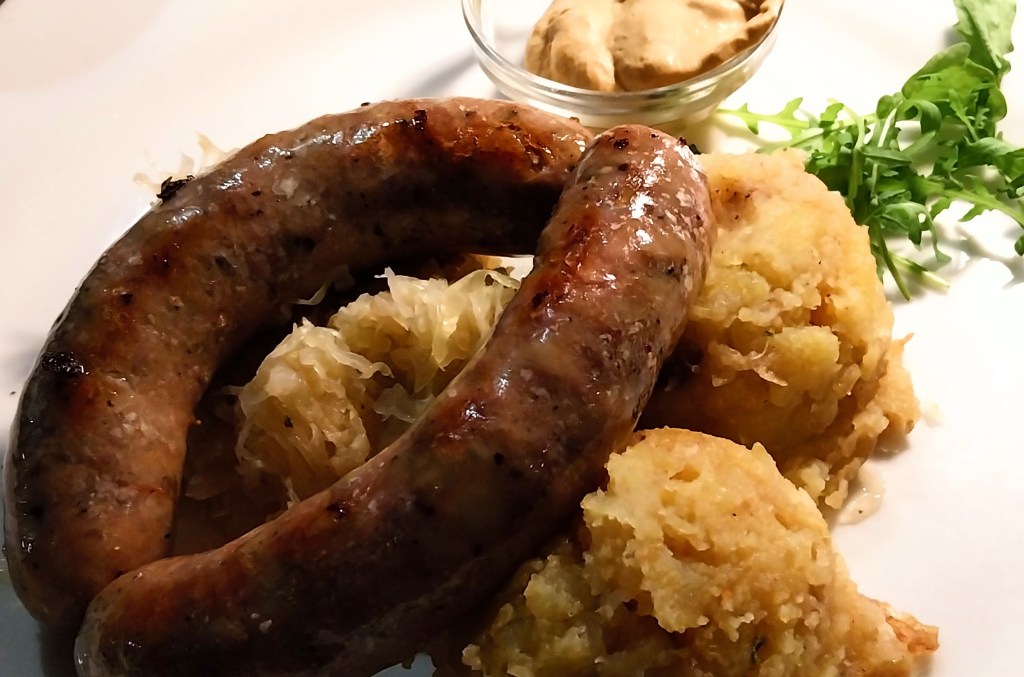
My meal is shown in the photo above. Two meaty, very traditional sausages served with sauerkraut. Sauerkraut is fermented, soured cabbage, and this serving was finely shredded and gently salted. In texture, it is not unlike the thin, fried onions that you might serve with a hot dog, but with a milder taste.

The sweet, to complement the sour, comes in the form of sweetened mustard, which I’ve found is a traditional accompaniment to sausage, or bratwurst, in Germany, Austria, Switzerland and, now, Slovenia.

The plate is completed with potatoes that, miraculously, somehow manage to be both roasted, yet served scooped and mashed (see my photo – don’t ask me how).

There is really only one choice of drink to accompany this meal, and that is a large glass of draft beer from local Slovenian brewer, Union. The glasses bear their name and their logo of the dragon, which is the city emblem of Ljubljana.

A wonder of a meal featuring local Slovenian cuisine, that I thoroughly enjoyed.

All this talk of sauerkraut has reminded me of a great track by this band. I will leave you with Portishead, and Sour Times.

Categories
Mains Recipes

Slow Cooked Beef and Stilton

I first tasted the combination of beef and stilton cheese some years ago, as a hot filling in a Cornish Pasty. I thought the taste was divine and have been a fan ever since, enjoying it in casseroles as well as pies. Stilton adds a salty sharpness to the beef juices, making a rich and creamy gravy to coat and complement the tender and succulent beef.

What better dish to make, therefore, as the next in my slow cooker season.

Servings

6 adult servings, alongside your choice of veg.

Timings

20 mins to prepare, and 4 – 5 hours bubbling away in an electric slow cooker.

You Will Need

  • 700g braising beef, cut into chunks
  • a few spoonfuls of plain flour
  • salt and pepper
  • oil
  • 1 large onion
  • 1 clove garlic
  • 1 litre of beef stock
  • 1 large glass of red wine
  • 200g stilton cheese
  • some cornflour and tap water

Method

  1. Turn on the electric slow cooker to the high setting.
  2. Sprinkle the flour, salt and pepper on a dish, then roll the pieces of beef in it till they are coated all over.
  3. Warm some oil in a frying pan and fry the beef until the pieces are seared all over. Transfer to the slow cooker bowl.
  4. Crush the garlic clove and add to the remaining hot oil in the pan. Chop the onion and add also. Stir until softened, then add to the slow cooker bowl.
  5. Pour the stock and wine into the hot pan, and heat until it is bubbling. Pour over the beef and onions in the slow cooker bowl.
  6. Leave the slow cooker on high for around 30 mins, then reduce to the medium setting. Let it bubble away for 4 – 5 hours.
  7. Using a fork, pull out a piece of beef to check that it is cooked. It should be tender and flake apart when pressed with the fork.
  8. Cut the stilton into pieces and then crumble with your fingers into the slow cooker. Stir gently so that the pieces begin to melt into the gravy, thickening it as they go.
  9. If you wish to make the gravy thicker, mix up a couple of teaspoons of cornflour with the same amount of tap water, and stir to dissolve. Add into the gravy. You can repeat this again if necessary, to reach the thickness you desire.
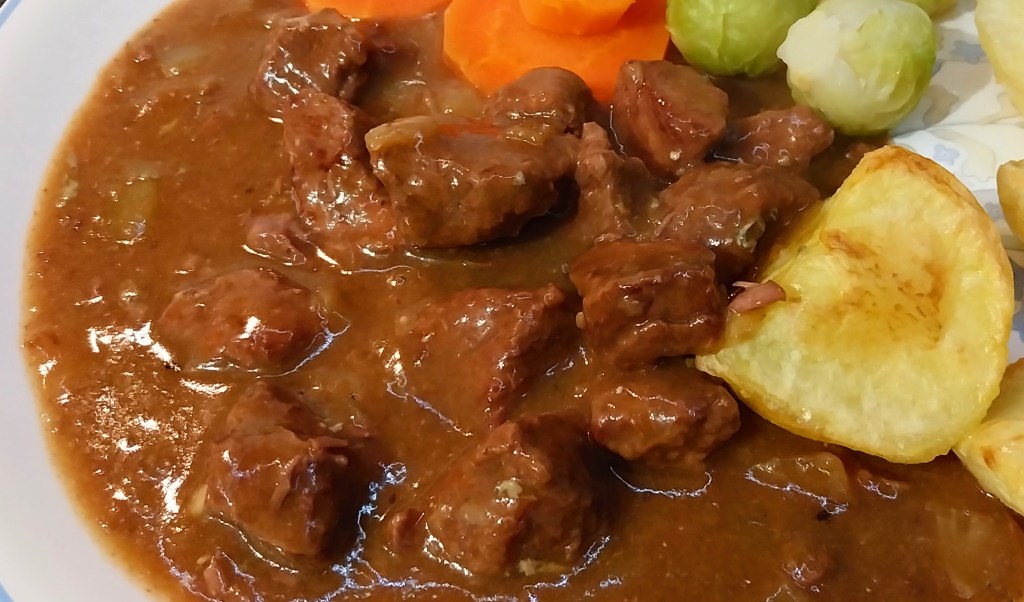
  10. Serve with your choice of roasted, boiled or steamed veg. Mine in the photo is served with roast potatoes, boiled brussels sprouts and carrots.

Customise It!

If you wish, you can add veg directly into the slow cooker, and they will take on the flavours of the beef gravy as they cook. Root veg, such as carrots, swede, parsnips and celeriac will work well. You could also serve the dish with rice instead of roast potatoes, to soak up all that rich, stilton sauce.

Don’t worry if you do not have an electric slow cooker. You can use a casserole dish instead, and cook it in the oven. Start off with the oven at 180C, then reduce it to 160C at step 6 above.

It’s getting to that time when I receive my playlist from Spotify with all my most-played tracks of the year. This is one that will almost certainly feature, as I’ve listened to it many times. It’s by New York band Yeah Yeah Yeahs: Heads Will Roll.

Categories
Mains Recipes

Spanish Chicken

With the start of the November evenings, I’m declaring the opening of slow cooker season in our household.

The electric slow cooker is a fine invention, in my view. It means I can put the family Sunday dinner together in the morning, and let it spend the afternoon and early evening quietly bubbling away in the corner of the ADK Kitchen, with very little more for me to do. An important benefit of this is that I can then spend the lead-up to dinnertime on the sofa with a cold beer, watching the Premier League on Super Sunday, safe in the knowledge that all prep is taken care of. Get in!

First up is this slow cooked dish combining chicken with Spanish onion, red pepper, tomatoes, spicy chorizo, black olives, stock and Spanish white wine. Left to develop for 4-5 hours, all the flavours will gradually meld together and infuse the chicken. Delicioso!

Servings

4 adult servings.

Timings

20 mins to combine, 4-5 hours to slow cook.

You Will Need

  • 3 chicken breasts
  • Oil
  • 1 large Spanish onion
  • 1 red pepper
  • 1 whole chorizo sausage
  • 700ml chicken stock
  • 400g tin chopped tomatoes
  • 1 large glass of Spanish white wine
  • 15-20 pitted black olives
  • A handful of frozen peas

Method

  1. Switch on an electric slow cooker at the hot setting.
  2. Cut the chicken breast into chunks, and fry in oil in a pan until lightly browned all over. Transfer to the slow cooker bowl.
  3. Chop the onion and pepper and fry. Slice the chorizo into discs, then cut each disc in half. Add to the onion and pepper, and after 5 mins, transfer to the slow cooker bowl.
  4. Next into the pan, put the chopped tomatoes, stock and wine. Stir till it all begins to bubble, then add to the slow cooker bowl.
  5. Put the olives and peas directly into the slow cooker bowl and give it all a stir. Place the lid on the slow cooker and turn the setting down to medium. Leave for 4-5 hours.
  6. Serve with plain boiled rice.

Customise It!

If you don’t have an electric slow cooker, you can use a casserole dish. Put it in an oven at 180C and transfer in the ingredients from the frying pan as described above. When all have been added, turn the oven down to 160C, and leave for 4-5 hours.

You can add in other veg as you like – carrots and celery will go well. You can include a garlic clove or spices if you want, though I find the chorizo brings all the garlic, flavouring and colour needed.

Chicken thighs or drumsticks will work well in place of the chopped chicken breast, if you don’t mind eating meat off the bone.

The next track for the ADK Playlist has a Spanish feel, naturally. This band is one of the New York punk and new wave generation that grew out of CBGBs in the mid to late 70s: Mink DeVille with Spanish Stroll.

Adios!

Categories
Mains Recipes

Butternut Chilli Soup

This autumn warmer of a soup combines seasonal sweet, silky smooth, roasted butternut squash with fiery red chillis. Energy prices being so high these days, a bowl may also save you some money – it gives all the central heating your body needs!

Servings

3 – 4 bowls.

Timings

40 mins – 10 mins to prepare the butternut, and 30 mins for it to roast. The rest of the soup can be made while the veg is roasting.

You Will Need

  • 1 butternut squash, peeled, seeds and pith removed, and cut into chunks
  • 1 red pepper, cut into 7 – 8 pieces
  • oil
  • 1 clove of garlic, crushed
  • 2tsp grund cumin
  • 1 tsp turmeric, fresh or powdered
  • 1 onion, chopped
  • 2 medium red chillis, chopped
  • 2 sticks celery, chopped
  • 3 – 4 potatoes, peeled and chopped
  • 700ml veg or chicken stock
  • salt and pepper

Method

  1. Switch the oven on to 180C. Spread the butternut and red pepper pieces on a roasting tray, and drizzle with oil. Place in the oven when up to temp, and leave for 30 mins.
  2. Pour some more oil into a large saucepan and warm on the hob. When the oil is hot, put in the garlic, cumin, turmeric, chillis and onion. Stir and let it cook for a few mins, before adding the celery and potatoes.
  3. Let it all cook for another few mins – the onion should soften, and the celery/potatoes brown a little at the edges.
  4. Pour in the stock and bring to the boil. Reduce and simmer until the butternut and pepper have had their full 30 mins in the oven.
  5. Take the butternut and pepper from the oven – it should all have softened and become a little charred at the edges. Scrape it all into the soup and stir.
  6. Finally, grind it all smooth with a hand blender. The soup should take on a creamy consistency, and orange colour, with red specks, as in my photo above.
  7. Ladle into bowls and serve with freshly baked bread.

Customise It!

If you want to increase the creaminess you could add a swirl of single cream when serving.

Adjust the strength of the chillis to your personal taste – I used medium, but you can revert to mild, or fire up to hot!

A bit like changing their intensity from low to high, I suppose – a cue for me to add Ohio’s the Black Keys to the ADK Playlist. Here’s Lo/Hi.

Categories
Mains Recipes

Creamy Pumpkin Soup

This week, on a visit to my good friends Kelvin and Eva, I was treated to a bowl of Eva’s delicious, Austrian-inspired pumpkin soup. I am please to say she has agreed to share the recipe in this guest post. Over to Eva. Enjoy!

………………………………………..

Homemade soups are one of my favourite comfort foods for a cold autumn day. As I am a member of a community farm near where I live, it’s that time of year when you get an abundance of different pumpkins and squashes. So here is a recipe that my mum used to make for us, served with a special pumpkin seed oil, that comes all the way from Austria, also referred to as the “black gold of Austria”.

You Will Need

  • 2 -3 tbsp olive oil
  • 2 onions, finely chopped
  • 2 or 3 cloves of garlic, finely chopped
  • 1 teaspoon of paprika
  • 1kg pumpkin or squash (try kabocha), peeled, deseeded and chopped into chunks
  • 1 sweet potato chopped into chunks
  • 150g of lean smoked diced bacon
  • 700ml vegetable stock
  • 150ml double cream or sour cream or crème fraiche
  • * Pumpkin seed oil, optional

Method

  1. Heat the olive oil in a large saucepan, then gently cook the bacon till crisp. Add the chopped onions and garlic and cook for 5 mins, until soft but not coloured.
  2. Add 1kg pumpkin or squash with the sweet potato chunks to the pan, then carry on cooking for 8-10 mins, stirring occasionally until it starts to soften and turn golden.
  3. Add the paprika, give it a quick stir and immediately pour the vegetable stock into the pan and season with salt and pepper. Bring to the boil, then simmer for 10 mins until the squash and potato are very soft.
  4. Pour 150ml double cream into the pan, bring back to the boil, then purée with a hand blender.
  5. Reheat the soup if needed, taste for seasoning, then serve scattered with croutons and a drizzle of pumpkin seed oil, if you want. A perfect accompaniment for a more complete meal is a freshly baked baguette!

*Styrian pumpkin seed oil is a geographic protected product by the EU. Nutty and rich, pumpkin seed oil is full of good fatty acids, minerals and vitamins and on top of it all it is cholesterol free. It partners perfectly with green salads, cheese, scrambled egg and pasta dishes. Did you know it takes 2.5-3kgs of pumpkin seeds to press 1 litre of pumpkin seed oil?

As the author of a guest post on A Different Kitchen, I get to choose the next track for Kevin’s ADK Playlist. This track reminds me of childhood dinners around the kitchen table in Austria with my family: Billy Joel with Piano Man.

Categories
Mains Recipes

Smokey Puy Lentil Roast

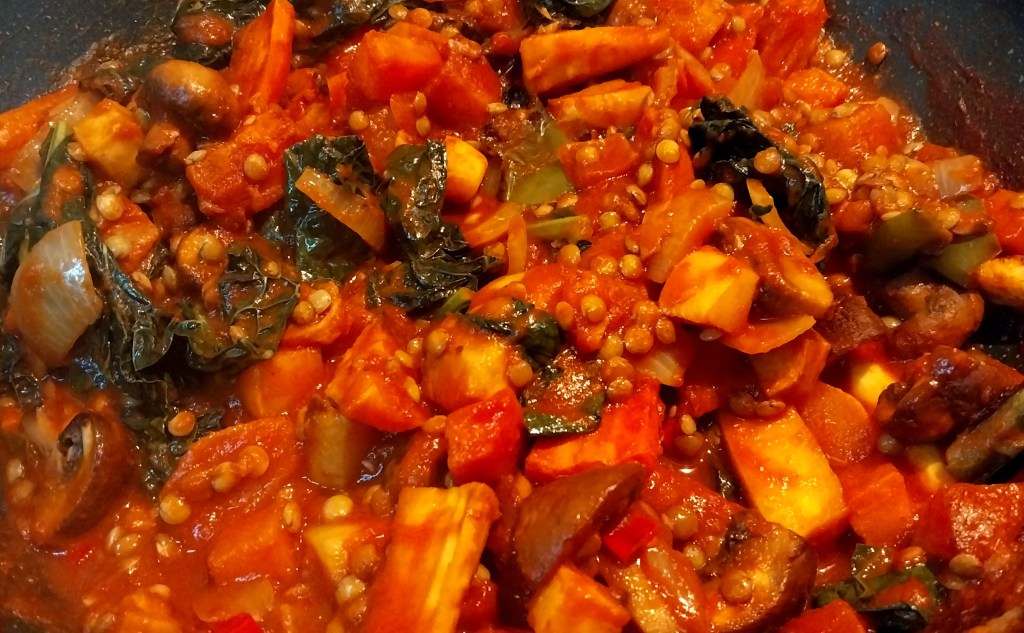
Ready for some autumn evening comfort food? If that’s a yes, you’ll love this rich, smokey, spicy stew with seasonal roasted vegetables and puy lentils. It’s vegetarian and vegan, while the puy lentils are a great source of protein.

Servings

4 adult servings.

Timings

40 mins to make and cook.

You Will Need

  • 1 roasting tray’s worth of chopped root veg (mine comprised sweet potato, swede, carrot, parsnip and celeriac)
  • 1 red pepper, chopped
  • oil
  • 1 clove garlic
  • 2 medium chillis
  • 1 tsp ground cumin
  • 1 onion
  • 8 – 9 mushrooms
  • 1 tbsp gojuchang paste
  • 1 500g carton of tomato passata
  • water
  • 100g puy lentils
  • 4 – 5 leaves of cavolo nero

Method

  1. Warm the oven to 180C. Fill a roasting tray with the chopped root veg and red pepper, and drizzle to coat with the oil. Place in the oven for 30 mins, once it is up to temp.
  2. Drizzle some oil in a wok. When it is warm, add in the crushed garlic, chopped chillis and cumin, and stir.
  3. Tip in the chopped onion and mushrooms, and stir again. When the onion is softening, add in the gojuchang paste and stir.
  4. Pour in the passata. Fill the carton with cold water and add in also. Put in the puy lentils and turn up the heat to boil, then reduce to a simmer. Leave for about 10 mins, while the sauce reduces and the lentils cook.
  5. Chop the cavalo nero into strips and wilt in for the last 5 mins.
  6. Take the roasting tray from the oven – the veg should be softened and a little charred around the edges. Scrape the roasted veg into the wok. Stir to combine.
  7. Spoon into bowls to serve.

Customise It!

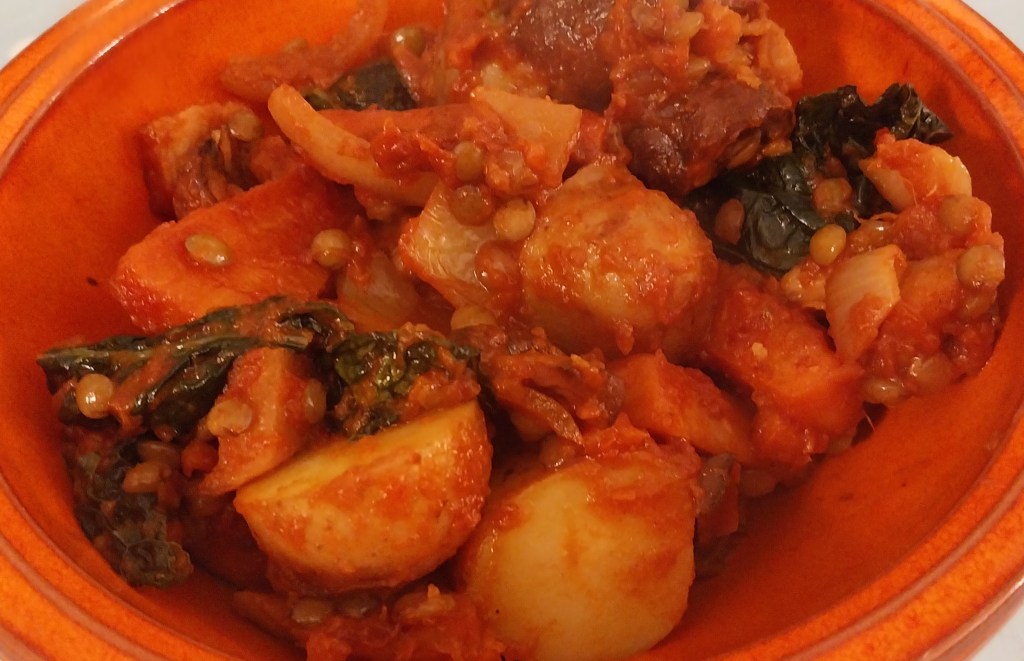
Feel free to swap in any veg you like or have to hand. Butternut squash or celery will work well. Boil or steam some brussels sprouts and add in if you wish. For the second serving of this dish I mixed in some new potatoes that were already cooked and in the fridge – see below.

The key ingredients you should keep are the passata, garlic, chillis and the gojuchang paste – which combine to create the delicious smokey background sauce – and the lentils, which give texture and protein.

Talking of Smokey, here’s a classic track to add to the ADK Playlist. I actually prefer this ska version to his original, however: The Beat with The Tears of a Clown.